I reflected this morning on what the root cause is of the feeling of gratitude. I think ultimately it comes from the emotion of joy. When you are truly in a state of joy, you will combine that with an acknowledgement of what caused this higher emotion of joy and you will feel gratitude. This concept let me down the path of thinking about human emotion in general. Is it possible to contemplate, consider, and ultimately change your emotions?
The first step in this would be to actually understand the range of human emotions that you could experience. Aristotle laid these out in his book on Rhetoric. Darwin was also keenly interested in emotion as a trait passed down through genes. Some modern researchers have spend a great deal of effort cataloging the human emotion spectrum. One such example is Robert Plutchik who identified the 8 core human emotions and how they related to each other. You can see his emotion diagram below:
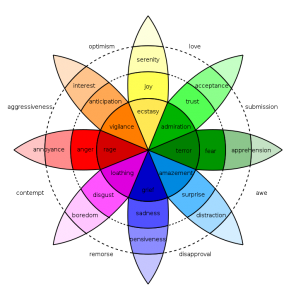
The basic emotions are (listed in the middle ring of this flower:
Fear, Anger, Sadness, Joy, Disgust, Surprise, Trust, and Anticipation
I set out today on a journey to identify these emotions and how they are related to my behavior during the day. When I am doing something that really produces the emotion of joy, I tend to be more likely to trust people and to anticipate more to come. In essence, I am more likely to love and be optimistic.
When what I anticipate starts to fail, I get aggressive and then ultimately angry. When I trust someone and I become more submissive to them, I start to fear that maybe I am being too trusting.
When I see behavior that disgusts me, I build contempt and then anger. If what I did was disgusting, then I might have remorse then sadness. I learned many things while analyzing this flower diagram from Plutchik. For example, I did not occur to me that fear was so related to surprise. However, now that I think about it – when you fear something will happen and then something else occurs entirely it puts you into a state of awe and then the emotion you experience is surprise.
It is also interesting to consider the extremes of a particular emotion. For example, disgust can lead to loathing, anger to rage, fear to terror, joy to ecstasy. The emotion can also become more subdued. Disgust can lead to boredom, anger to annoyance, fear to apprehension, and joy to serenity. I thought today that I should become really good at identifying the root cause of my emotions and see if I can start to influence them proactively.
Am I feeling mad, well what exactly is that emotion and where is it coming from? Where would I like it to head? Is my mad feeling (anger) becoming rage, or just an annoyance? Am I turning that anger into aggressive action or am I holding others in contempt which will lead to a feeling of disgust. Maybe, I can actually strive to remove those feelings, the cause of those feelings and focus on the positive emotions of anticipation, trust, and joy.
I am going to spot check myself throughout the day and determine where I am at on this emotion flower. Perhaps by becoming cognizant of my emotion I will be able to influence how I feel and ultimately aspire to the greatest emotion – which I think might be gratitude?
Guy Reams (284)
365 Member