Day 217 – GridIron

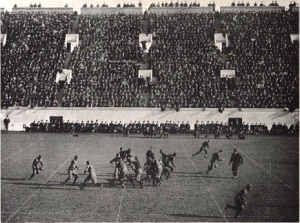
Check out this image from the 1904 Mythical National College Championship. No one could really agree on how the teams were selected, which is why it is called mythical. On the official record books Michigan, Minnesota, and Penn State were considered co-champions. Everyone however believed that Penn state really had to prove themselves in this game played @ Harvard in their brand new stadium. The debate rages as to who the true champions were that year.

However, the point I am making is where football got the name “gridiron”. Take a very close look at the field in 1904. Notice anything different? Yup, it is an actual grid of squares. The game was primarily a more organized version of rugby, and those grids really meant something. American Football consisted of a lot of blocking, tackling, and driving the ball forward inch by inch, where each grid square obtained was considered a major victory. The forward pass was not even really a thing yet. It was a a slug fest, brute strength of a team pushing forward to get to the next square on the field.

Well, I write this because that is exactly how today felt. Football in 1904. Pushing my way through, driving bare knuckled through grass and mud to carve out one more day on my 365 list.

Guy Reams (217)
365 Member
Subscribe
Notify of
guest
0 Comments
Inline Feedbacks
View all comments
Share the Post:

Recent Blogs

Day 309 – The Price Tag of Automation

The author recounts his frustrating experience with home automation after Google abandoned its Nest architecture, leading him to build his own system. He highlights the significant time and effort required for maintenance and the eventual abandonment of his automation efforts due to the high ‘economic life’ cost. However, with the advent of AI, the cost and effort of automation have decreased, making it more feasible and renewing his interest in deploying future automations.

Read More

Day 308 – Speed is The Champion

This article explores the concept that speed often leads to success in various fields, from business to technology and sports. It argues that systems capable of rapid action, feedback, and adjustment tend to outperform those focused on avoiding errors. The author highlights the importance of fast feedback loops, citing John Boyd’s OODA loop and its application in AI systems. The piece also discusses the speed-accuracy tradeoff, noting that while speed can lead to more mistakes, these are often recoverable, and the compounding effect of rapid learning ultimately drives better results.

Read More

Day 307 – Iterative Could be Insufficient

This article explores the contrast between iterative and linear thinking, highlighting their respective strengths and weaknesses. It argues that while iterative thinking is beneficial in many fields, it can sometimes be an excuse for insufficient upfront planning, and proposes a hybrid approach for more robust decision-making.

Read More

Day 306 – The Zeigarnik Effect

The article explores the psychological relief gained from writing down unfinished tasks and concerns, linking it to the Zeigarnik Effect. It explains how externalizing thoughts through writing can free the mind from constantly remembering and worrying about unresolved issues, allowing for greater mental peace and the ability to conclude the day effectively.

Read More
0
Would love your thoughts, please comment.x
()
x