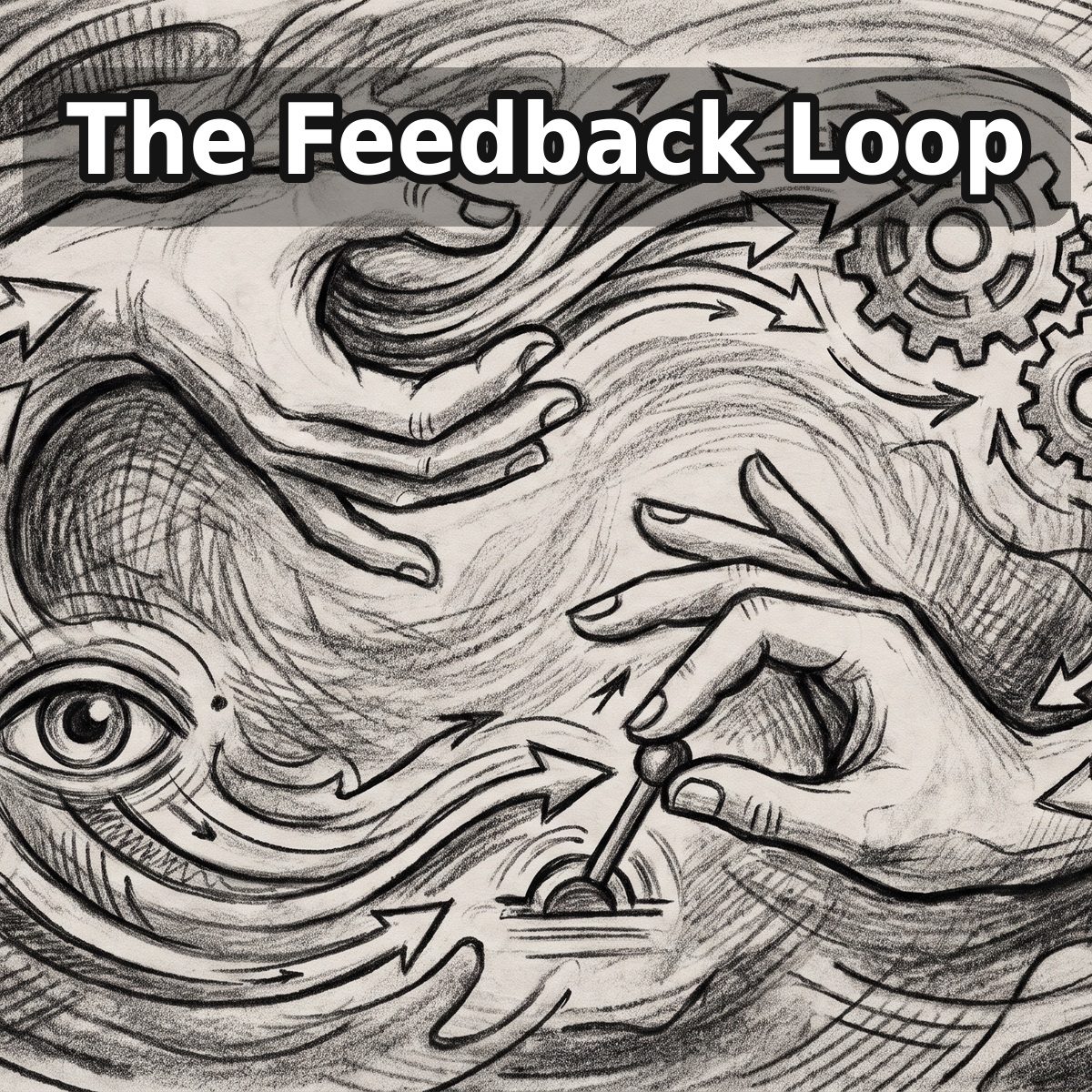
When looking at self it is helpful to look at self as a system. Dispassionately. Look at self from a bird’s eye view and consider self as several discrete parts, just like you would do when troubleshooting a system.

If we really do look at self as a system, then we must consider feedback loops. Every system has a feedback loop, or I should say every HIGH FUNCTIONING system has a feedback loop. A loop is really rather simple. You collect data regarding your functioning, bring it in for analysis, review and then make decisions on improvement. You simply cannot become a highly functioning human without serious consideration of a feedback loop.

Most of us have small feedback loops. Check the scale, evaluate our weight, freak out, go on a diet. That sort of thing. However, how many of us really consider, thoughtfully, a feedback loop to help one particular area of our lives improve.

When we go to school, there is a constant feedback loop. That is why education systems exist. Centered around a feedback loop, to help people improve skills and knowledge. Once we leave school, our principle feedback loop disappears and we are left to wander on our own. We may get into a job or employment, where there is a feedback loop, but they are usually weak.

A thought for consideration – do you have any formal feedback loops that you use to improve yourself in any way?

Guy Reams
Subscribe
Notify of
guest
0 Comments
Inline Feedbacks
View all comments
Share the Post:

Recent Blogs

Day 268 – Positive No to Search Noise

This article explores the concept of a “positive no” in the context of search query normalization, arguing that effective systems prioritize commitment to consistent, relevant retrieval by actively refusing noise. It emphasizes that focus is an active choice, requiring judgment to distinguish between noise and meaningful variations, ultimately leading to better understanding and protection of purpose.

Read More

Day 267 – Commitment as a Daily Ritual

This article explores how consistent daily engagement transforms goals into an integral part of one’s identity. It emphasizes that commitment is a daily practice, not a one-time declaration, and highlights the power of showing up consistently, building support systems, and the shift from habit to identity.

Read More

Day 266 – Party Like it is Thursday

This article argues against using your birthday as a conditional start date for major life changes, suggesting it often leads to procrastination and sabotages progress. Instead, it advocates for using your birthday as a day of rest and renewal, focusing on one sustainable habit rather than a complete overhaul.

Read More

Day 265 – Boredom’s Blessing

This article explores the unexpected value of boredom, suggesting it’s not a problem to be solved but an opportunity for reflection, creativity, and self-discovery in an overstimulated world. It challenges the urge to constantly fill empty moments and encourages embracing stillness.

Read More
0
Would love your thoughts, please comment.x
()
x