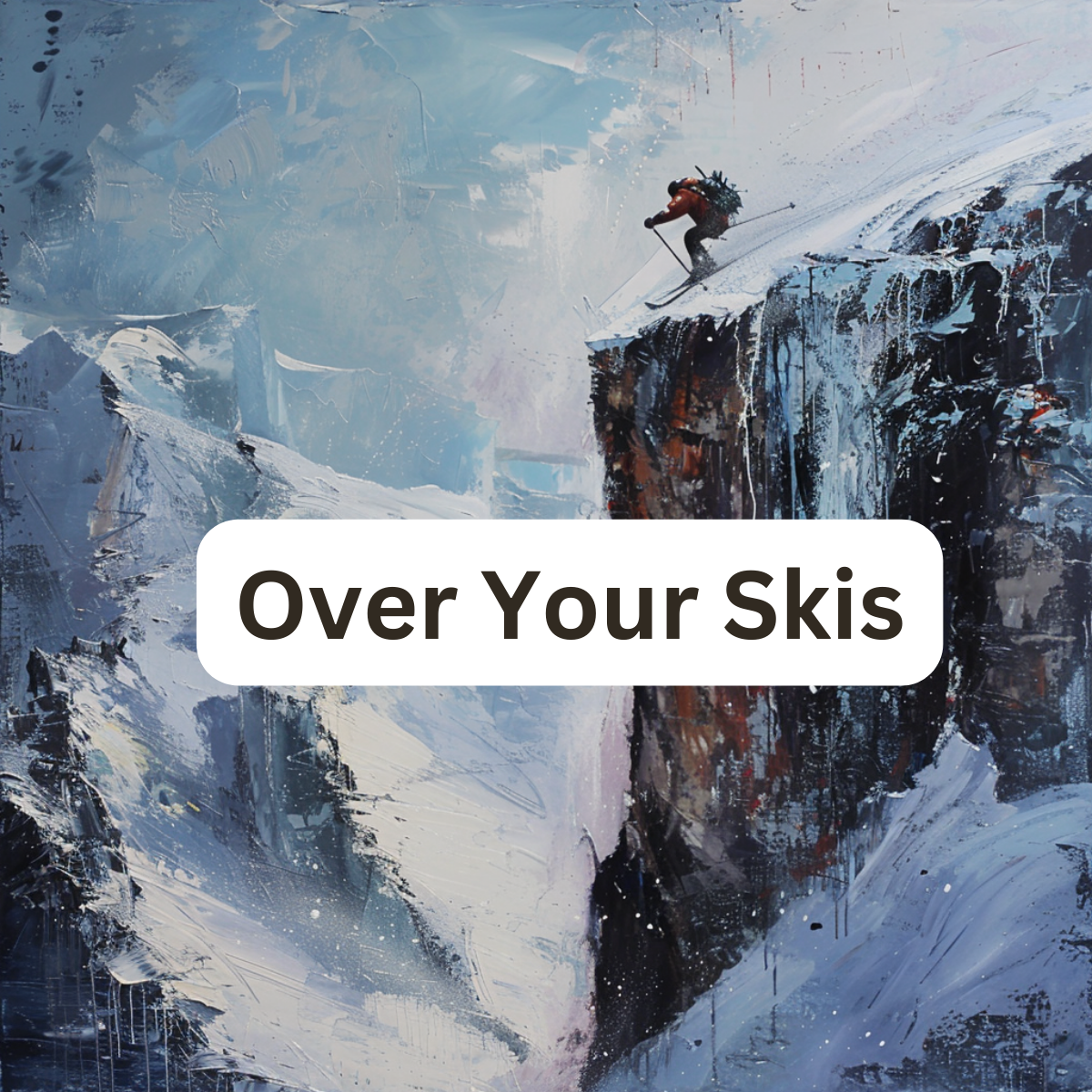
For some reason, idiomatic expressions have always intrigued me. The English language must be particularly challenging to learn, given its abundance of these expressions. I make it a point to note them down whenever I hear one, pausing to ponder its true meaning. Take, for example, the phrase “over your skis.” This idiomatic expression is often used to describe someone who is getting ahead of themselves or taking on more than they can handle. It finds its origins in skiing, where leaning too far forward over your skis can cause you to lose control and fall. Metaphorically, it serves as a caution against overreaching or entering situations without adequate preparation or skills. It suggests that such actions could lead to failure or a metaphorical “fall.” Essentially, it warns against undertaking tasks or making commitments that are beyond one’s current capabilities or understanding.
However, this is one expression with which I respectfully disagree. I believe we should occasionally find ourselves ‘over our skis’! It’s in these moments, albeit extremely uncomfortable, that we often learn the most. I recall a defining experience from my early teens, around 14 or 15 years old, when my uncle was somewhat reluctantly tasked with taking me up to the local ski resort. It seems the encouragement for him to teach me how to ski came from his parents. The method he chose for this lesson is etched vividly in my memory. He led me to the most challenging part of the mountain, a run marked by double or triple black diamonds, and there we stood at the edge of a precipice overlooking a bowl filled with rocks and trees. Not wanting to disappoint my uncle or appear scared, I mustered my courage and followed him off the cliff. In doing so, I was quite literally “over my skis.”
My uncle quickly disappeared down the course, leaving me alone to navigate the treacherous bowl filled with powder, rocks, branches, and unexpected drop-offs. It took the better part of the day to make my way down the mountain and back to the ski lodge. When I finally located my uncle, he was unwinding with a few beers alongside his ski patrol friends. That day, I was undeniably “over my skis,” overwhelmed with fear and trepidation for much of the time. Yet, something significant happened. I had faced the worst of it head-on. I came to understand that I could handle it, and I knew exactly what I was up against. That was the day I truly learned how to ski.
So, no matter what you’re striving to learn in life, I wholeheartedly recommend embracing the notion of being in over your head, of being way out over your skis. This approach not only fosters resilience but also accelerates learning by forcing us to navigate through our fears and uncertainties. It’s a testament to the idea that the most profound growth often comes from the most challenging experiences.
AMEN! I thought the phrase was dead but I heard it again at I get the fingernail on chalkboard feel. I worked in a ski area Pro Shop and I loved it. Ski school and ski patrol folks have a fun connection we’d harrass each other if we if we saw a fault. I’ve got great stories but the last harrass I got, stuck with me and advanced my skiing to the level I sought. I went for a quick run, skating down the top sloped easy terrain to pop over the far edge of the slope drop-off to get up to speed quick. I didn’t plan a turn until a lift tower in my path. To my surprise,a small group lesson was occuring in my landing zone and I quickly adjusted however I let my natural reaction occur and I subconsciously relaxed my posture and my weight was more mid ski
It was just a hop over the edge and my skis turned as planned however I was behind them and my upper body wasn’t leading my ski. It was continuing straight downhill. I avoided the group easily and regained control and rounded out my turn and pulled up to stop . Peter was a British instructor and I can’t recall all the cussing and verbal messaging he laid on me in fun but it reinforced what I knew and gave me a que to implant in my muscle memory. I was good but inconsistent untill that point. If you’re not driving, you’re along for the ride. I know of only 1 fatality that ever occurred at the area and it happened on the 15th season. I was in the shop that day and we monitored ski patrol and we knew something unusual had occurred when we heard the first call. A female had hit fencing at the base of hill. She was moving backwards sitting on the tail of her skis. She was with her boyfriend who had 1 day more experience. She reached for the ground approaching the panel fence with made her pivot 180 in the last few feet. She was gone and it hit everyone in every department very hard. It was an accident and unpreventable. Why didn’t she just roll over on her side,? There was a 30-40 yard flat rollout and fencing was never an issue but there’s always possibilities. Everyone knows the helpless feeling loosing forward balance. I’d challenge anyone to try to get over their skis. I took a much more aggressive stanch and attitude and it felt exagerated but I had attained the level I desired and with muscle memory skiing became simple. I love the sport and invested part of my life encouraging and assisting others to know the experience and the many great folks to meet along the way. That’s why I hate that damn phrase. Your comment was the first I found when I decided to discover the origin. My last change to accept the phrase might happen if water skiing was inferred, I don’t involve myself in things beyond my control or expertise but this one is a part of me.
Awesome, thanks Bill. I will send you an email.