I am on a Greek Mythology path now, thanks to my daughter. I was in a conversation in which I was encouraging someone to work hard to achieve a goal of theirs. The person responded by saying, “Lord Willing.” After the conversation, this caused me to take a pause and evaluate what this actually meant. It was interesting that I told this person to put in the required workload to achieve a feat, and the person responded with an appeal to the will of the divine. That fascination caused me to ask the question – is there an intersection between Divine Will and Human Effort?
I know that I am not the only one to ask that question. I can almost hear John Calvin, the French theologian from the 16th century, screaming from his grave, “NO!!!!!” I distinctly remember from history that Jacobus Arminius, a student of Calvin, might be yelling equally loudly, “MAYBE!!!!!” Regrettably, I am pretty sure that Christianity will not provide an answer to this question, just more debate. So, I naturally decided to dive into the root of Western Civilization, or what we call “Paganism.” That was a joke; do not get bent out of shape. Surely, the Greek Mythos was not Pagan, was it?
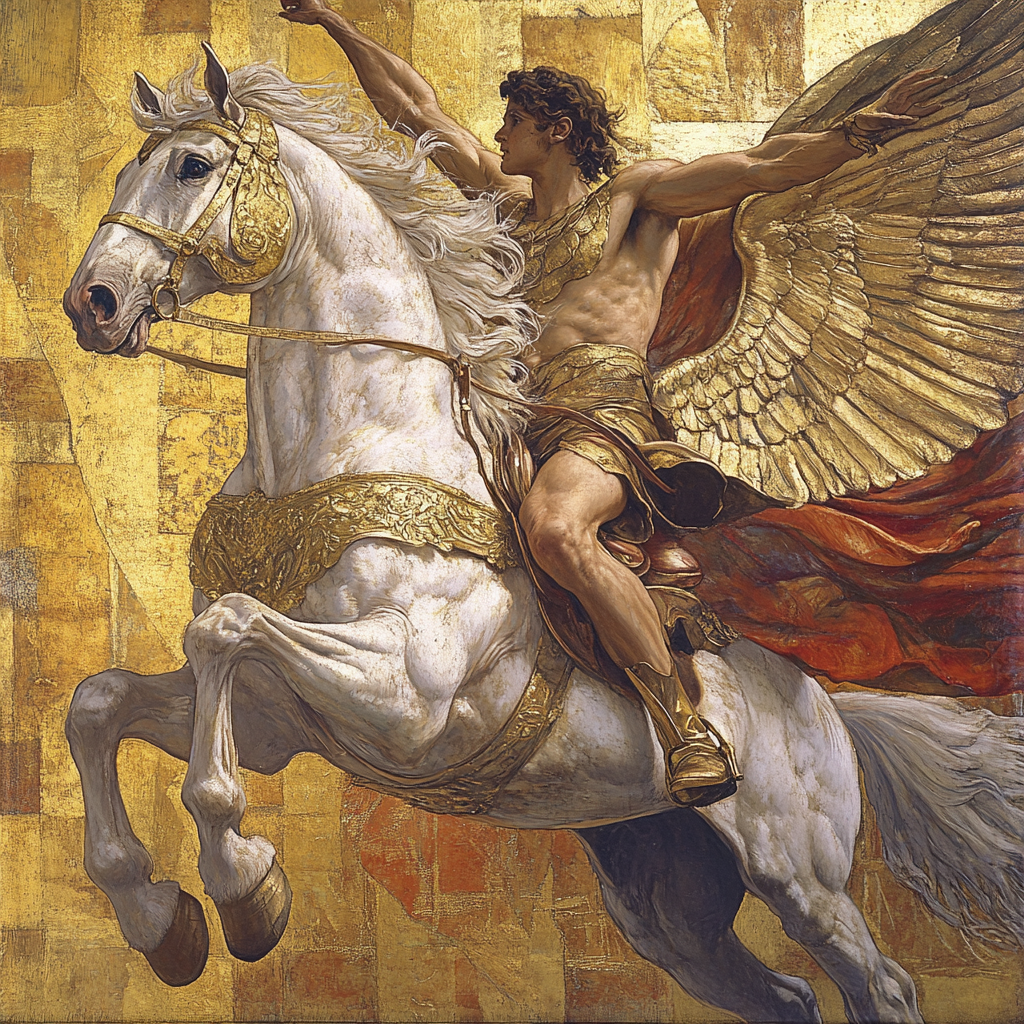
Yes, this debate had been going on long before the Nazarene started his journey in Galilee; I remembered the story of the Pegasus. A mythical creature that was born from the blood of Medusa after she was slain by Perseus. Pegasus was a winged horse that was a magnificent and powerful creature that was a sacred emblem to the gods, especially that of Athena.
One mortal, named Bellerophon, was a young hero who had not proven himself yet. Athena decided to appear to him one day in a dream and give him some divine aid. She gave him a golden bridle and instructions on how to use it to tame the Pegasus. However, before I write about that, it is important to note that Bellerophon’s life began with a story of redemption.
Although he was one of the many offspring of Poseidon, he found himself in exile, having been found guilty of murder, albeit most likely accidental. He was able to seek atonement for his crime by making a plea to a King named Proetus. However, once the pardon was granted, the King’s wife made advances on Bellerophon. The hero rejected her advances, and then she accused Bellerophon of making the advances instead. The King could not put a guest in his home to death, so instead, he sends Bellerophon on an impossible quest, which he most certainly would not survive, and that was to slay the dreaded Chimera.
Long story short, it was on the advice of a fortune teller that Bellerophon sleeps in the temple of Athena, where she visits him in his dream. When he wakes and finds the golden bridle, he uses it to tame the Pegasus. With this boon, he is able to slay the Chimera and then go on many more epic quests. The slaying of the Chimera was not easy, Bellerophon had to be clever and have his wits about him in order to survive the ordeal.
So, back to our original query. This story of Bellerophon receiving a divine boon at the right time and in the combination of his pursuit of redemption demonstrates this intersection of the will of the divine and our own efforts. Even if one does not believe in divinity, there are forces in our lives that are beyond our control. The cross-section of our will, with the will of God or the will of other forces, is oftentimes presented as a critical point in our lives. It certainly was in the case of Bellerophon.
So, does the divine approval and/or the belief in divine aid the hero (us) on our journey? I certainly believe it does, and this does indicate that in our lives, we are sometimes granted a boon whether we deserve it or not. Athena, who was known as the goddess of wisdom, was the grantor of this divine gift. This may indicate that with knowledge, foresight, and wisdom, we can devise a strategy to achieve our goals. Buried in the ethos of Greek mythology is always the concept that reason, wisdom, and intellect are the divine, and with that, we may become heroes ourselves.
Then we have the bridle itself. A symbol of control and mastery of the untamed forces of nature. In the broader context, it could symbolize the human capacity to bring order to chaos, to tame the wild, and to direct immense power toward a purposeful goal. The bridle also symbolizes the unlocking of potential. With the bridle, Bellerophon is able to access the full potential of Pegasus and, by extension, his own potential as a hero. It signifies the tools or opportunities provided by the gods that allow mortals to rise above their ordinary limitations and achieve extraordinary feats.
I conclude that divine will is a critical, necessary part of our pathway, just as it was with Bellerophon. Being blessed with insight and wisdom to participate in the will of the divine is one thing, but being able to receive direct benefit as a recipient of a boon is another. Either way, our own free will can be directed toward great accomplishments, especially when we find the intersection with the divine. In essence, the golden bridle is a powerful symbol in this myth, representing the intersection of divine will, human effort, and the potential for greatness when the two align.