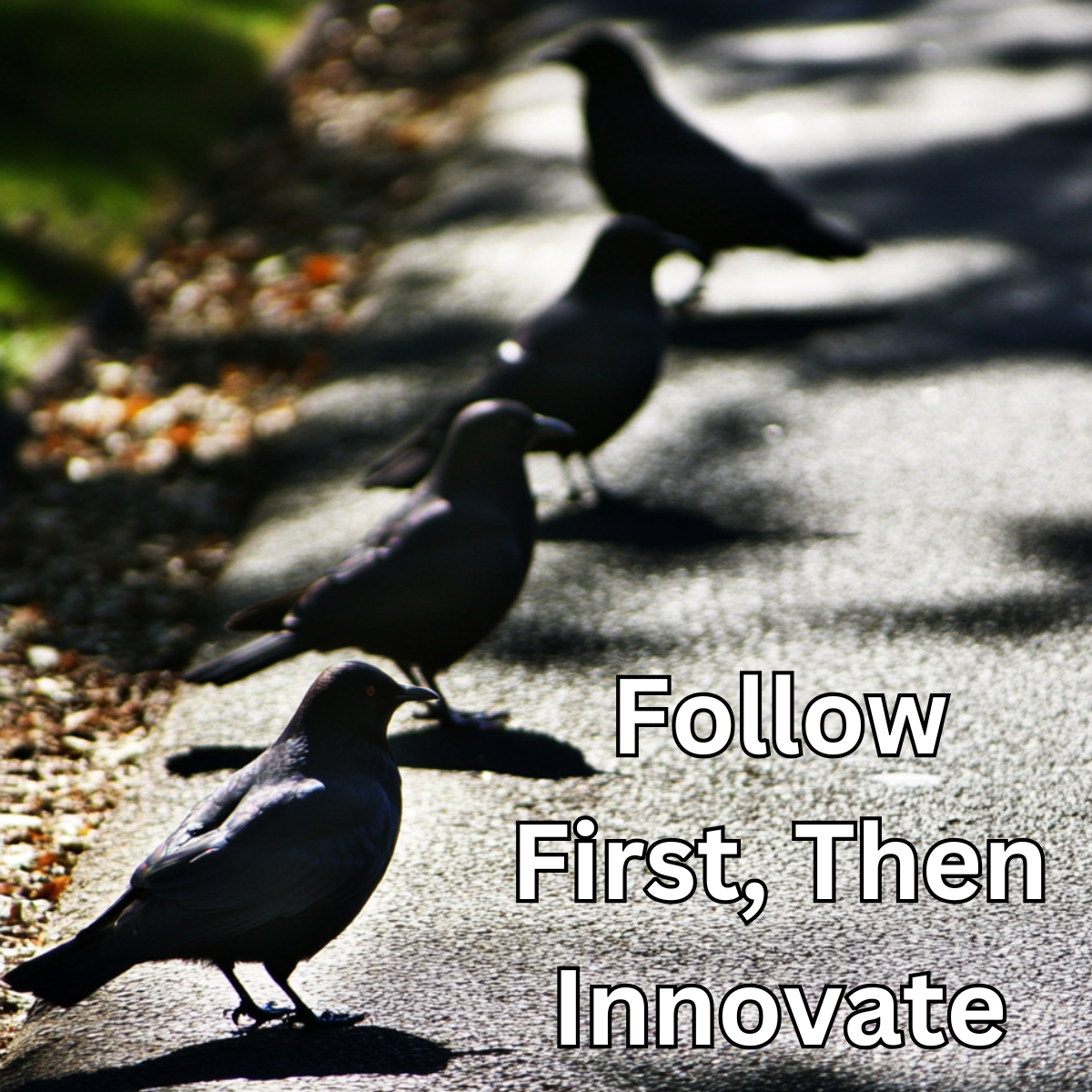
I asked my grandmother, who is about ready to have her 100th birthday, what one of her secrets to life she has picked up along the way. She said one of her primary lessons was to “shut up and follow the leader.” This was funny because if you knew my grandfather – you would understand why she said this. However, there is a deeper meaning behind this sentiment. Oftentimes, we relate “good work” with something new and innovative. We think we have to create a process and “come up” with something. I think this is false; what we should be doing is first discovering who else has paved this pathway and what process they followed. Then, after following the process carefully and recreating the success, we can start considering a deviation. True innovation, as it seems, comes not from the wellspring of nothingness but rather from a deep pool of lessons learned along the way.
The reality is that we have zero justification for starting from scratch in this modern day. There quite literally is “nothing new under the sun,” meaning if you search for a while, you are going to find others who have come up with paths to success in what you are pursuing. With the advent of large language models, you can easily get a cursory canvas of what humanity has come up with in regard to what you are trying to accomplish. We have never had it so easy to identify a framework, understand how the framework works, the strengths and weaknesses and then try to implement this as a first course of action. Following what others have done is not a sign of weakness but rather an indicator of wisdom. By pursuing what others have found successful first, you are able to take rapid shortcuts past the early-stage difficulties that the trailblazers in that particular field have already uncovered.
There is no shame in copying others. Our entire scientific community is based on this very premise. Taking a look at what the existing research is saying and then expanding upon it, often repeating the same experiments but with some slight variations. There should be no difference in how we pursue any major challenge. For example, take marketing. Assume that you have a marketing challenge. You need to get a message out to a potential set of buyers. You could try to reinvent this whole concept and chase a path that may or may not find success. Odds are you are going to failbecause marketing is a world of constant failure, and your brand-new and amateur attempt is most likely to suffer from the same fate. However, just searching around, you will learn there are many existing frameworks for marketing depending on what you are exactly trying to achieve. The AIDA model is a great fit for products that require a high amount of brand awareness. The STP Model when you need to strategically target a particualr niche market. We take this model for granted, and often people will try to do this without realizing it. However, there is some value in following the model as it was intended by some of the major thinkers on the subject. RACE seems to be the model for digital marketing because it is important to track the lifecyle of a consumer’s interaction with your online materials. I could go on with this list; there are probably well over 20 of these types of models created and modeled for future generations to use. Funny how we ignore all of this and try our own way when people have been thinking this stuff up for well over 100s of years.
In the end, my grandmother’s advice to “shut up and follow the leader” is not just a humorous anecdote; it’s a profound reminder of the wisdom in humility and the value of learning from those who came before us. The path to success is rarely about blazing a trail in uncharted territory but more often about studying the well-worn paths that others have already mapped. By taking the time to understand proven frameworks, processes, and strategies, we honor the collective progress of humanity while giving ourselves the best chance at meaningful achievements.
True innovation doesn’t come from ignoring the past but from embracing it—building on it thoughtfully, with care and precision. Whether in marketing, science, or personal growth, the principle remains the same: start by mastering what already exists. Only then can we add our unique touch, knowing we’ve laid a foundation of solid understanding.
So, before you rush to create something “new,” take a moment to reflect on what’s already been discovered. The answers you seek may already be out there, waiting for you to uncover, apply, and perhaps improve. Following the leader doesn’t mean giving up your voice—it means equipping yourself with the wisdom of those who’ve already walked the road.