There’s a curious tendency within us all, one that has been both a survival mechanism and, at times, a stumbling block. It’s the tendency to center ourselves so completely in our own experiences that we assume the problems we face must be equally significant to everyone around us. It’s not that we’re inherently selfish in a malicious way—it’s more that we are wired this way. Our minds are tuned to the frequency of our own survival, our own challenges, our own stories. And so, when a problem looms large in our lives, it feels as though it must loom large everywhere.
But, more often than not, that’s simply not the case.
The truth is, what feels massive and all-consuming to us is often just a ripple in the lives of others. That’s not to say our struggles don’t matter—they absolutely do—but their impact and significance are often much smaller to those around us than we imagine. This realization isn’t meant to diminish what we feel but rather to remind us to take a step back and consider the bigger picture.
The Self-Centered Nature of Perspective
Perspective is a deeply human thing. We see life through the lens of our own experience, and everything is filtered through how it affects us. It’s not necessarily selfishness in the negative sense—it’s biology. Our ancestors survived by being hyper-aware of their immediate environment, threats, and needs. This inward focus helped ensure they made it through the day.
However, in our modern world, this same instinct often leads us astray. A disagreement at work, an unkind comment, or even an unexpected change of plans can feel like monumental issues. But if we pause for a moment and step outside of ourselves, we often realize that these issues, while important to us, barely register in the grander scheme of things.
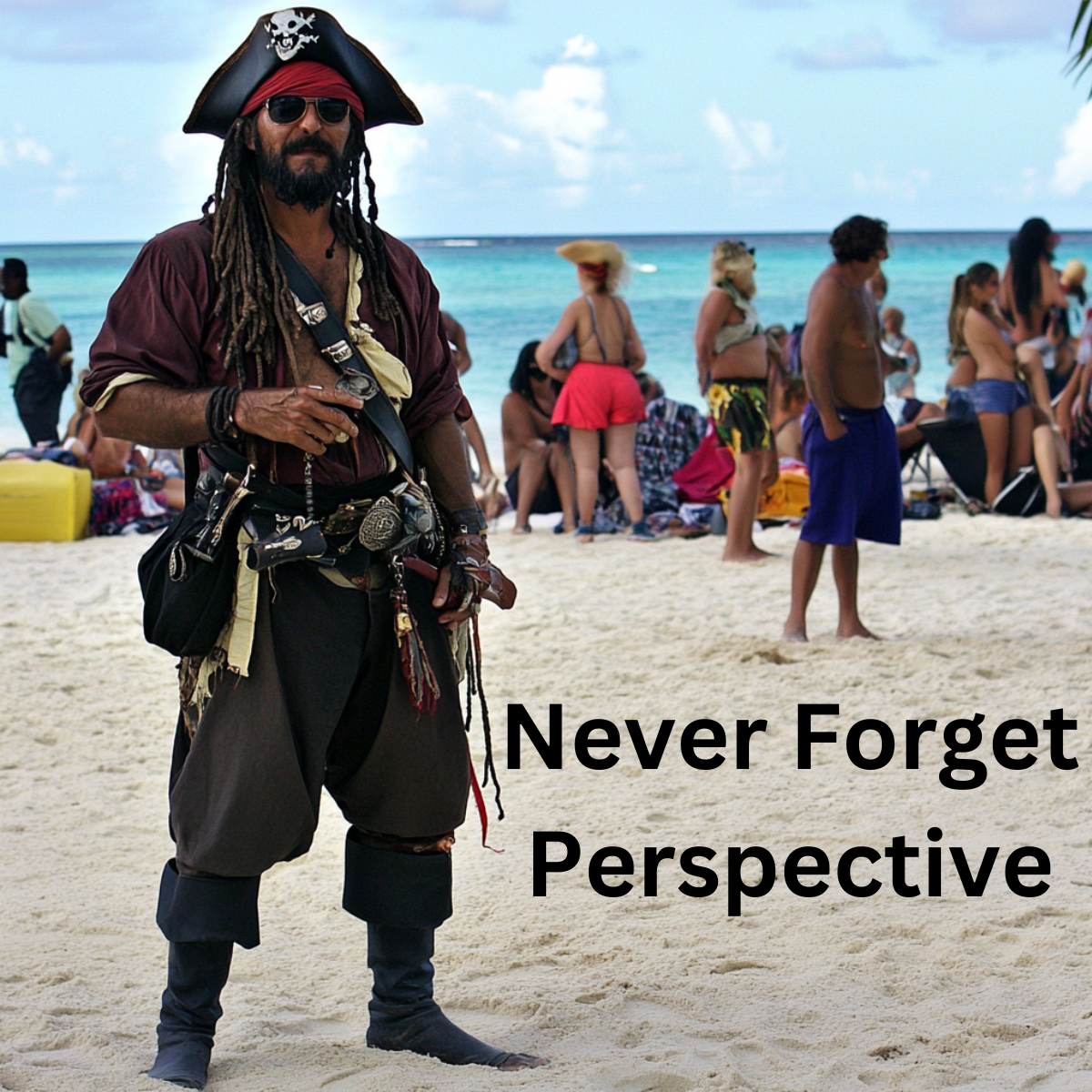
This is why perspective matters. It’s what helps us navigate the gap between our immediate experience and the broader realities of the world around us.
A Call for a Broader View
What’s fascinating is that every major religion, in one way or another, emphasizes the need to shift our perspective beyond ourselves. Whether it’s the Golden Rule to “treat others as you would want to be treated,” or the Buddhist call to mindfulness and compassion, these teachings push us to widen our view. They challenge us to consider not just how we feel about a situation, but how others might feel as well.
This isn’t an easy thing to do. It requires intentionality and humility. It means admitting that our perspective isn’t the only one and that, sometimes, it might not even be the most important one.
One practical way to do this is to ask questions. When faced with a challenge or disagreement, instead of doubling down on how we see things, we can pause and ask others:
- What does this look like to you?
- How are you experiencing this situation?
- What do you think we might be missing?
By doing this, we open the door to new perspectives—ones that might challenge us but also enrich our understanding.
Responsibility and Perspective
Now, this broader view doesn’t absolve us of responsibility. Perspective is not a free pass to ignore morality or dismiss the impact of our actions. We can’t harm others or trample on what’s right and then claim, “Well, from my perspective, it was justified.” That’s not how this works.
Instead, perspective invites us to take responsibility with greater clarity. It asks us to consider not only our own intentions but also the consequences of our actions on others. It’s about balancing self-awareness with an awareness of the world beyond ourselves.
The Gift of Perspective
Ultimately, remembering perspective is a gift we give both to ourselves and to others. It frees us from the trap of self-centered thinking and allows us to engage with the world in a fuller, more meaningful way. It reminds us that while our problems and challenges are real, they are not the entirety of the story.
So the next time you find yourself caught in the swirl of your own perspective, pause. Take a step back. Breathe. And consider what this moment might look like from another angle. You might be surprised at how much lighter the world feels when you do.
Perspective isn’t about minimizing your experience. It’s about expanding your understanding. And in doing so, you might just find a better way forward—not only for yourself but for everyone around you.