My home office is typically chaotic. A whirlwind comes and goes, leaving devastation in its wake. Papers stack up, cables tangle, books shift, and no matter how many times I restore order, entropy eventually wins. Yet amid the chaos, there is one constant—a small carved rock turtle that sits beneath my monitor, always in the same spot.
No matter how much turbulence surrounds him, he remains unmoved.
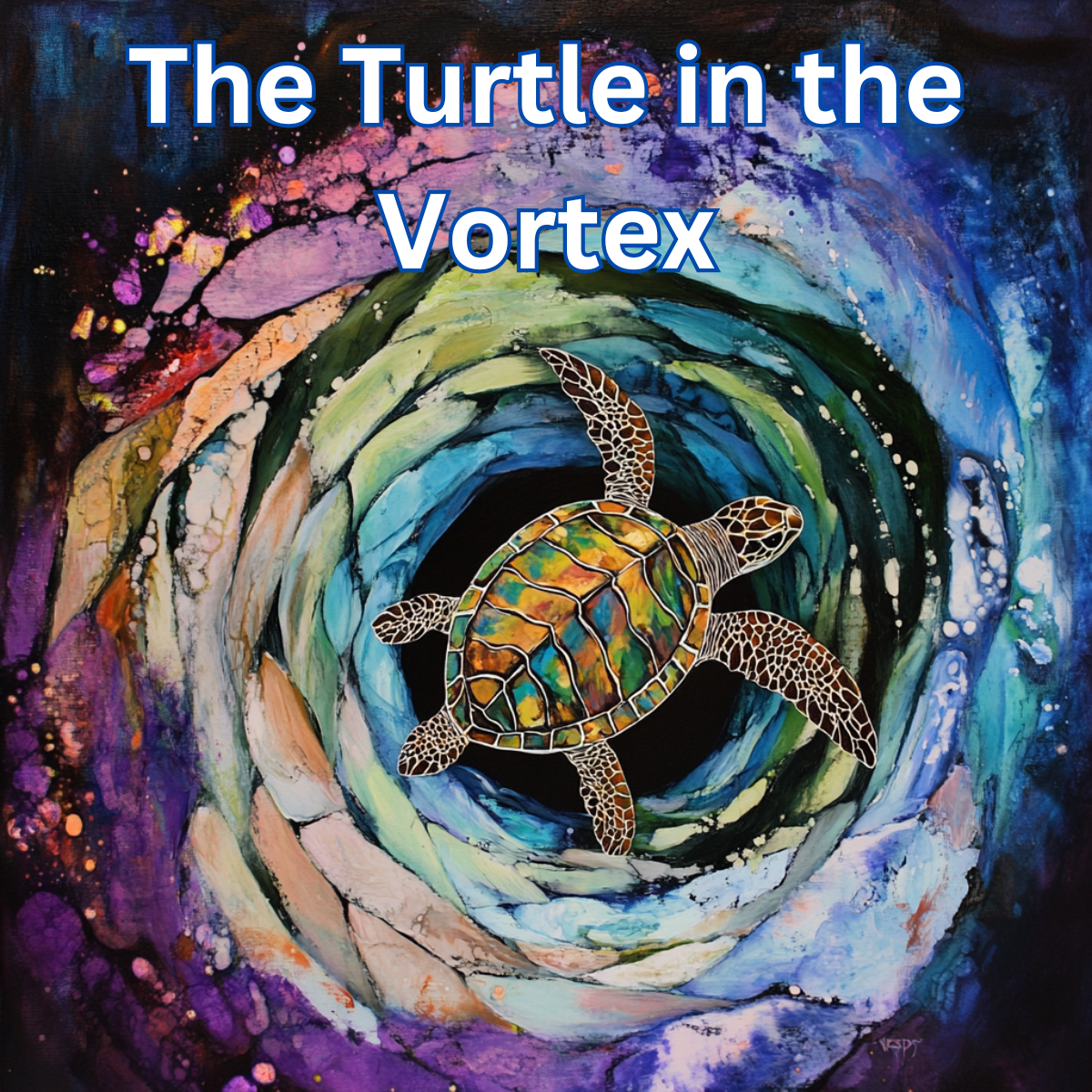
Today, as I sat staring at this tiny, unshaken presence, I found myself wondering: Could I be like this turtle in the vortex?
The Power of Stillness Amid Chaos
In any storm, whether physical, emotional, or organizational, there are two kinds of people: those who are swept up in the current and those who become a stabilizing force. The turtle is the latter. Not because he fights the chaos, but because he remains steady in the middle of it.
This is an essential principle of leadership, resilience, and even personal peace: true strength is not about controlling the storm, but about being the unmoving center within it.
The Center of the Swirling Vortex
1. Calmness Creates Stability
When people are overwhelmed, they instinctively seek stability. Whether in families, businesses, or societies, those who maintain composure in difficult times become a gravitational anchor for others.
This is why history remembers leaders who remained steady under pressure—Winston Churchill during the Blitz, Marcus Aurelius in the face of a crumbling empire, or even quiet mentors and parents who provided unwavering support in difficult moments. They did not eliminate the storm, but they refused to be consumed by it.
2. The Psychological Magnetism of Presence
In uncertain times, people are drawn to those who exude confidence and assurance. It’s a basic human instinct. If a fire breaks out in a building, people will look for the person who isn’t panicking.
The power of presence is not about shouting the loudest or forcing control—it’s about being the quiet force that others instinctively trust. In this way, leadership is often less about action and more about being.
3. Order Emerges from the Still Point
Nature provides countless examples of this principle. Hurricanes have an eye of calm at their center. Planets orbit around stable gravitational fields. Whirlpools create a structured flow of water, not because they fight the current, but because their presence shapes it.
In social dynamics, the same effect happens. A person who remains steady in crisis naturally creates order, even without force or authority. Their presence alone can guide others toward stability.
Becoming the Turtle in the Vortex
If being a stabilizing force is such a powerful principle, how do we cultivate it?
- Develop Internal Stillness – This isn’t about suppressing emotions but training yourself to remain calm amid uncertainty. Meditation, reflection, and discipline help cultivate an unshakable core.
- Control Your Reaction, Not the Storm – Most chaos is beyond our control. The only power we truly have is how we respond. A steady mind influences those around it.
- Be the Quiet Force in the Room – The loudest person is rarely the most influential. In meetings, conflicts, or crises, the one who remains composed has the greatest impact.
I look again at the small turtle under my monitor. He does not fight the vortex. He does not flee from it. He simply remains. And in doing so, he becomes the center of something greater than himself.
Perhaps the greatest leadership is not about what we do, but who we are when the storm rages around us.