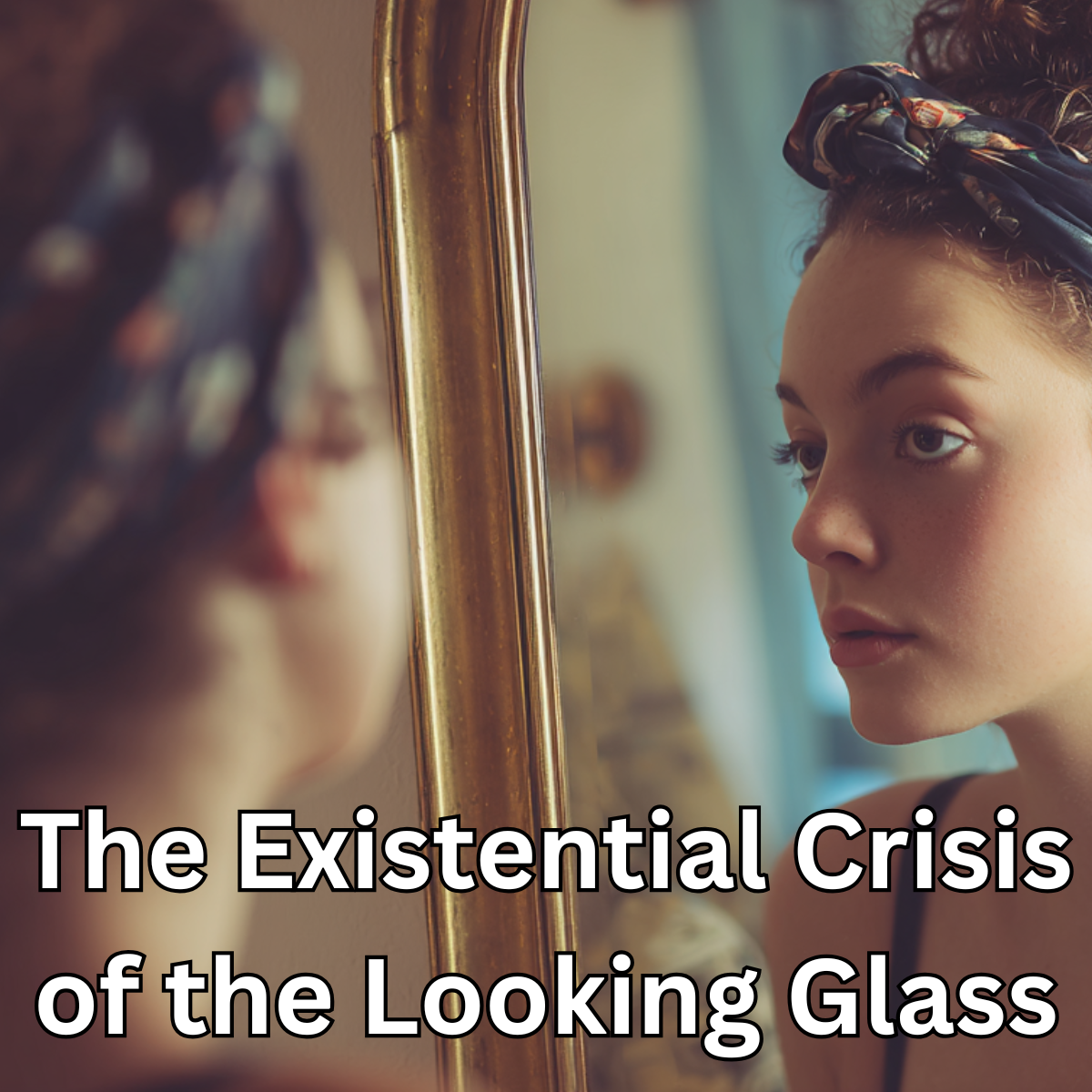
When looking into a mirror, unless there are imperfections in the surface or issues with lighting, the mirror will reflect back exactly what it sees. However, every time you look into the mirror and see a reflection coming back at you, there is a moment of existential crisis. This is because your human brain has been perfectly designed over thousands of years of evolution to be an absolute expert in quickly judging value in what you see. Should you run? Should you fight? Should you be attracted? Should you be afraid? Should you be interested? All of this is processed in moments, and you derive conclusions quickly. Through this effort, you ultimately only see what your brain wants you to see. Thus, we have an existential crisis.
Your brain does not passively reflect reality—it actively filters, interprets, and sometimes distorts what you see based on perception, attention, memory, and even emotion. Your eyes send raw visual data to your brain, but only a portion of it is consciously processed. This gets pretty technical, but there is fascinating research in this area. The visual cortex is quite advanced and can process basic shapes, colors, and spatial relationships. There is a special part of your brain that specializes in recognizing faces, including your own. You will ultimately engage in selective attention, which means your brain focuses on certain features, such as a blemish, your hair, or a facial expression, while ignoring others. What you notice is determined by what is relevant to you in that moment. If you feel fat, you are correct, you will see the fat. If you think you are unhealthy, you will notice those signs. If you are feeling insecure, you are more likely to zoom in on perceived flaws.
This is an important consideration and something to be highly aware of. You do not just see what is there—you see what your brain expects or believes is there. In effect, you process things from the top down, the top being your memory, your expectations, and your prior knowledge. This means your mental image of yourself can bias what you actually see. You may reinforce a self-image that is not fully accurate, either positively or negatively. Consider this: the mirror image is not what others see when they look at you. From a simple perspective, what you see in the mirror is reversed. This mirror reversal can alter your perception of facial symmetry and proportions. I read a study in a psychology journal that noted people prefer their mirror image more than their actual photographed image because they are more familiar with it. When they see a photo of themselves, they immediately react negatively. Others, however, prefer your real image, because that is what they see.
This proves a significant point, which is that you never actually see reality. You see what your brain decides to interpret. Note that a young child, under the age of one, will not be able to recognize themselves. They have not developed self-recognition because this is complex. The combination of multiple areas of the brain has to work in unison to be able to see, detect, and recognize your own image. This complexity reinforces just how biased we are in how we see ourselves and anything else around us.
On top of all this, other areas of your brain affect how you emotionally interpret your appearance when looking in the mirror. On a good day, you may see yourself as more attractive. On a bad day, your focus may be drawn to perceived imperfections. This is called affective bias—your emotional state skews your visual and cognitive interpretation of the mirror image. In addition, when you look at yourself, you tend to spotlight certain things; you overestimate how much others notice specific features you focus on.
So why do I bring this up? For one thing, stop believing every conclusion you reach when looking in the mirror. However, in a more poignant observation, what you see is not always reality. The way you perceive things is not the way they are. It is important to take a second or third look at things before making decisions, because often you are being swayed by one or more of these interpretations, the same way you are when looking into the mirror.
If looking at ourselves through the looking glass is so highly subjective and impacted by our current emotions or bias, then how much more influenced are we when reading or watching the news, or simply looking at faces in a crowd? I am sitting in an office building overlooking a beach community. What do I see? I see happy families walking to the beach together, laughing and having fun. Another person might see the couple on the bench across the street having an argument. Another might see the painting contractor loading his gear after finishing his job.
The ultimate point? I suppose it is that we see what we want to see. This realization, that our perception is so heavily filtered by emotion, memory, and expectation, offers a kind of quiet reassurance. If what we see in the mirror is shaped by what we believe, then perhaps things are not as bad as they appear in our most anxious or self-critical moments. The blemish we obsess over, the flaw we cannot ignore, the problem we think is insurmountable, these may all be exaggerations born from within. By understanding this, we can learn to pause, to question, and to reframe. We can remember that what we see is not the full truth, only a version of it. Sometimes, stepping back from the mirror, whether literal or metaphorical, is all it takes to recognize that life is not as bleak or as broken as it might first appear.