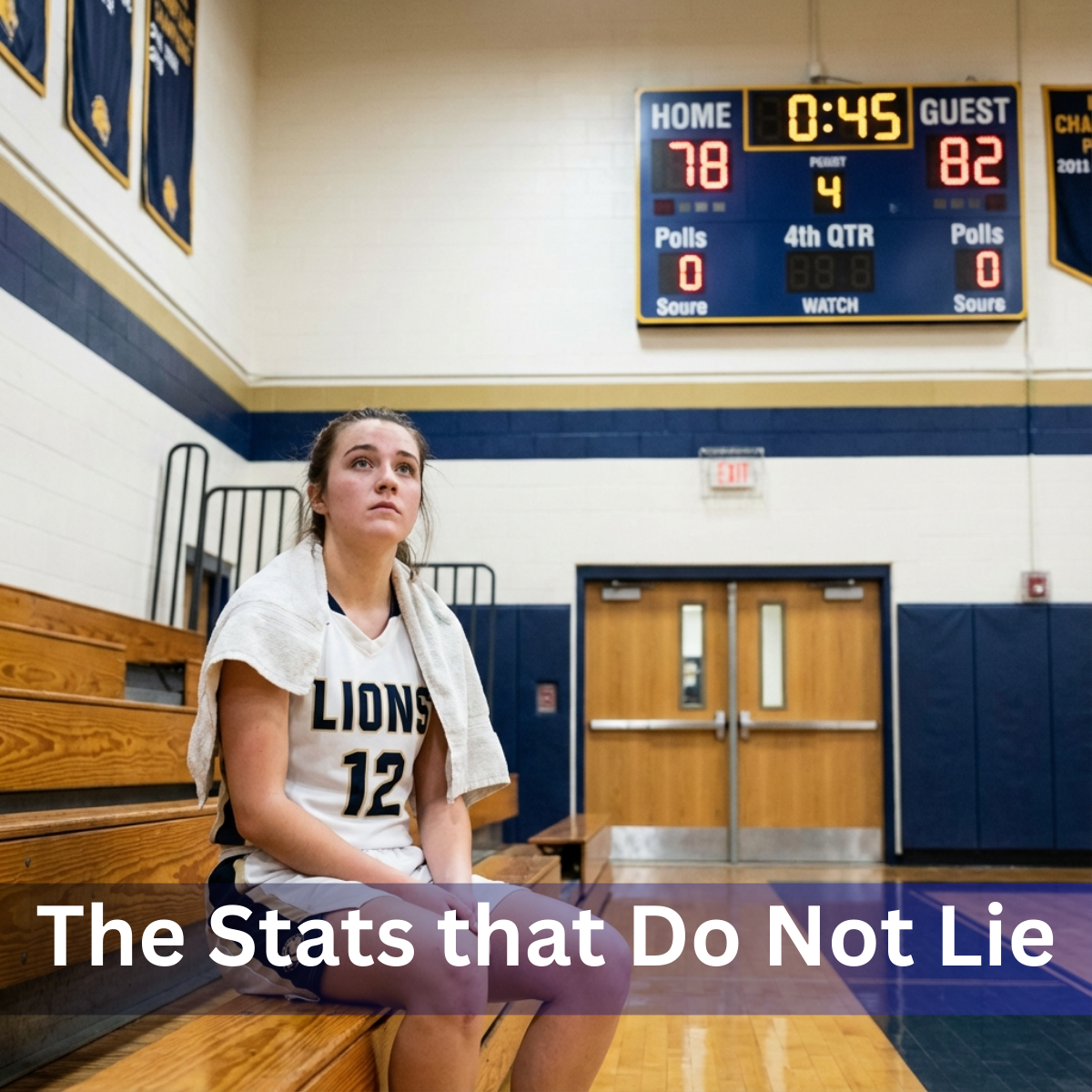
I have been recording my daughter’s basketball games and then running them through an AI engine to derive stats. Now that I am up to eight games, the stats are starting to paint a meaningful representation of player performance. I realized that as I was determining what the best stats were to use, the right combination of stats can show one player as having a greater impact than another. This is of course based on what you think is strategically important during a game. Are steals more important than rebounds? Are blocked shots a better indication of defensive ability than the number of turnovers the other team has when the player is on the court? I realized that these are rather subjective considerations, but there are definitely some stats that you cannot escape. Basic fundamental stats that everyone uses to determine basketball performance, and try as you might, these stats do not lie. If a player is averaging a high number of points per game or a high number of rebounds or assists per game, then there is no doubt that they are having a positive influence on the outcome of the team’s performance.
I thought about this for a while this morning. Every time a college or professional player gets on a basketball court, all their core actions are being tracked and recorded by stat observers. These then get posted on websites where anyone can go and look at your stats and judge for themselves what kind of player you are. That is a tremendous amount of scrutiny, I realized. There is no hiding if you are not contributing to the game in a meaningful way. The stats reflect an accurate picture of your tangible impact. Not all things are that tangible, but in the game of basketball, getting the ball into the hoop to score seems about the most straightforward litmus test for player and team results that I can think of. I started to think about this. What if my life was recorded all day long and there was a team of stats people tracking my every move? What would be the stats that do not lie?
This led me down a rabbit hole indeed. What would be the critical human performance stats? I came up with eight areas that I would need to ponder a key stat for. Energy or vitality, cognitive performance, emotional regulation, social or relationship health, intentionality, creativity and problem solving, and finally the hardest one, integrity. I eventually came up with the one keystone stat, like points per game, that would have the greatest impact: adaptability. How effectively can a person adapt their behavior, emotions, goals, and thinking to changes in their environment? That would be the human growth stat.
I started thinking, how would I know if I was doing well in these key human performance areas? I imagined recording everything that I say, type, or communicate throughout the day and putting that through an AI system. The system would be trained on my core beliefs and it would have one purpose: to determine how often my communications reflected my belief system. What is my integrity percent throughout the day? That one hurt to think through. I imagine that it would not be as high as I wanted it to be. Now this is not realistic. I am not going to build a system to track my every movement and every expression, but this thinking did lead me down the path of realizing that much like a basketball player, perhaps I should start considering my life in terms of key immutable stats.
I realized that if these stats existed for my life, they would show patterns that are otherwise easy to ignore. They would highlight when I am consistent and when I drift, when I contribute and when I withdraw, when I am aligned with my values and when I fall short. In the same way a box score exposes the truth of a basketball game, these human stats would expose the truth of how I am living.
The thought stayed with me. A basketball player does not get to argue with the numbers. The numbers tell the story. If I had numbers for my daily choices, would they tell the story I think they would? Would they show a person growing, learning, and adapting, or someone repeating the same unhelpful patterns? It became clear that even without a tracking system, the idea of these stats could still serve a purpose. They could guide me toward the parts of life that matter most.
Maybe the real value is not in measuring everything but in becoming aware that certain areas of life are as foundational as points per game: energy, focus, emotional steadiness, relationships, intention, creativity, integrity, and adaptability. These are the categories that quietly determine whether I am moving forward or standing still.
I ended my reflection with a simple question. If these were my personal stats, what would I want them to say at the end of the day? Even without the cameras and the observers, the answer to that question gives me a clearer way to live.