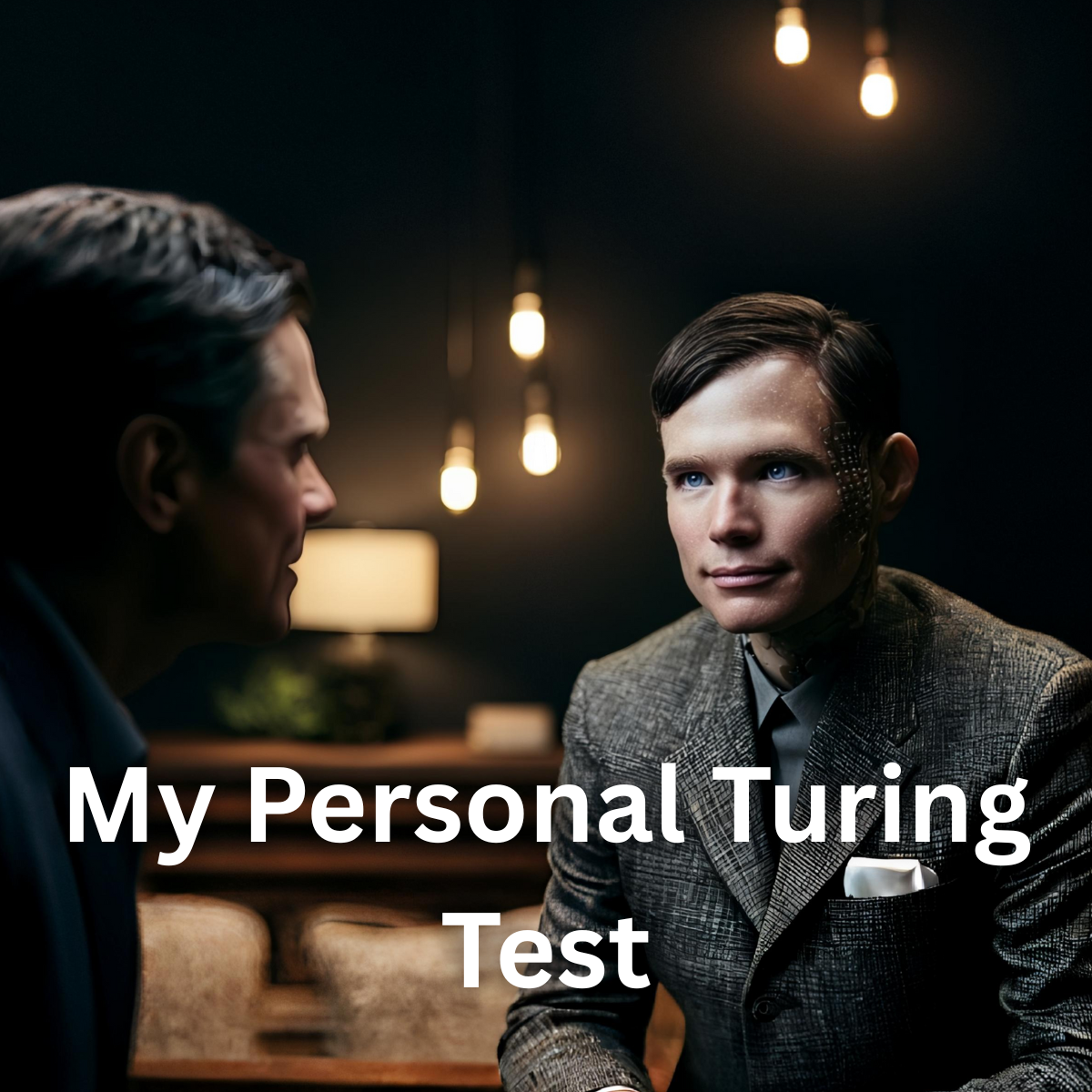
Yesterday, I decided to conduct my own experiment. I wanted to see how far the platform we are building could replicate me. Not just my words, but my tone, my creative thinking, the way I construct an argument or tell a story. I wanted to know if AI tools could replicate me well enough to fool the people who know me best. So I did my own Turing test.
I had the AI engine write something in my style. Then I took it further. I created a video of me speaking, using my voice and my image. I sent it to family and friends to see if they could tell the difference. The results were interesting. It largely failed. They could tell. But even though it failed, it was remarkably close. Close enough to make me uncomfortable. Close enough to make me think harder about what this means.
The original Turing test was designed by Alan Turing in 1950 as a way to measure machine intelligence. The idea was simple. Put a human evaluator in a room and have them communicate with two entities through text, one human and one machine. If the evaluator cannot reliably tell which is which, then the machine has passed the test. It was never meant to be a perfect measure of intelligence, but rather a practical benchmark. Can a machine fool a human into thinking it is human? That was the question.
But my experiment was different. I was not trying to see if a machine could fool a stranger into thinking it was human. I was trying to see if a machine could fool people into thinking it was me. That is a much harder test. A stranger does not know my quirks, my patterns, the way I think or the way I express myself. They do not know the stories I tell or the metaphors I use. They do not know the rhythm of my sentences or the way I build an argument. But my family does. My friends do. The people who read my writing regularly do. They know me. They know my voice. And that is what I wanted to test.
The classic Turing test asks if a human evaluator can tell whether the responses come from a machine or a human. Applied to my experiment, the question becomes more nuanced. If a reader who knows me well could immediately tell the blog was not me, then the AI fails. If a neutral reader suspects it is AI, even if they do not know me, then the AI fails. If a neutral reader and someone who knows my writing both cannot confidently say it is artificial, then we are approaching a creative Turing threshold. But here is the issue. The Turing test was never designed for personalized creativity. It only measures surface-level imitation. It does not measure style depth, emotional authenticity, consistency with your worldview, alignment with lived experience, or temporal coherence in your writing history. The classic Turing test evaluates plausibility, not personal authenticity.
So I need a better test. I need a test that measures not just whether the AI can fool a stranger, but whether it can fool the people who know me. I need a test that measures not just plausibility, but authenticity. I need a test that measures not just whether the AI can replicate my words, but whether it can replicate me. That is a much harder problem. That is the problem I am trying to solve.
I propose a new test. I call it the Personal Turing Test. It is an adapted version of the original, but designed specifically for personalized creativity. It asks three groups of people to read the piece and evaluate it. The first group is people who know my writing very well. They read my blog regularly. They know my style, my tone, my patterns. They know the way I think and the way I express myself. The question for them is simple. Can they tell it is not me? Where does it ring false? What gives it away? The second group is people who know me personally but not my writing. They know my personality, my worldview, my values. They know the way I talk and the way I think. The question for them is different. Does it sound like something I would say? Does it match my personality and worldview? Does it feel like me? The third group is people who know neither me nor my writing. They are neutral evaluators. They do not have any context. The question for them is whether anything feels generically AI. Does it feel repetitive? Over-smoothed? Lacking specificity? Does it feel like it was written by a machine?
When all three groups cannot reliably detect AI, the piece has passed a Personal Turing Test for Authored Work. That is the standard I am aiming for. That is the benchmark I am trying to reach. And right now, I am not there. I am somewhere around a sixty to eighty percent pass rate. The AI got my tone. It got my phrasing. It used my thematic patterns. But it still lacked the texture of human experience. It lacked the specificity, the lived detail, the personal anecdotes that make my writing mine. It lacked the mistakes, the tangents, the moments of vulnerability that make writing feel human. It was close, but it was not me.
The question is why. Why did it fail? What is missing? What is the difference between plausible and authentic? I think the answer lies in the details. The AI can replicate patterns, but it cannot replicate experience. It can mimic my style, but it cannot mimic my life. It can generate sentences that sound like me, but it cannot generate sentences that come from me. It lacks the context, the history, the lived experience that shapes the way I think and the way I write. It lacks the mistakes, the false starts, the moments of doubt that make writing feel real. It lacks humanity.
But here is the thing. It is getting better. The gap is closing. The AI is learning. It is getting closer to replicating not just my words, but my voice. And that raises a question. If the AI can replicate me well enough to fool most people, what does that mean? What does it mean for authenticity? What does it mean for creativity? What does it mean for me? I do not have the answers yet. But I am going to keep testing. I am going to keep refining the Personal Turing Test. I am going to keep pushing the boundaries of what is possible. And I am going to keep asking the question. Can AI replicate me? And if it can, what does that say about what it means to be me?