This morning I was scanning through a few podcasts while taking care of a project for my wife and daughter. They are having a holiday party today and of course Dad gets the brunt of the last minute great ideas that turn into a backyard makeover. Anyway, I hit on a podcast where a gentleman was being interviewed, and in this discussion he reflected that he felt we were finally getting away from the tight authoritarian grip that Christianity had on American society for so long, and that minds were finally free to think for themselves. He was, in not so many words, encouraged by the disassociation that the common lifestyle in the United States was having in regard to the teachings of Christianity.
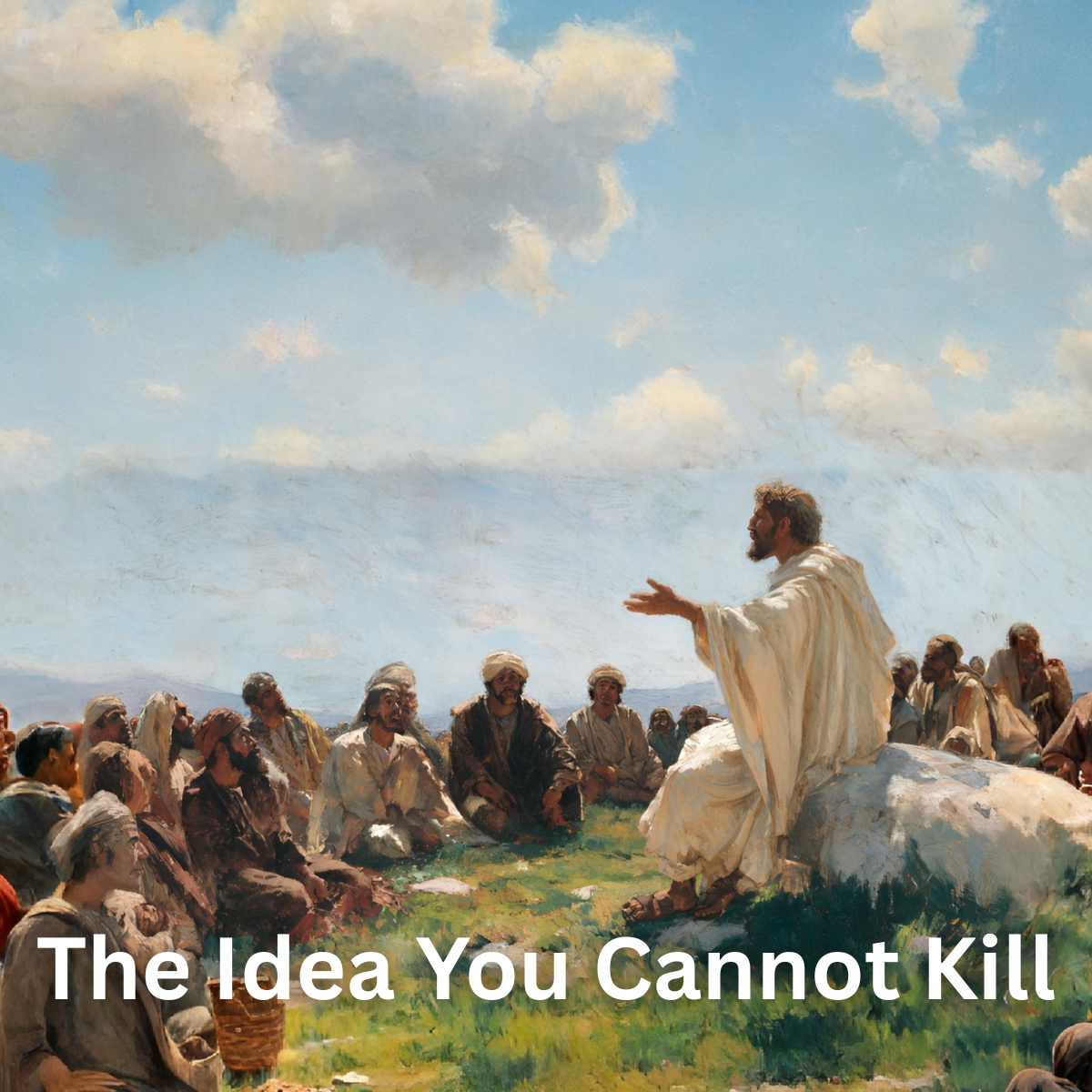
He warned that the recent return of the younger generation to religion could cause a revival of the traditional Christian ethos and he felt that might not be a good thing. That discussion stayed with me most of the day. I came to the conclusion that, try as he might, this man and other philosophers like him do not realize that they do not have the ability to kill the idea behind Christ. The idea itself, much more than the historical person we have learned about who was born in meager circumstances and became a renowned teacher who was then crucified and resurrected three days later, is an idea that has power. Tremendous power. It does not seem to be lessening much after two thousand years. Although I think this man might have been referring to the more puritan ideals of early Christianity in the New England area, the power behind the message, the mission, and the purpose of people who follow Christ is not going away. At least not anytime soon.
Last night I was at a retirement party and sat by a couple who attended church with the woman who was retiring. There was an opening prayer to commence the party, and this couple next to me offered more than one quiet Praise to Jesus during and after that prayer. I thought to myself that the man on the podcast has no clue what really goes on in households, church buildings, choir groups, and prayer vigils throughout the land he is professing to be void of Christ.
I started to think more about this. Not everyone who reads my daily blog is Christian, but I have noticed that those who choose to comment from time to time are certainly religious. So I began to think about the common threads that hold most of us together in this society, Christian or not. What exactly is this idea behind Christ that has held such latent power for so long? Even those outside the Christian faith acknowledge this, and many accept and adopt some of the teachings themselves. The Christmas tradition seems ubiquitous. Although many Christians lament the Santa Clauses, the reindeer, the Amazon Prime deliveries arriving just in time for Christmas, they still smile as much as anyone else when you greet someone in line at Starbucks with a Merry Christmas or a Happy Holidays.
So I came up with a few ideas to answer this interesting question.
The first idea that came to me was rather radical. It is the idea that God is not a distant, nebulous being, but a participant in our suffering. In the minds of Christians, the idea of Christ is the meeting point between the divine and the human. At the highest level, Christ represents the belief that God does not remain distant. Instead, the divine steps into human experience fully, vulnerably, and personally.
Philosophically, this is a radical idea. The divine is not merely a lawgiver, but a participant in human suffering. God becomes knowable through relationships, not only through rules or rituals. The ideal form of humanity, what we could be, is expressed in a living person. This makes Christ both a revelation of God and a revelation of what it means to be human. This is an idea that is not going to go away easily. It is powerful and was never quite represented in such a way until the advent of Christianity. Since that time there have been others, so the personalization of the divine is indeed powerful.
The second idea I identified was inescapable. It is the universal Christian ideal of love. This is certainly not the exclusive domain of Christians, as all religions capture this idea in one way or another, but Christianity frames love as the organizing principle of reality. At its core, Christ’s teaching builds on a single organizing principle: love is the fundamental truth of the universe. Not romantic love, but sacrificial love, unconditional goodwill, and the love of your enemies. It is the idea that love is best expressed in action and that love can heal what is broken. The philosophy suggests that love is stronger than power, violence, or fear, and that the most transformative force in human life is self-giving love.
Another thought I had was this concept of individualism, the power for a single individual to transform into something greater. Not just simple improvement. Christ does not propose moral self-improvement as the primary path. He proposes transformation, a change of being. At a high level the philosophical points are that humans are not merely flawed. They are fragmented, disconnected from their true self, and are on a journey to become something greater. Additionally, transformation requires grace, something beyond human effort. Spiritual rebirth means seeing reality differently, not just behaving better. Humans cannot work their way into wholeness. They must awaken to it. This philosophy is common to many other faiths, so it is a powerful concept that not only members of the Christian faith embrace.
There is another thought. It is the idea that through the small and weak, great things happen. The paradox of power through weakness. A central philosophical paradox in Christ is this: true strength is shown in vulnerability, humility, and the willingness to suffer for good. The belief is that this simplicity will overturn political power, social hierarchy, and religious elitism. It challenges the idea that force creates righteousness and Christ’s life models a power inverted universe. Those who serve are greatest. Those who lose for the sake of good ultimately win. The meek inherit the earth. This is a deep challenge to both ancient and modern systems. I wish the man on the podcast good luck in trying to kill this idea. It is not going away, ever.
Christianity also offers a narrative of redemption and renewal. For one as flawed as I am, this message resonates. Christ embodies the belief that nothing is beyond restoration, that broken things can be made whole, and that death is not the end of the story. Evil and suffering are real, but they do not have the final word. The rebirth of Christ represents that life and goodness are ultimately stronger than death and chaos. This forms a philosophical worldview of radical hope. Of all things, I think it is this ideal that has kept this faith strong for hundreds of generations and will continue to revive it in hundreds more.
I do not think that Christianity is a tribal thing, as the guest on this podcast seemed to believe. Rather it is a universal call that extends to everyone, the poor, the outsider, the sinner, the oppressor, the oppressed. The philosophy says that human worth is intrinsic, not earned. Every person is invited into transformation. The divine image exists in all people, even when hidden. This universalism is part of why the idea of Christ spread far beyond its religious origins in a small provincial town in northern Judea.
I do not remember the name of the person on the podcast I was listening to, but I think he was generally naive. You are not going to kill off the teachings of Christ any more than you are going to remove the powerful teachings of any human we have been blessed to listen to. If there is one thing we humans are really good at, it is remembering the good word. We recite it, pass it down, print it, talk about it, teach it again and again, and create stories and myths around it. We remember. We have Aesop’s Fables and now we have YouTube. So despite this one naysayer’s modern attempt to brush aside the power that resides in an idea, you are never going to stamp out the voices. Whether that is Jesus of Nazareth, Siddhartha Gautama, Moses, Laozi, Confucius, Mohammad, or Krishna. The idea that God is love, that love came in human form, that love transforms, that love redeems, and that love wins is not going anywhere anytime soon.