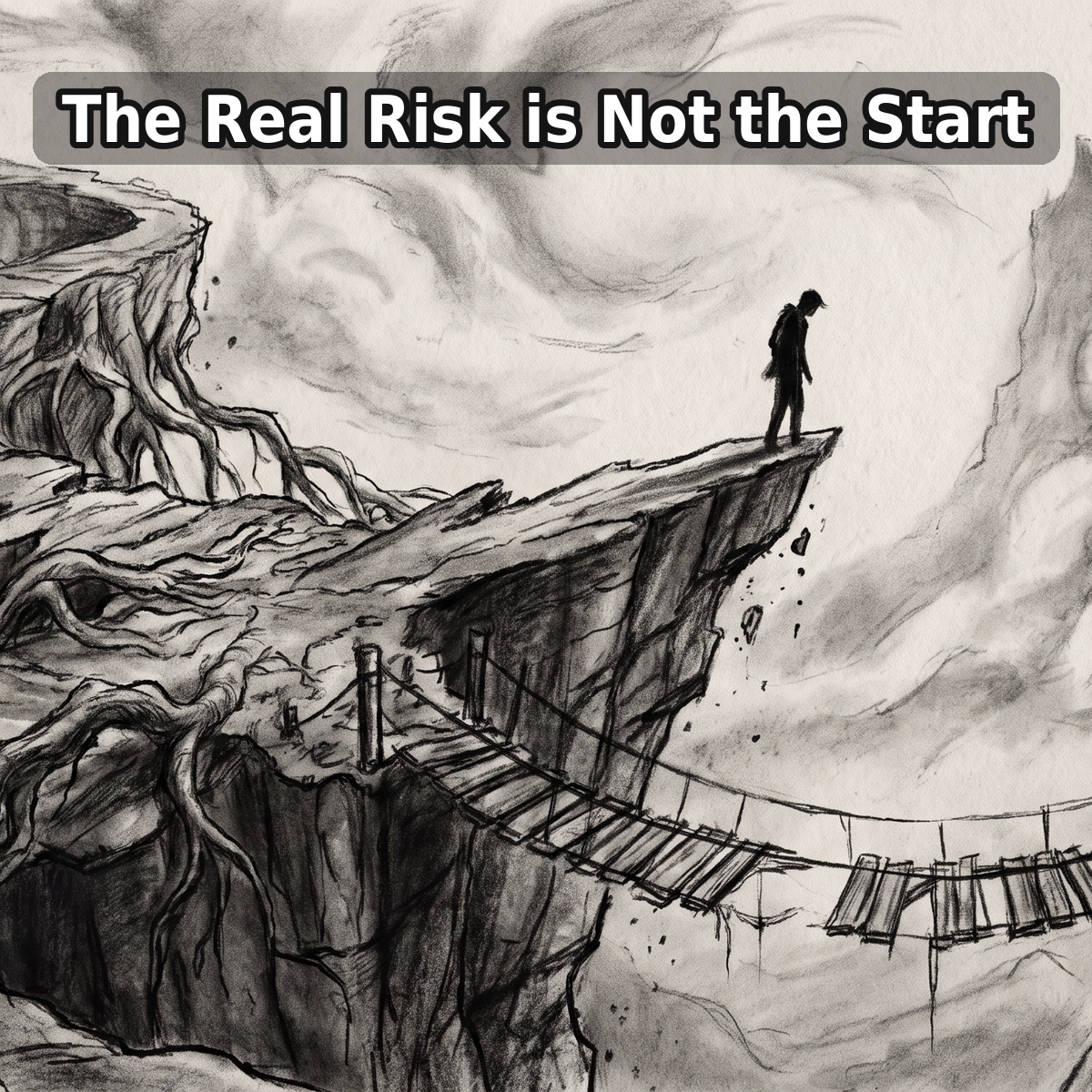
Day 351 – The Real Risk is Not the Start

Many people fear starting new initiatives due to the perceived risk of initial failure. However, the beginning often offers easy gains and quick successes. The real challenge arises after these initial successes, when progress plateaus and requires significantly more effort, skill, or a change in strategy.

The real risk is not beginning. It is what happens after the easy gains are gone. This is one of the biggest misconceptions that keeps people from taking on new initiatives that could change their lives. They fail to start because they fear initial failure. They fear that it will not be enough. People overestimate the risk of starting and underestimate the risk of continuing.

The initial plunge feels dangerous because uncertainty is highest. But in many endeavors, the beginning actually contains the easiest opportunities: enthusiasm is high, expectations are low, obvious improvements abound, and the first customers, pounds lost, miles run, dollars earned, or features built can come surprisingly quickly.

Then you reach the first plateau.

Now the economics change. The next increment of progress requires more time, more specialization, more capital, more discipline, or a different strategy. What got you there may no longer work.

Starting a company, writing a book, getting fit, learning a skill, building software, or changing careers can produce enough early evidence of success that you think you’ve validated the entire endeavor. What you’ve actually validated is only the first stage.

When you first create something, obvious improvements are often available. You solve the biggest problems, serve the easiest customers, capture the clearest opportunities, and fix the most visible defects. A relatively small amount of effort can therefore produce surprisingly large results.

Then you exhaust the low-hanging fruit. At that point, every additional unit of success requires disproportionately more effort.

The real risk is not starting. Whereas the startup is uncertain, the plateau is expensive. Plateau Risk is the risk that appears after initial success, when the easy gains are exhausted, and continued progress requires disproportionately more effort, skill, capital, or change.

So if you’re thinking about starting something and worried that your startup attempts will fail, you are worried about the wrong thing. Chances are that when you start, you will have some success. Perhaps more than you had considered possible. The real worry isn’t your initial success, but how hard it is to get off the first plateau.


Subscribe
Notify of
guest
0 Comments
Inline Feedbacks
View all comments
Share the Post:

Recent Blogs

Day 351 – The Real Risk is Not the Start

Many people fear starting new initiatives due to the perceived risk of initial failure. However, the beginning often offers easy gains and quick successes. The real challenge arises after these initial successes, when progress plateaus and requires significantly more effort, skill, or a change in strategy.

Read More

Day 350 – Learning to Triangulate

The article explains the concept of triangulation, drawing parallels between its use in surveying and navigation to its application in evaluating information. It emphasizes the importance of cross-referencing multiple independent sources to determine truth, especially in an age of misinformation and AI-generated content. The author argues that accepting information at face value is no longer viable and that triangulation should become a default reaction.

Read More

Day 349 – The Practice of Conceptual Decomposition

This article explores the author’s accidental discovery of conceptual decomposition as a superpower. Initially used to overcome learning difficulties, this method of breaking down complex systems into understandable parts proved invaluable in their career, particularly in teaching and computer science. The author advocates for applying this technique when interacting with AI to achieve more accurate and reliable results.

Read More

Day 348 – First Things First

The author shares their experience of maintaining seven daily habits for over 3,181 days, emphasizing the importance of doing crucial tasks first thing in the morning. They advise tackling life-changing habits immediately upon waking to avoid procrastination and increase the likelihood of completion, drawing on personal examples like early morning runs.

Read More
0
Would love your thoughts, please comment.x
()
x