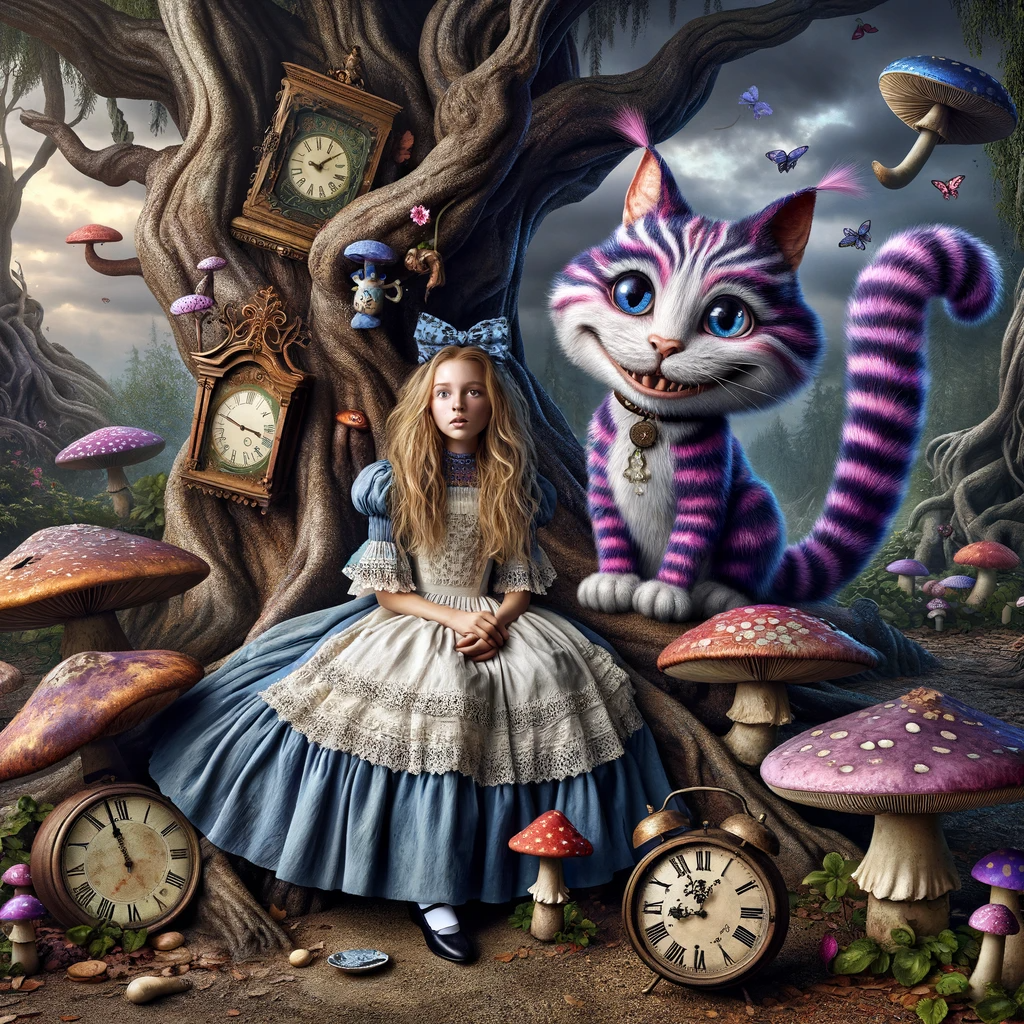
Last week, as I watched my niece shine in her high school’s rendition of ‘Alice in Wonderland,’ a particular scene caught my attention. In it, Alice and the Cheshire Cat engage in a whimsical yet profound debate about time. While Alice frets over returning to her birthday party punctually, the Cheshire Cat challenges her with the notion that time is, in essence, an illusion. This scene, especially the cat’s musing, struck a chord. I often hear phrases like ‘finding time,’ ‘creating time,’ or ‘making time’ in everyday conversations. But there, in the middle of a whimsical world of talking cats and mad hatters, I was struck by an epiphany. As Alice spiraled down the rabbit hole, so too did my understanding of time. Perhaps it isn’t time that governs us but rather the choices we make within the time we are given.
In the tangible reality of our everyday lives, the only true existence is the present moment. The past and the future serve as mental constructs: tools for learning from experiences, harboring regrets, or nurturing hopes. While the past is beyond our reach and the future is a tapestry of possibilities, not certainties, it’s the present that holds our true power. We often label forward-thinking as visionary and chastise ourselves for procrastination, ruminating in a cycle of complex emotions over past actions. However, these reflections, though potentially insightful, cannot change what has been or what will be. It’s in the immediacy of ‘now’ where our choices resonate most profoundly. Each decision, every action taken in the present, is where our true influence lies. It is this constant stream of ‘nows’ that shapes the tapestry of our lives, more than any regret or aspiration ever could.
Now, imagine this everyday scenario: An employee approaches you, seeking time to discuss a matter of importance to them. You’re faced with choices, each reflecting a different stance on time. Choice A involves explaining your busy schedule and offering a possible meeting in the weeks ahead. Choice B means directing them to coordinate with your admin to ‘find a slot’ in your calendar. Then there’s Choice C: seizing the immediate moment to hear them out. Think about the impact of each choice on the employee. While Choices A and B might seem practical, reflecting a conventional approach to time management, Choice C embodies a deeper understanding. It acknowledges that the most opportune moment for connection and assistance is now. Having been in both positions, I’ve observed that leaders who embrace the immediacy of the present, who realize that the concept of ‘later’ is often an illusion, are the ones who truly engage and inspire their teams. It’s in these moments that real leadership shines, transcending the conventional bounds of time to make a genuine, immediate impact.
Letting our lives be dictated by artificial constructs of time often means missing out on life’s most impactful moments. We frequently question how to better ourselves, oblivious to the countless opportunities presented each day. The sheer potency of a single, well-chosen moment often eclipses extensive future planning. A moment’s decision can heal the wounds of the past. Take, for instance, the relationship with an estranged child. One might dwell in the regret of past absences or fantasize about future gestures of reconciliation. However, it’s the spontaneous moments of connection—those instances where we halt our busy lives to truly engage—that leave lasting impressions. Personally, my children recall most fondly not the events I missed or the elaborate plans I made, but those unscripted times when I paused everything to be fully present with them.
In essence, our lives are composed of countless ‘nows’—each one a chance to make a meaningful choice, to forge a connection, or to mend a past oversight. As we move forward, let us remember the lessons from Alice’s journey and the wisdom of the Cheshire Cat: time is not just a sequence of hours and minutes, but a canvas for our decisions. So, I encourage you to embrace each present moment. Let it not be just another tick of the clock, but an opportunity to make a small yet significant difference. In doing so, we may find that the time we’ve been trying to ‘find’ or ‘make’ has always been right there, in the here and now, waiting for us to seize it.