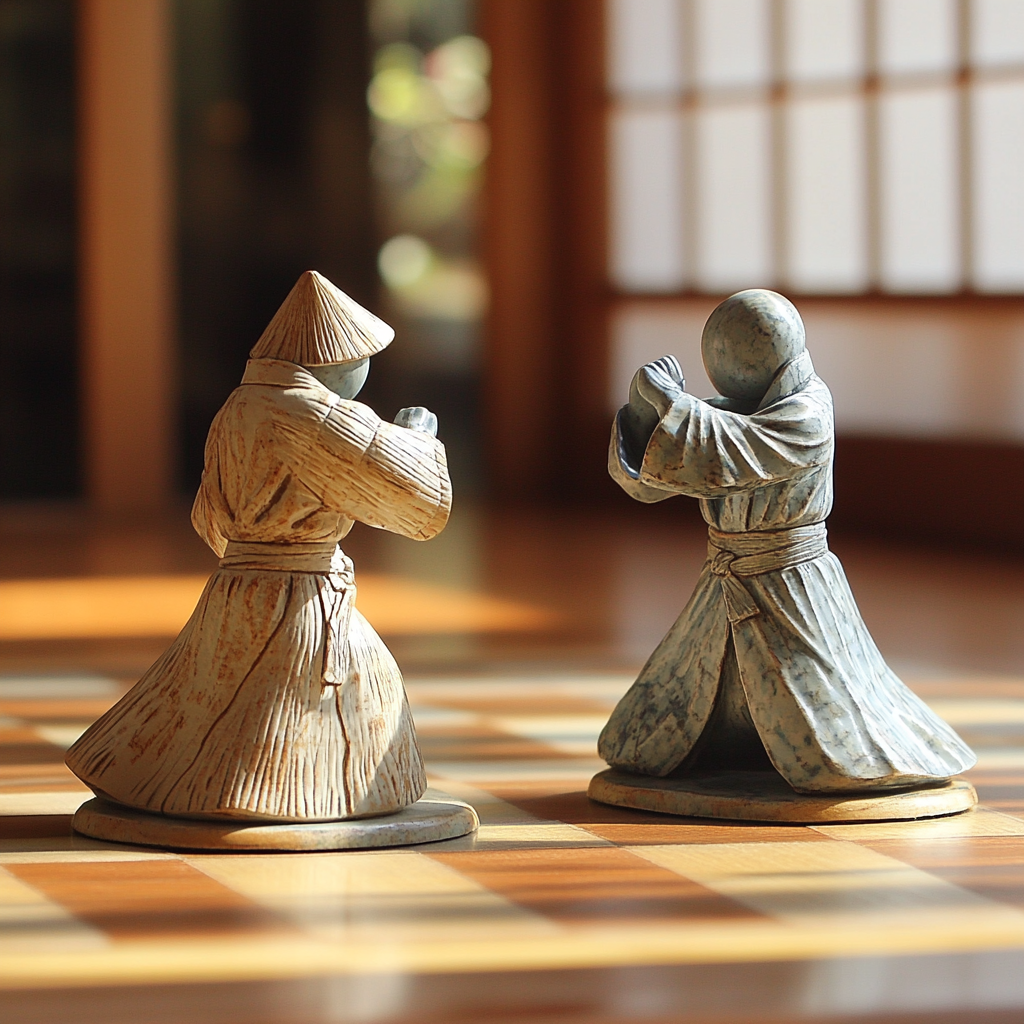
In martial arts, specifically aikido and judo, the term kuzushi is used to describe the concept of “breaking the opponent’s balance.” Kuzushi is an essential principle for setting up throws or other techniques, as it involves disrupting the opponent’s stability and positioning in a way that makes them vulnerable to an attack. In practice, kuzushi involves subtly manipulating the opponent’s center of gravity, either by pushing, pulling, or redirecting their energy, so they lose balance. Once kuzushi is achieved, it becomes much easier to apply a throw, joint lock, or another technique. The principle can be applied physically, mentally, and strategically in martial arts, making it a key concept in gaining an advantage over an opponent.
Having said all that, I was playing a game of chess this morning. I realized that toward the end game, I made a move to try to attack my opponent’s king side. I moved a bishop to a different diagonal to prepare for the attack. By so doing, I upset a very balanced position in which both my opponent and I were in equal opposition. This move upset me, and unfortunately for me, my opponent was able to quickly use that shift in tension against me, and suddenly, I was defending against a barrage of attacks and ultimately lost the game. I made the connection between this and kuzushi because, just as in aikido, my opponent used my momentum against me and caused my position to become unbalanced.
I reflected on this for a while this morning and realized that the powerful lesson to be learned here is not necessarily how to use someone’s momentum against them but rather how to make sure this does not happen to yourself. I am now talking about life and business and not martial arts or chess. In business, we are often trying to make strategic decisions and ways to approach a market, gain value, and disrupt our competition. However, I wonder how often we are attempting this from an unbalanced starting position. It is difficult to gain leverage of kuzushi on an opponent if you yourself are not balanced and ready. When one is stable, balanced, and consistent, they can then use their opponent’s move against them. This is a different way for me to view life. I have always believed that the person who will have the advantage will be first and, therefore, was always pushing fast. That speed always caused me to approach scenarios off balance or not prepared enough.
In a phrase, consistency and balance must be achieved before one can truly take advantage of an opportunity, counter position, or competitive advantage. This does not mean that speed is unimportant, I would say that it is critical. However, from what position can you strike the fastest? One that launches from imbalance or one that comes from deep within a centered core? In martial arts, the latter is true. In chess, you can never get to a balanced position unless you follow the basics of development and defense. If anything is off about your positional play, then you might as well forget launching a coordinated attack that will throw your opponent off guard.
In both martial arts and life, balance is the foundation upon which everything else is built. Without it, any move we make—whether in a fight, on a chessboard, or in a business strategy—becomes inherently unstable and prone to collapse under pressure. Just as a well-grounded martial artist waits for the right moment to apply kuzushi, a balanced individual in business or life must first ensure they are operating from a position of strength, control, and clarity before making bold moves. Only when we are centered can we respond fluidly to the shifting dynamics around us, using the energy of challenges to our advantage. The real power lies not just in seizing the opportunity, but in doing so from a place of unwavering equilibrium.