I was browsing through an art gallery with my daughter recently. The gallery had some original artwork, but also, likely to help keep up with their lease payments, they had clearly decided to put out some lithographs of more famous pieces to draw in crowds and sell a few items. They had them in nice frames with good lighting. And of course, they had a sale going on with select pieces. They always do.
I like to joke that you can always tell when a gallery has a lease payment coming up because they have the “certified” Van Goghs up front with sale stickers on them.
Anyway, as we wandered around, we rounded a corner, and there on the wall was a single small charcoal sketch of Dora Maar by Pablo Picasso. You might have seen this one. It is really quite simple, a sketch of one of his more famous lovers. It is not abstract or cubist, but actually a rather straightforward drawing. There is a sense of emotion behind it. Perhaps she is staring straight at you. Perhaps she is distracted by something else. Perhaps both.
She has flowers in her hair, and her eyes, although crudely illustrated, draw you in. In the bottom left corner is the famous Picasso signature, just as crude and a bit faded. As if Pablo Picasso did not really care that much about his signature. And yet, he underlined it. Which made me think maybe he did.
Anyway, there was a price tag clearly on display. Several hundred thousand dollars.
My daughter was just about to ask me a question about the drawing when the art dealer came up behind us and said, “That is only one of a few hundred signed lithographs of that drawing.”
“What is a lithograph?” my daughter asked.
I told her it was basically an exact copy of an artist’s work.
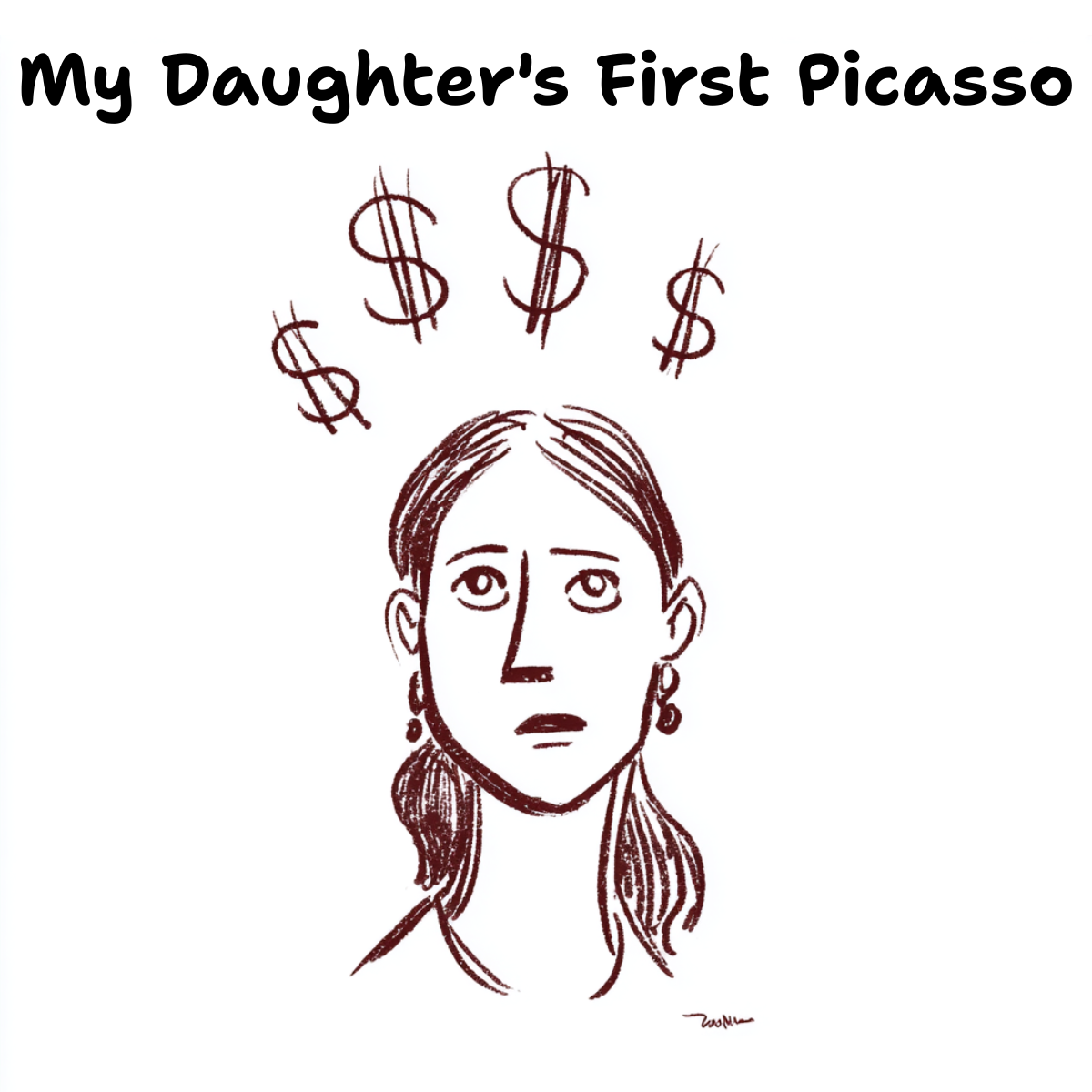
Looking shell shocked, she asked, “How could a copy of a sketch that bad cost that much money? I could draw that myself in five minutes!”
The art dealer replied, “But this one is signed by Pablo Picasso himself, which makes it highly valuable.”
My daughter shook her head. “But the drawing is terrible! How can this be that famous? Why is it valuable at all?”
“That,” I said, “is a great question. One that many have asked before.” I had asked that same question myself when I was younger. How can something like that go for such an enormous price tag?
The art dealer, having a bit of fun at my daughter’s expense, said the original drawing had sold for several million dollars to a private collector a few years ago. He then pointed to a framed print of Guernica and asked her, “How much do you think that one sold for?”
She guessed until she hit the double digit millions.
He then revealed that Guernica had sold at auction for several hundred million dollars. She just could not believe what she was hearing.
Later, as we walked down the street, I tried to explain why the price had gotten so high, why it was so precious in the minds of collectors. I walked her through how artwork is now considered similar to stock, and that owning a Picasso was like owning a blue chip stock in a major company. They hold their value over time and often grow in value.
I tried to explain why Picasso was unique. My son, of course, jumped in to say that Picasso was a womanizer and a mean spirited grumpy man who annoyed everyone around him. That got my daughter even more confused. Not only was Picasso a bad painter in her eyes, but he was also apparently a person of questionable character.
Poor dad had his work cut out for him.
Over the last few days, I have been thinking about my daughter’s question. What gives a Picasso sketch so much value?
If we asked an art history teacher, we would get a lesson on how revolutionary Picasso was. That he reinvented art as we know it. He created Cubism, a radical departure from traditional representation, breaking objects down into abstract forms and shapes. He effectively defined what we now know as modern art. They would also talk about how he evolved with each phase of his work, constantly finding new ways of expressing emotion, making his artwork feel fresh and unpredictable.
A sociologist or political theorist might point out how his paintings tackled powerful human themes. Works like Guernica resonated globally, giving voice to the feelings of angst, horror, and confusion about what humans are capable of, especially in times of war.
An economist might say that his value lies in a unique blend of scarcity and volume. Picasso was a fanatic worker by any artist’s standards. He created tens of thousands of pieces. While his truly iconic works are rare and the demand is intense, there are still many Picasso pieces out in the world. His prolific output ensures he remains a constant presence in the art world. When you combine historical significance, scarcity with volume, and the powerful iconic role his name plays, that is what drives the value.
Even copies of his artwork, if signed, can demand high prices.
But what struck me most as I read more about Picasso is that he was a marketing genius. He created a brand before branding became a thing. I have been thinking about brands a lot lately. What makes something valuable, unique, and powerful enough to command attention?
Picasso had all the necessary ingredients. He had an outsized personality that fed the myth around him. He was intentionally provocative, charismatic, and fully aware of his legacy. He lived a public life filled with famous lovers and dramatic episodes. His story became as captivating as his art.
And he only signed a portion of his lithographs.
You see this all the time now, but he was one of the first to elevate the practice. Picasso personally signed many of his lithographs, but only a select portion of each edition. At studios like Atelier Mourlot in Paris, he collaborated with printer Fernand Mourlot to produce hundreds of lithographs. He would sign only a limited number of impressions and label them things like deluxe edition. He created perceived rarity by only releasing a handful of hand signed copies.
Today, art dealers look for a pencil signature, proper numbering on the left hand side, and authentication from the original publisher.
Picasso was extraordinarily prolific. He created hundreds of lithographs and thousands of prints. But he valued control over how his signed works were distributed. He did not want his name to be mass market.
After doing all that research and explaining everything to her in detail, my daughter looked at me, smirked, and said, “Well, I still think I could do better.” Then she rolled her eyes and walked away.