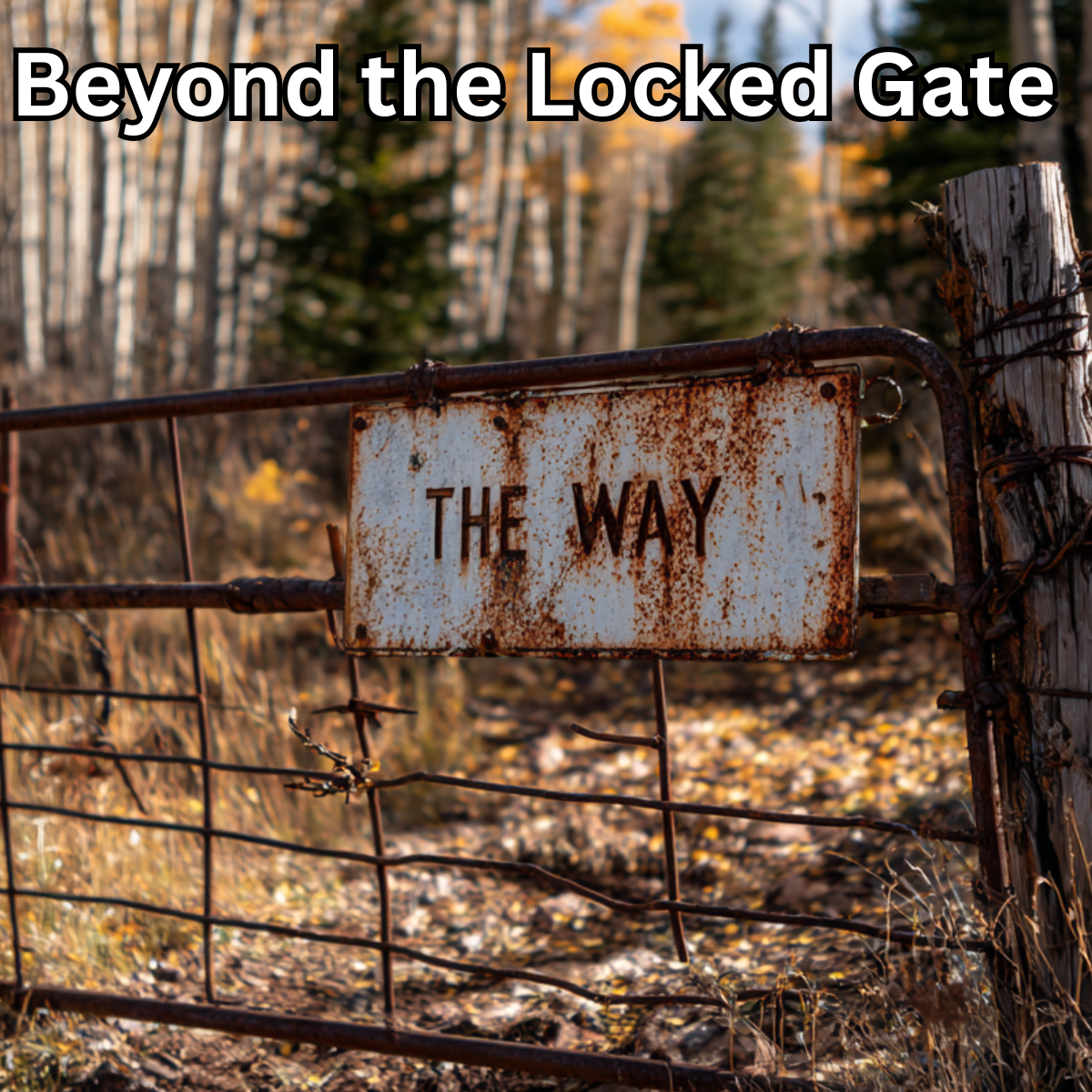
When I was a child growing up in western Colorado, I remember hiking in the mountains and coming across a compound tucked away at the end of a winding dirt road. It was quiet, nestled among the aspens, but what caught my attention was not the structure itself. It was the gate. Heavy, steel, and locked. Hanging on that gate was a weathered sign with a cryptic message: “The Way.”
I remember standing there for a long moment, staring at those words. “The Way.” Why would someone lock a gate to something called “The Way?” I asked myself. And then came the second, more important question: what exactly is the way?
Years later, I would learn about The Way International, a religious organization started by Victor Paul Wierwille. They believed they had discovered a path worth following, one they called “The Way,” and many of their followers lived in tight-knit, isolated communities. That gate in the Colorado mountains was not marking a road or a trail. It was marking their belief, their version of truth. They had the way, and the rest of us were on the outside.
That moment has stuck with me ever since. Sometimes when I hear someone say “I know the way,” or “you need to follow our way,” that image of the locked gate comes rushing back. It happened again today. A marketing agency reached out, promising that they knew the way to grow my product. They had the secret, the method, the system. But access was limited. Their way was locked behind months of waiting, high fees, and exclusive access. The metaphor could not have been clearer: once again, I was the boy outside the gate.
This experience got me thinking again about the elusive nature of “the way.” In the world of marketing, it is a phrase that gets thrown around with alarming frequency. Agencies, consultants, and platforms all claim to have found the secret route to success. Yet with each new trend or “best practice,” another one is quietly discarded. What worked brilliantly yesterday is ineffective today. What was once sacred is now obsolete. The landscape is shifting too fast for any one path to stay valid for long.
But here is the thing. While the methods constantly change, the principles do not.
I have come to understand this distinction: there is no permanent way, but there are enduring principles. These principles are not locked behind gates. They are not the property of a secret society. They are accessible to anyone willing to observe carefully, think critically, and act with integrity.
Consider P.T. Barnum. He lived in a time without digital advertising, without social media algorithms, yet he understood the most fundamental principle of all: attention is the currency of commerce. He did not need a specific method to get that attention. He used posters, parades, and spectacle. What mattered was the principle behind his actions: attention precedes persuasion.
Then there is Carroll Shelby. He did not build the Cobra by following the conventional way. He followed a different principle entirely: invention creates opportunity. He was not interested in what was being done. He was interested in what could be done. He used what he had, failed often, but kept building until something extraordinary emerged.
And David Ogilvy. His success did not come from cracking some secret advertising formula. He simply respected the intelligence of the consumer. He told the truth. He communicated clearly. His principle was not hidden behind a paywall or a marketing funnel. It was out in the open, obvious and yet too often ignored: honesty sells.
Each of these individuals found success not by following a fixed “way,” but by staying anchored to principles that transcended time and technology.
So what does this mean for us? For those of us trying to build, to create, to lead?
It means we must stop looking for the gate to someone else’s compound. There is no gate. There is no one path. Instead, there are truths that continue to work, regardless of the medium or moment. Truths about human nature, about how we make decisions, about what earns trust and what breaks it.
The danger is in thinking that the map is the territory. That someone’s diagram, someone’s funnel, someone’s ten-step system will work the same for us. But those are temporary. They expire. They become outdated before they’re even published. What does not expire are the principles underneath.
So when someone tells you they know the way, remember the locked gate. Remember that “the way” is always just another method. Another temporary fix. Look instead for the why. The what. The unchanging truths that still point us in the right direction when the map has faded and the terrain has shifted.
There is no way. There are only principles.
And those, we are all free to follow.
So true. Thanks for the reminder!
You are welcome!