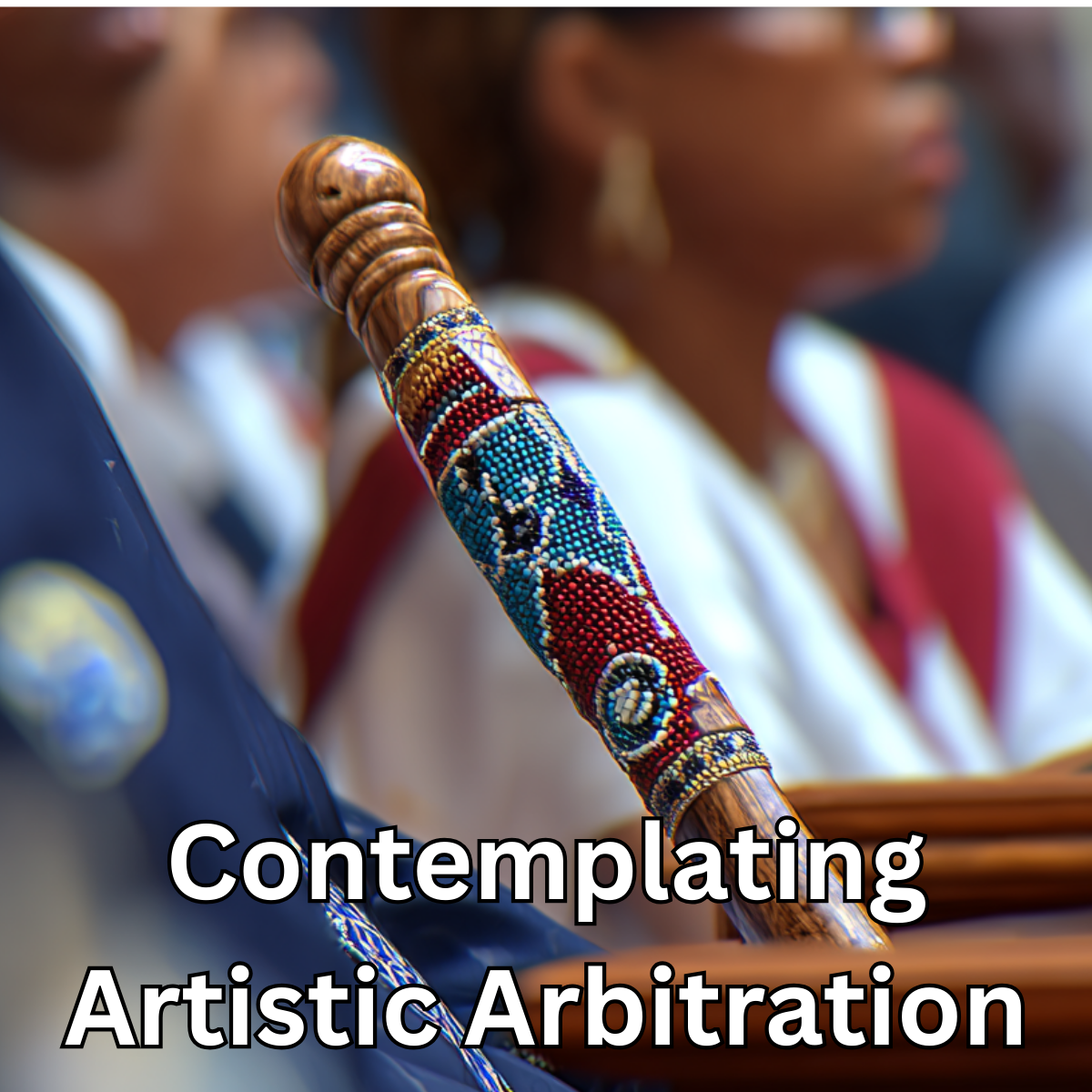
I went to a birthday party this weekend and participated in a ceremony in which people passed a rock around. As each person received the rock, they shared a few words of positive encouragement with the birthday girl. As the rules of the proceeding were explained to me, I commented that I certainly understood the basic concept of token passing as an arbitration method. The young hipsters in attendance looked at me as if I were insulting them, or trying to poke fun at their time honored method of celebration.
This caused me to reflect on the idea that the tradition of trying to get humans to be quiet long enough so that others can be heard has been going on for a very long time. I can imagine early indigenous traditions in the area where we were having this party, passing a talking stick, feather, shell, or some similar object from person to person in a council meeting for the same purpose. People have been trying to solve this basic problem of how groups of people share a common channel without talking over each other. It seems that using a ceremonial object for this purpose has been around since the beginning of time. “Hey, Adam, it is my turn to talk. Quit talking over me,” says Eve. Then she comes up with the idea that the only person who can talk is the person who is holding the ceremonial object, and thus the negotiation for the method of arbitration between humans began.
When I was a young man, I joined the open systems revolution. We were adherents to the Novell NetWare religion (we wore red, by the way), and we were bound and determined to take out the likes of IBM mainframes, ARCNET, and every other archaic leftover technology of the 70s and 80s. There was a principle that was followed in the good old days of computing that everything had to be guaranteed, secured, and reliable. This requires pristine communications between nodes on a transmission medium. Enter the early days of Ethernet where we did not care about silly things like reliability. So what if we had a few colliding signals. We could make up for it in speed. For a few short years there was a battle between collision avoidance systems and collision detection systems. The old network designs, like Token Ring, borrowed from this idea of waiting for the token before you could speak, whereas Ethernet would follow the tried and true method of listening quickly and, if you heard a gap in the communication, starting to talk before anything else did. I am oversimplifying here on purpose. I am not trying to teach shared media access arbitration methods; I am trying to emphasize the point that negotiating when we can talk is a human thing that exists in everything we do, even in our technology.
My point is that in any company, in any organization, in any situation where you need humans to interact with each other as a group, you are going to run into a need to provide fairness and order in their communication. There is always going to be a risk of collision or contention for the shared space; coming up with an arbitration method early in a culture is an absolute must. I am not arguing for the birthday stone, but this is a proven method that has lasted for millennia, so it is not a bad place to start: token passing.
Now, of course, if you want to get really crazy you can go with something like the 1876 Robert’s Rules of Order. Because people like Benjamin Franklin would not stop talking in meetings, formality was created around meetings of importance to make sure that rules were followed when someone, like a member of Congress, has the floor. In these rules the principle is the same as the birthday stone or the talking stick. Only one person can talk at a time. There is an agreed method to recognize that it is that person’s turn to talk and a way to get them to stop when you need to. In Congress, this is the Sergeant at Arms. That is rather drastic for a company situation, but there have been times when I wished I could have held a colleague in contempt.
This concept of arbitration, when you are with a group of humans, cannot be underestimated. Your Zoom call does not have a token passing feature (maybe it needs one). Arbitration, in the broad sense, is deciding who has the right to act, speak, or decide at a given moment. This is one of the quiet foundations of human progress because it allows groups to cooperate without collapsing into noise or conflict. This is needed in a group of any size so that you can prevent chaos, create fair participation, increase efficiency, and support the ideal that we are all striving for, which we call collective intelligence.
This is something I do naturally over time. When I come into a room full of people, my first inclination is to establish the rules of order quickly. I have learned that people will not tolerate this. They will resist any formality, so what I do is force it or will it into being. Effectively, I recognize that someone is speaking, and then I shut down any attempts to interrupt, collide with, or stop them from addressing the group when they have the floor. This can be uncomfortable and at times it puts me in the authoritarian role, but I will tell you this with confidence. Some of the greatest and most monumental ideas that have transformed the companies that I have worked with have come as a result of letting people be heard.
I will let that concept speak for itself. If you want people to be heard, and you feel that is important, then you are going to have to be creative, perhaps even artistic, in coming up with ways to pass the token.