You might remember watching the short movie called Monty Python and the Holy Grail. This could go down as one of the lowest budget cult classics ever made, stacked right up there with Napoleon Dynamite. The rumor is that Terry Gilliam got Led Zeppelin, Pink Floyd, and Jethro Tull to help finance the film, and that tidbit alone elevates the movie into the stratosphere of cool. Anyway, near the end there is a scene where we lose poor Sir Robin and Sir Galahad. The band approaches a place where they have to answer five questions, no, three questions, at the Bridge of Death. The first person to cross is brave Sir Lancelot, who marches right up to the bridge and with no fear dares to answer the three questions. They are easy questions, and he passes through with no harm.
The fun continues, with the loss of two of the band, and the moment where the question about unladen swallows saves King Arthur. This story of a wizened old figure asking questions before a bridge is rooted in ancient Gaelic legend. When the Celtic band of Scots came over from Ireland and settled in the Highlands, they brought folklore with them; one tale was of Scathach and the Bridge of Leaps. The legend says that on the Isle of Skye there lived an ancient teacher named Scáthach, who dwelled in the shadows. She trained heroes at her fortress, Dún Scáith, in secret martial arts that would serve them in many adventures. The first challenge was to cross the bridge that allowed travelers to reach her island fortress.
This first test had serious consequences. There was the risk of injury or death, and there was the risk of rejection from her training, because without crossing they could not participate. The legend has many instances of would be warriors attempting and failing to reach the isle. In one story a young man is given three attempts. On his first attempt he spends considerable time to measure, evaluate, and predict the best conditions to brave the crossing. Each time he tries, he fails again, and the bridge flips him upside down to drop him into the water and rocks below. Bruised and battered, he demands to know from Scáthach why the bridge is rejecting him. She replies, It is not rejecting you; it is only revealing that you are divided.
The young warrior learns the secret. You cannot approach the bridge with trepidation and caution; you must take a leap. The leap cannot be halfhearted; it must be a great leaping bound, and with that you can cross the bridge and reach the other side. This is the story of the hero Cú Chulainn, and the great leap he takes to overcome this obstacle becomes known as the Salmon Leap. When you decide to take a leap, make it count. Do not hesitate. Do so with all that you have, for no reward waits for those who take half a leap.
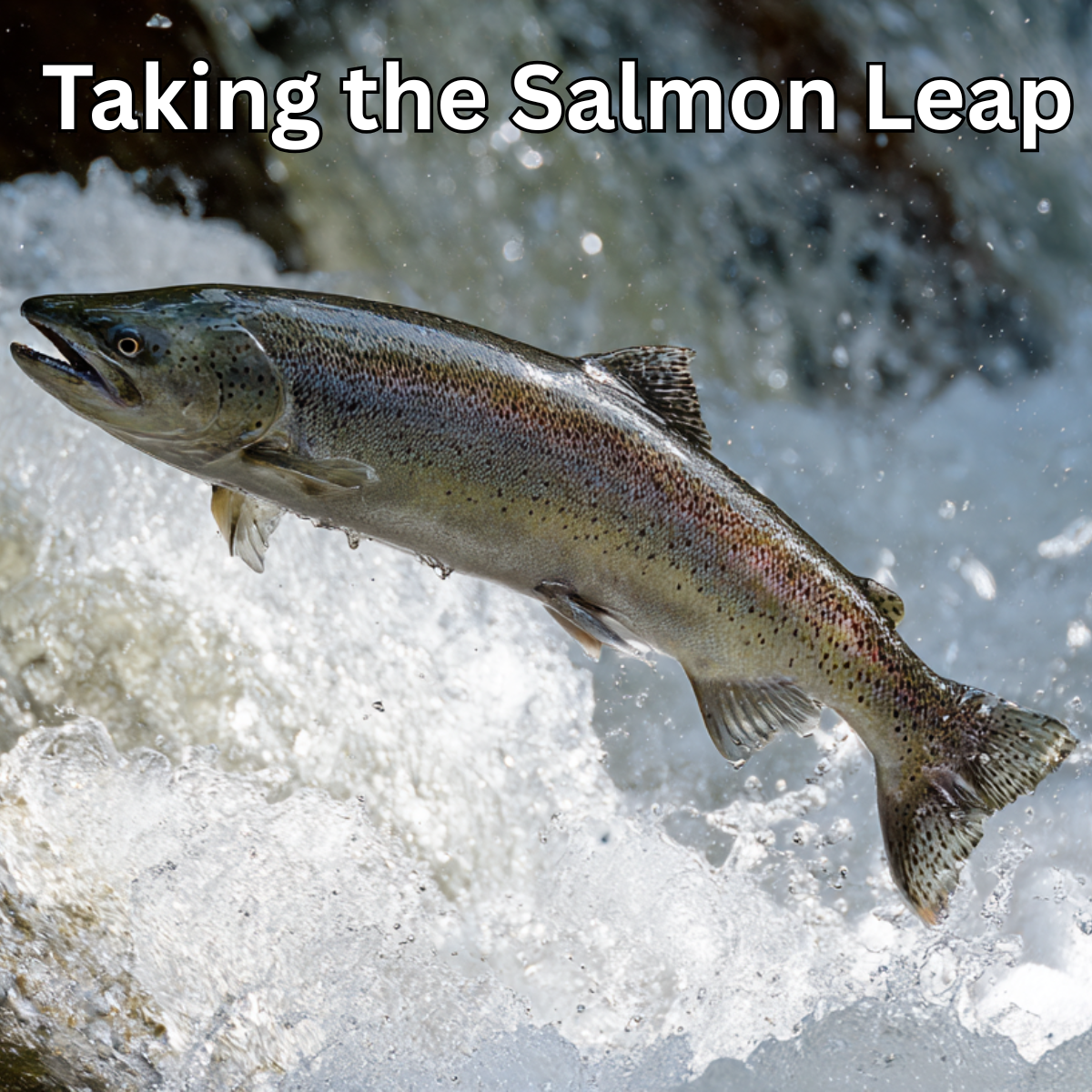
So we have a lesson worth remembering. If you want to go to the next great quest, or receive the next boon bestowed by your gods, then you must be willing to take a great leap of faith. In the Celtic and Irish tradition this is often called the Salmon Leap. The name fits, because when the salmon jumps against a waterfall or an obstacle in the stream, it propels itself forward in a high arc, curling its body and coming down on the other side of the natural barrier. This is the leap the warrior must mimic in both form and in mentality to train with Scáthach.
It is no accident that the salmon is a symbol tied to wisdom. This act stands for more than a daring physical stunt; it stands for courage, cleverness, and the power to rise where others choose to fall back.