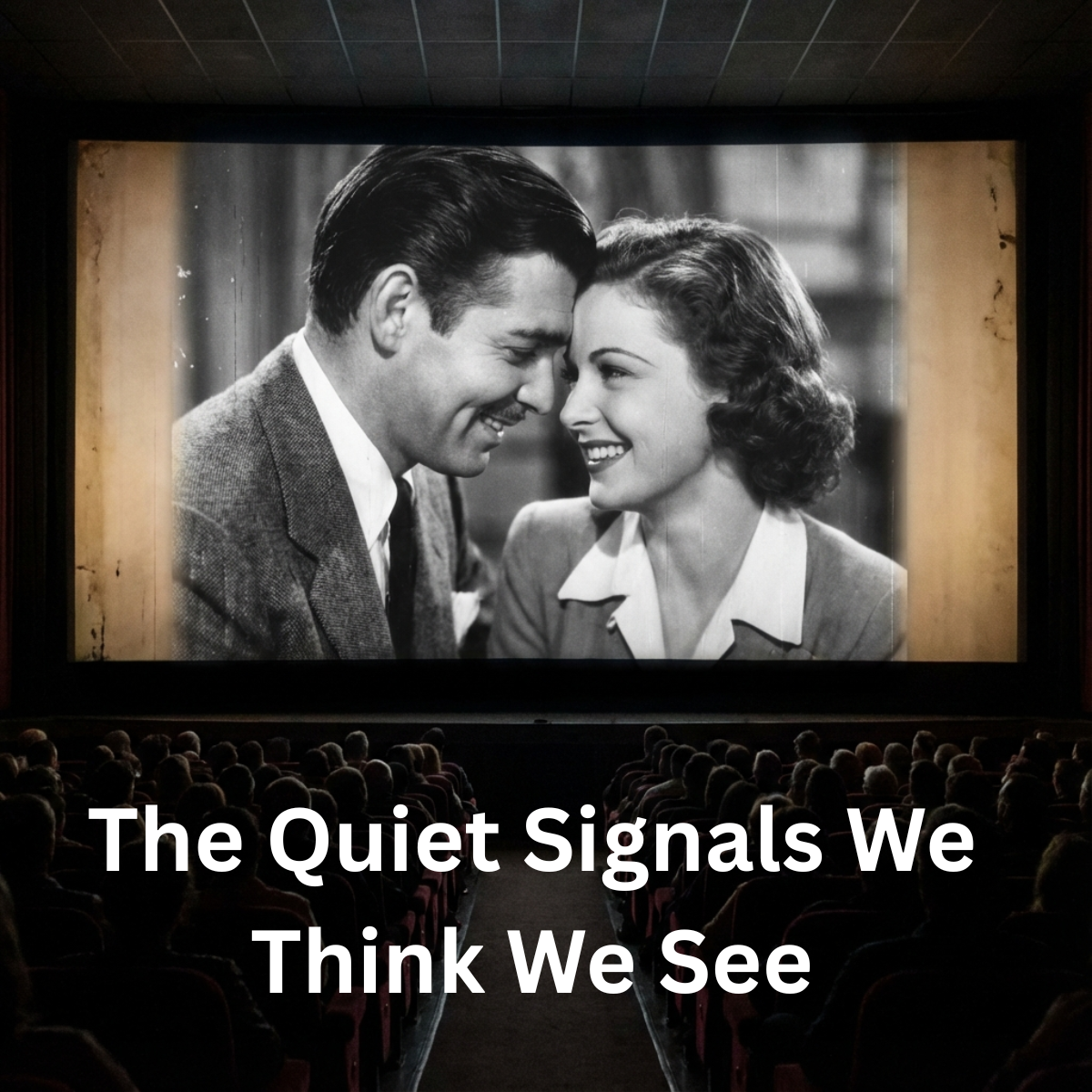
Last night while watching a show, my wife mentioned how the actor and actress on screen had a certain chemistry. It looked like they were truly attracted to each other, even though they were only performing a scene. That simple comment sparked a long conversation. Were we witnessing pure acting or was there something real between them that made the scene believable. And if we as viewers thought there was chemistry, what exactly were the clues that made us reach that conclusion.
It is fascinating how quickly the mind builds a story. A glance held one second too long, a subtle smile, the way two people shift their bodies toward each other. None of these things confirm anything. Yet our brains connect them into a narrative and label it chemistry.
This is where Kenneth Burke’s work adds depth to the moment. Burke wrote extensively about identification, the idea that humans naturally sort, classify, and judge others as a form of survival. In the earliest days of humanity, making fast judgments kept us safe. We learned to read expressions, postures, tones, and movements before we even understood language. That instinct never left us. According to research often referenced in rhetorical studies, we process tens of thousands of inputs at once when evaluating other people. Our minds are constantly scanning for patterns, confirming or rejecting assumptions, and placing people into categories without conscious effort.
This means that when we say two actors have chemistry, we are drawing from a massive set of clues that our brains interpret instantly. But it also means we can be wrong. What we perceive as natural chemistry might be skilled acting. What we read as tension might be misread body language. What we assume to be a connection might be nothing more than well-timed editing. We see what our minds are prepared to see.
And this is where the idea becomes much more important than a conversation about actors.
If human beings automatically put others into categories, then we need to be careful about how quickly we do so in real life. Especially when we are building a team. It is easy to decide that one person is the analytical one, another is the creative one, and another is the quiet one. Those categories feel helpful at first. They give our brains shortcuts so we can navigate relationships more easily. But they can also blind us.
If you are always trying to fit someone into your pre-defined buckets, you might miss the full range of who they really are. You might overlook a strength that does not fit your initial impression. You might ignore potential because your brain already decided who that person is. And in doing so, you could be holding your business back.
Chemistry on screen reminds us how quickly and confidently we form judgments, even with very limited information. It is a mirror for how we operate everywhere else. The challenge and the opportunity is to slow down, suspend the instinct to categorize, and give people room to reveal the parts of themselves that do not show up in first impressions.
When we do this, we build stronger teams, create more trust, and unlock talent that might otherwise go unnoticed. And we learn to see others not as categories, but as whole people, far richer and more capable than our instincts first suggest.