We take the human brain for granted. We walk through our days making thousands of decisions, reading countless social cues, and navigating complex situations without pausing to marvel at the computational miracle happening between our ears. One thing we rarely stop to consider is how extraordinarily good the brain is at determining intent, both our own and others’. We make intent judgments almost instantaneously, often before conscious thought catches up. Over the past several months, as I have been building an AI engine, I have wrestled constantly with this concept of intent. The struggle has forced me to reflect on all the scenarios in life in which I evaluate intent, sometimes correctly, sometimes not. I have begun to wonder where my instinct about intent might be flawed, where it might be highly accurate, where I should trust my first impression, and where I should pause and reconsider.
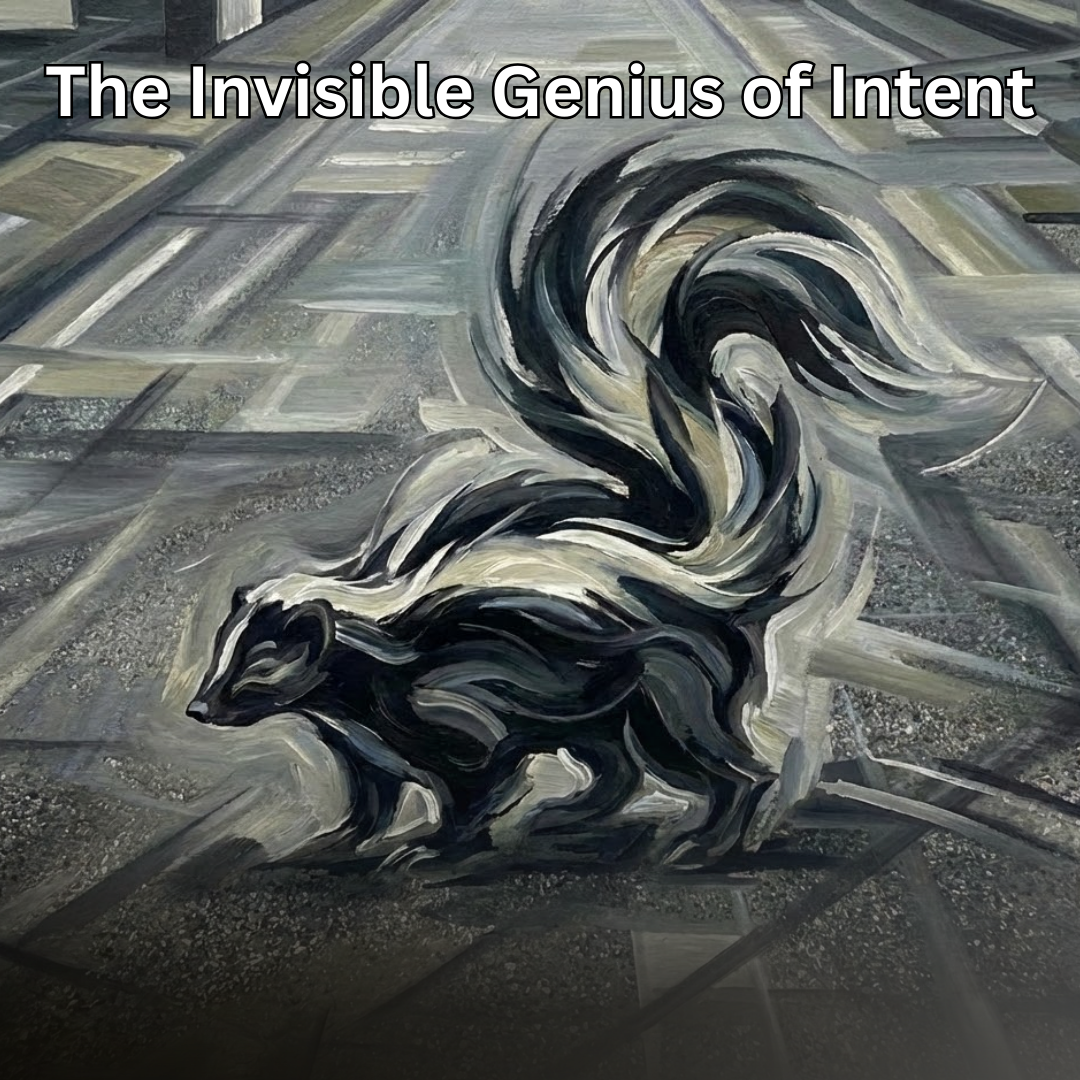
This idea of intent classification came to life for me this morning during an early run. My head was in the clouds, turning over work problems, thinking through design challenges, and system architecture. My conscious brain was not focused on running at all. Yet my body kept moving, my cadence steady, my pace consistent, my eyes scanning the path ahead without deliberate instruction. Then, as I rounded a corner, there was a skunk. My conscious mind did not have time to process the threat. I did not think, “That is a skunk. Skunks spray. I should move.” Instead, my brain predicted what I wanted to do, and I immediately leapt out of the way. I must have jumped higher than an NBA player’s vertical as I flew clear of harm. The whole thing happened in a fraction of a second. In that experience, I learned two things about how the human brain classifies intent. First, it understands what you want even when you are not actively thinking about it. Second, it can interrupt what you are doing for something critical, something that demands immediate attention for safety or survival.
The challenge with building AI systems is that for every issue you uncover, you have to create an intermediate step to resolve it before allowing the system to continue. This creates latency in the interaction. The human brain is enviable in its ability to resolve things like intent at an incredibly rapid rate. The body automatically activates specialized mechanisms to increase the system’s responsiveness once intent is perceived. Yes, that skunk was about to spray me. Yes, I would not want that to happen. Yes, jumping high and to the right is the best option because there is no traffic on the road right now. All of that happened without a single conscious thought, without a single line of code being executed in sequence. The brain did not wait for permission. It acted.
In thinking through human subsystems, I have come to realize that intent is not all handled at once. There are layers of intent classification, and this is a great lesson to borrow as we try to design similar methods without introducing excessive latency. A route-everything-through-one-process way of thinking is not the best approach, because our own brains do not do this through a single system either. The lesson is that intent classification is a multi-layered problem and is most likely being continuously monitored. There is a background process that runs continuously, scanning for threats, opportunities, and changes in context. Then there are higher-level processes that evaluate more complex social and strategic intent. The brain does not wait for one layer to finish before starting the next. It runs them in parallel, with each layer feeding information to the others and ready to escalate or interrupt when necessary.
Then, of course, the human brain has ways of elevating or changing the response and determining the best course of action, including interrupting the current process and adding additional resources to make an emergency request more important. This demonstrates how far behind God computer scientists really are in developing intelligent systems. There are so many nuances in dealing with intent that the human body has built an entire ecosystem to address this issue. This emphasizes to me that figuring out intent and then responding appropriately is not a quick fix. It is a continuing, evolving issue to grapple with. We are not going to solve it with a single algorithm or a clever trick. We are going to have to build systems that learn, adapt, and operate in layers, just like the brain does.
What strikes me most is how effortless this all feels. I did not train myself to jump away from skunks. I did not rehearse the movement. I did not consciously decide to prioritize my safety over my train of thought. My brain just knew. It knew what I wanted, even when I was not thinking about it. It knew what mattered more, even when I was distracted. It knew how to act, even when I had no time to think. This is the kind of intelligence we are trying to build, and it is humbling to realize how far we have to go.
The more I work on AI, the more I appreciate the human brain. Not just for what it can do, but for how it does it. The speed. The efficiency. The elegance. The way it handles ambiguity and uncertainty without breaking down. The way it balances competing priorities without needing explicit instructions. The way it learns from a single experience and generalizes that learning to new situations. The way it operates in the background, always watching, always ready, always protecting us from dangers we do not even see coming.
I think about that skunk now, and I smile. Not because I avoided getting sprayed, though I am grateful for that. I smile because that moment reminded me of something important. The brain is not just a processor. It is a guardian. It is a partner. It is a system that cares about what we want, even when we are not paying attention. It is a system that knows us better than we know ourselves. And if we are going to build machines that can truly understand and serve us, we need to learn from that. We need to build systems that do not just execute commands, but that understand intent. Systems that do not just wait for instructions, but that anticipate needs. Systems that do not just follow rules, but that know when to break them.
That is the challenge. That is the goal. And that is why, even after a morning run interrupted by a skunk, I am more excited than ever to keep working on this problem. Because if we can get even a fraction of the way there, we will have built something remarkable. Something that does not just compute, but that understands. Something that does not just respond, but that cares. Something that does not just follow, but that leads. And that is worth the effort. That is worth the struggle. That is worth every early morning run, every late night at the keyboard, every moment spent trying to teach a machine what the human brain does without even trying.