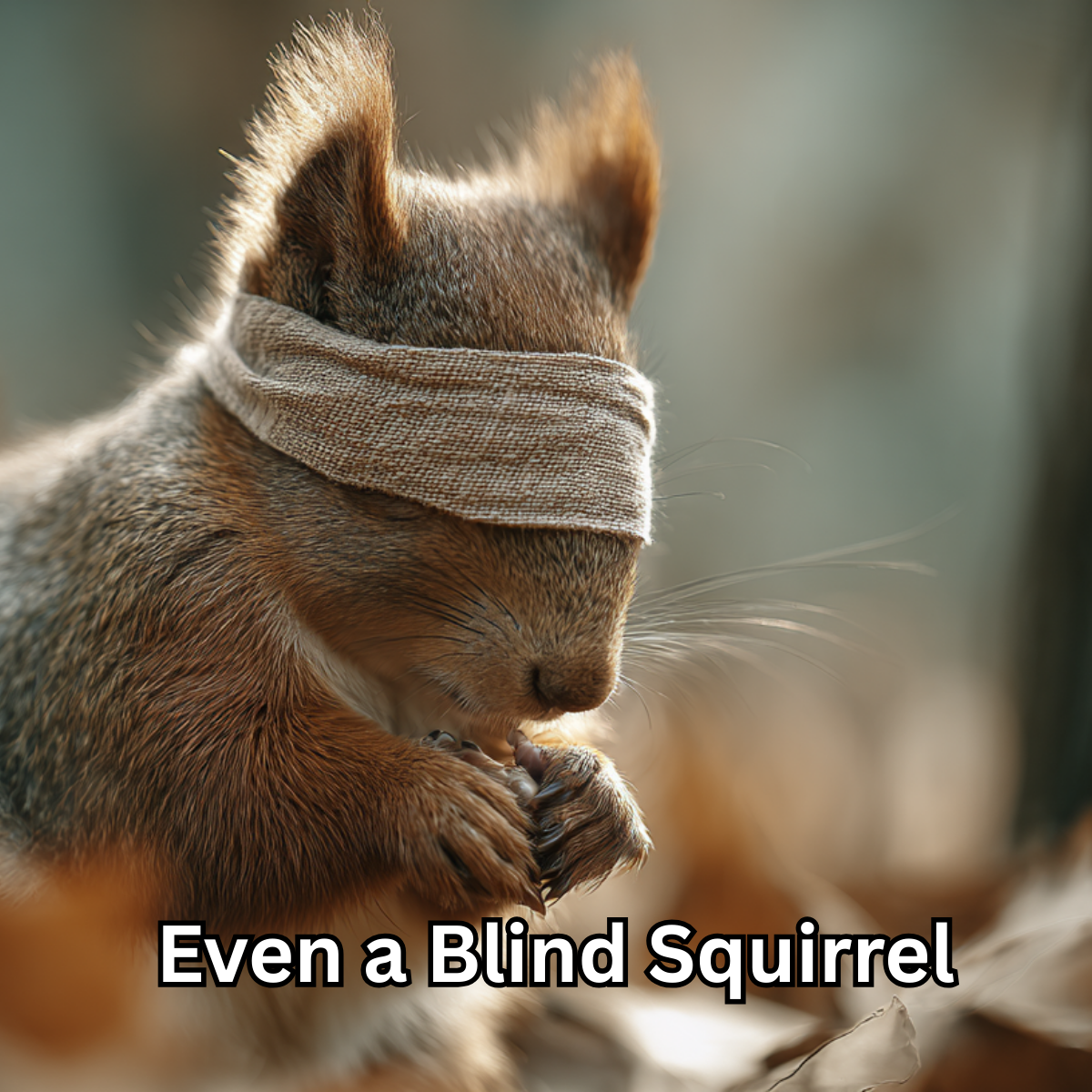
Day 133 – Even a Blind Squirrel

When I was a child in midwestern Colorado, people used figures of speech to make light of someone or to clarify a point. Whenever I did something right, they might tell me, “Even a blind squirrel can find an acorn in the forest now and then.” I realized today that they probably never actually crawled around on the forest floor before.

If you have ever sat down on the forest floor around trees that have acorns in them, you will notice that finding an acorn is not that hard at all.

In fact, a blind squirrel might not have that much trouble. That is, unless all the other squirrels beat him to it.

This got me thinking about my predicament right now. Everyone says that my target ideal customer is hard to find and that there is a lot of competition. They say that the one or two I found were just lucky. A blind squirrel could do that. But the reality is that these people are blind to themselves: ideal customers are actually everywhere.

Getting the ideal customer is not that hard at all. In fact, so far, the experience has been just like that forest floor. Acorns everywhere. The reality is that a blind squirrel would thrive in a forest full of acorns.

I have been listening to the wrong voices. The people telling me it is hard have not looked closely at what is actually there. They are repeating what they have heard, not what they have seen. They are speaking from fear, not from experience.

“The reality is that a blind squirrel would thrive in a forest full of acorns.”

So I think I will just ignore these blind men and keep harvesting as much as I can. The work is not to find the acorns. The work is to stop listening to people who say they are not there.

Subscribe
Notify of
guest
2 Comments
Oldest
Newest Most Voted
Inline Feedbacks
View all comments
Betty Radley
Betty Radley
6 months ago

So true! Thanks for encouragement!

Share the Post:

Recent Blogs

Day 318 – Quiet the Inner Monologue

Researchers discovered that temporarily shutting down the prefrontal cortex in mice allowed them to adopt better, unlearned paths in a maze. This suggests that our active brain can sometimes hinder us from adopting new and improved methods, favoring learned ones instead. The findings imply that quieting our inner monologue might help us find better solutions.

Read More

Day 317 – Work is a Human Problem

Studs Terkel’s 1974 book ‘Working’ explored what people truly seek in their jobs beyond financial compensation, revealing a human desire for meaning, dignity, and recognition. This perspective is increasingly relevant today with the rise of AI and automation, prompting us to reconsider the inherent value of human work.

Read More

Day 316 – Name the Feeling

Many people struggle to identify specific emotions, often lumping them into a general ‘not feeling good’ category. This article highlights research suggesting that developing ’emotional granularity’—the ability to precisely name feelings—is a learnable skill that can lead to better emotional management and personal growth.

Read More

Day 315 – High Peaks and Happy Endings

This article explores how our memory of experiences is not always accurate, drawing on research by Barbara Fredrickson and Daniel Kahneman. It highlights that people tend to remember peak moments and happy endings more vividly than the duration of discomfort, influencing their overall perception of an event.

Read More
2
0
Would love your thoughts, please comment.x
()
x