I was sitting in a meeting last week when someone called me an expert. I shifted in my chair, uncomfortable with the label. Expert feels too grand, too final. But I couldn’t deny what they were seeing. I am good at a few things. Not many, but a few. And when I do them, they flow. People notice. They assume talent.
They’re wrong.
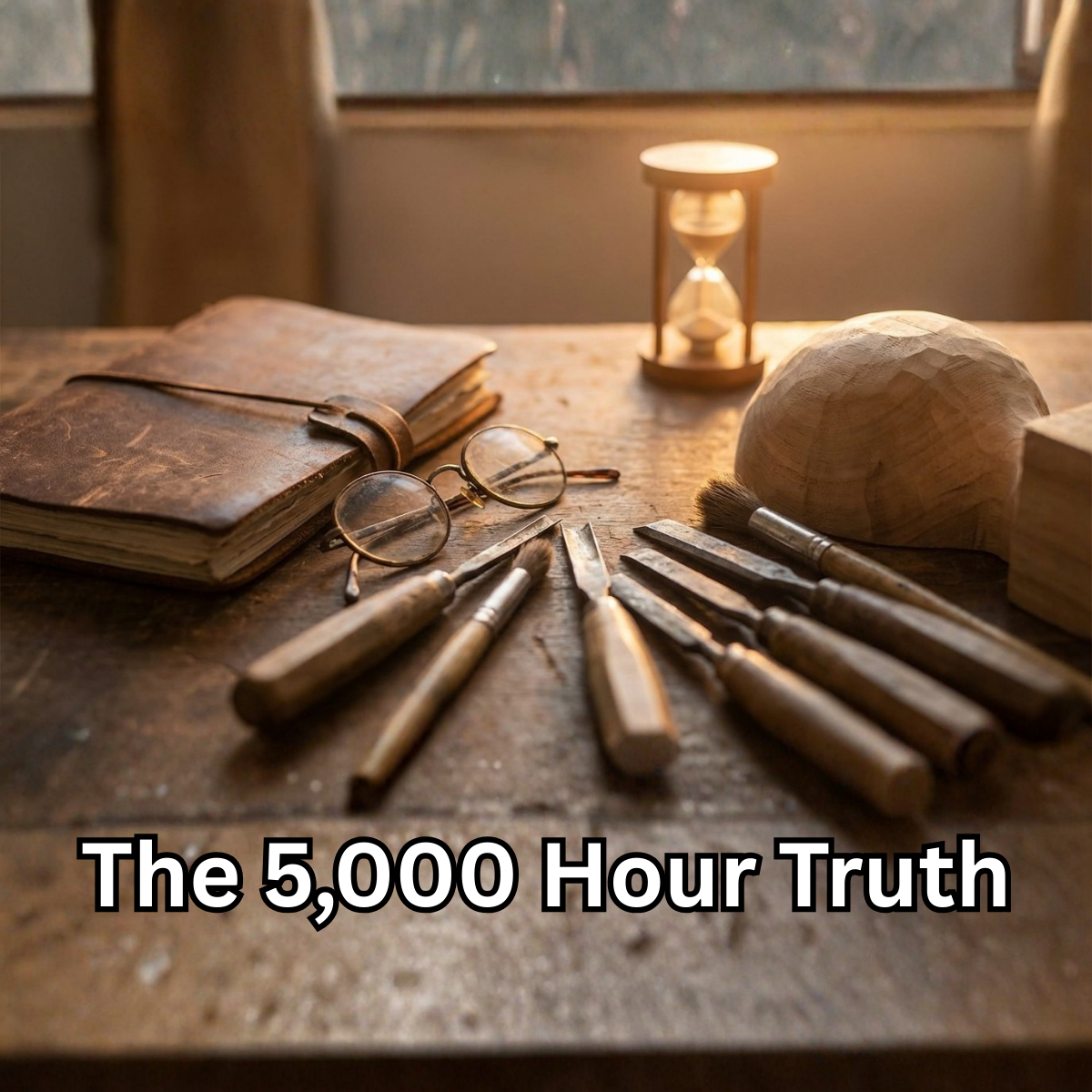
Here’s what I’ve realized about everything I’m genuinely good at: they all share one non-negotiable ingredient. Every single one required at least 5,000 hours of showing up, failing, adjusting, and doing it again. Five thousand hours of repetition, trial, and experience. That’s the threshold where competence stops being a hope and becomes a reality.
Let me put that number in perspective. If you worked a full-time job learning a new skill, eight hours a day, five days a week, you’d rack up 2,080 hours in a year. Not even halfway there. If you somehow spent every waking hour on that skill, sixteen hours a day, seven days a week for an entire year, you’d hit 5,824 hours. You’d also probably need therapy, but you’d cross the threshold.
Most people can’t do that. Most people have jobs, families, obligations. If someone is truly dedicated, they might carve out two hours a day, five days a week. That’s 520 hours a year. At that pace, it takes ten years to reach competency. Ten years. And most people quit long before that because they don’t see results fast enough. They look at someone who’s good and think that person was born with something they weren’t.
This is the lie we tell ourselves about talent.
Take Britney Spears. She’s my favorite example because people love to point to her as proof of natural star power. At sixteen, she exploded onto the pop scene, and everyone marveled at this teenage phenomenon.
What they didn’t see was the decade and a half that came before. Britney had been performing since she was two years old. Dance classes, singing lessons, talent shows, auditions. Conservatively, she was logging at least ten hours a week. By the time she was sixteen, she had over 7,000 hours of stage time under her belt. She wasn’t a miracle. She was prepared. She had more performance experience than most people in the entertainment industry accumulate in their entire careers. We saw a teenage girl. She brought the résumé of a veteran.
Or consider Magnus Carlsen, the Norwegian chess grandmaster who has held the highest rating in the history of the game. People look at him and see genius. They see something otherworldly. But Magnus started playing chess obsessively as a child. He practiced, studied, and competed every single day. By the time he was fourteen, he had likely accumulated over 20,000 hours at the board. Twenty thousand hours. That’s not genius. That’s devotion. That’s time converted into mastery.
Could you take any child and turn them into a grandmaster with 20,000 hours of chess? I believe you could. Magnus had an aptitude for pattern recognition, sure. But so do most humans. What he had that others didn’t was access, encouragement, and an environment that allowed him to spend those hours. The skill didn’t make the hours possible. The hours made the skill inevitable.
This is what people misunderstand about being good at something. They think it’s a gift. They think some people are chosen and others aren’t. But the truth is simpler and harder. You only get good with time. That’s it. That’s the main ingredient. Everything else is just condiments and window dressing.
Talent might give you a slight head start. A good teacher might help you avoid some dead ends. But neither of those things matter if you don’t put in the hours. Time is the currency. Repetition is the transaction. There’s no shortcut, no hack, no secret method that lets you skip the work.
If you’re overwhelmed today, remember this: the person who helps you carry it, solve it, or transform it may already be on their way into your life. So stay open. Keep walking. Keep showing up. Your story still has introductions left. But also remember this: the skills you need to build, the competence you’re chasing, the version of yourself you want to become—none of that arrives by accident. It arrives through accumulation. Hour by hour. Day by day. Year by year.
So if there’s something you want to be good at, stop waiting for the moment you feel ready. Stop looking for the sign that you’re naturally suited for it. Just start. Show up. Log the hours. Because five thousand hours from now, someone will look at you and call you talented. And you’ll know the truth. You weren’t chosen. You just didn’t quit.