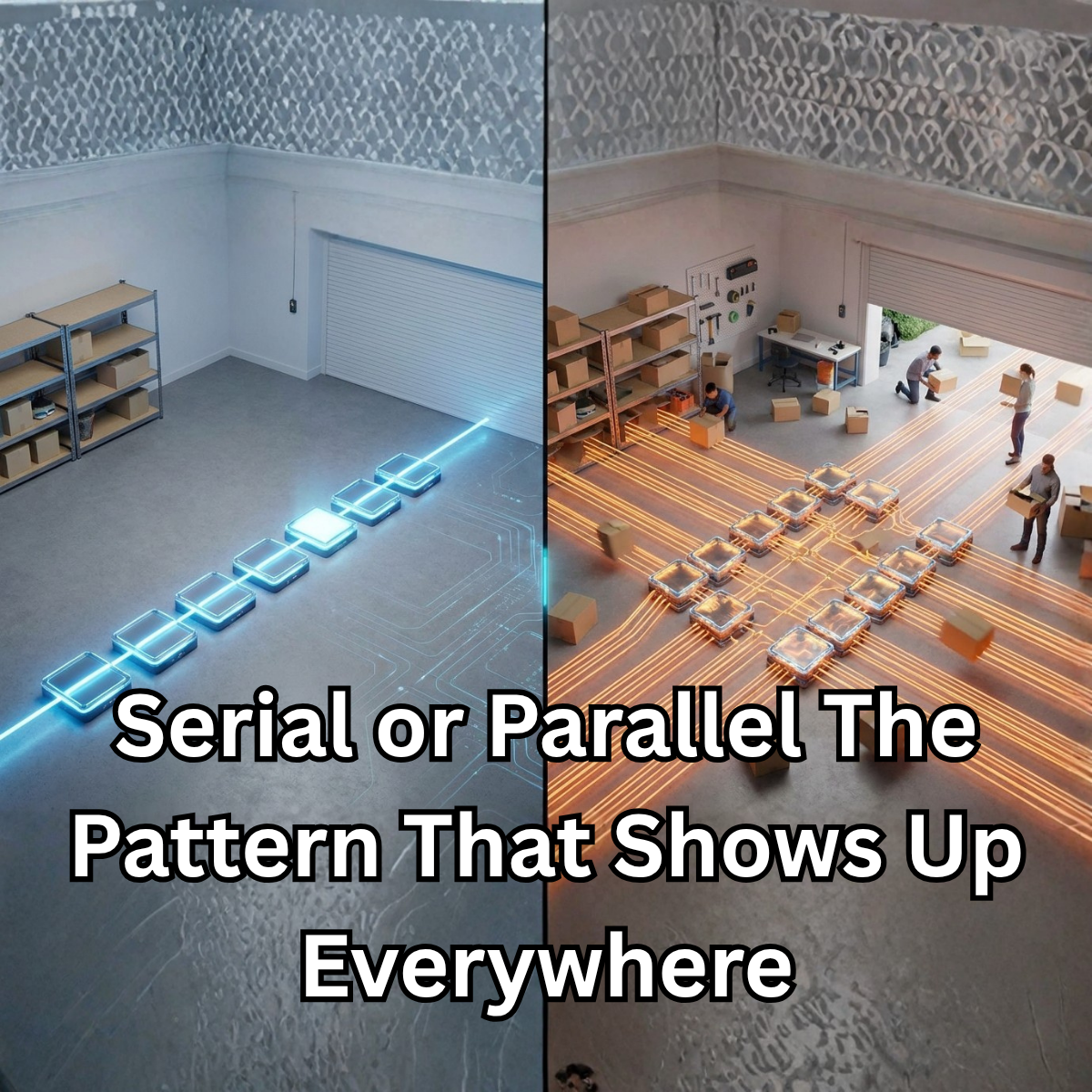
I was cleaning out my garage last weekend, and I noticed something. I had two choices. I could finish one corner completely before moving to the next, or I could sort all the boxes at once, then sweep everything, then organize the shelves. Same garage, same mess, completely different approaches. That choice shows up everywhere. In engineering projects, in sales pipelines, in how I manage my team, even in how I write code. It’s the difference between serial and parallel work, and understanding it changes how you get things done.
Serial work means you do one thing, finish it, then move to the next. It’s linear. It’s ordered. Each step depends on the one before it. You stay focused on a single thread until it’s complete. Parallel work means you do multiple things at the same time. The work is distributed across different tracks. The pieces are independent or loosely connected. When it works, you get faster throughput. When it doesn’t, you get chaos.
Serial work maximizes clarity and quality. You see the whole picture because you’re living inside one problem at a time. Parallel work maximizes speed and throughput. You’re covering more ground, but you’re also juggling more variables. Both approaches break down in predictable ways.
When you go parallel, you pay for it in coordination. Someone has to keep track of all the moving parts. Communication breaks down because people are working in different contexts. Quality becomes inconsistent because there’s no single thread of attention holding it together. Management gets harder because you’re trying to see around corners you’re not standing near.
When you go serial, you pay for it in speed. Throughput slows because only one thing moves at a time. Bottlenecks form because everything waits in line. Resources sit idle because they can’t all work on the same task. You might have three people ready to help, but only one person can paint that wall right now.
Here’s what matters. Your brain is fundamentally serial when you’re doing deep work. You can’t think two hard thoughts at the same time. You can’t scale serial work easily, but you can scale parallel systems. That’s the tension. The work that requires your best thinking has to happen one idea at a time. The work that requires execution can often happen in many places at once.
“If your bottleneck is thinking, go serial. If your bottleneck is waiting, go parallel.”
I’ve learned to ask myself one question before I start anything now. Where is the bottleneck? If the constraint is my ability to think clearly, to solve the problem, to make the right call, then I go serial. I protect that focus. I finish the thought before I start the next one. If the constraint is time, if I’m waiting on other people or processes or information, then I go parallel. I set up the work so multiple things can move without me being the center of every decision.
Great operators don’t just work harder. They architect when work flows in sequence and when it flows in parallel. They know which mode serves the problem in front of them. Next time you start something, pause. Ask yourself if you’re bottlenecked on thinking or waiting. Then choose your path and commit to it. That small decision will shape everything that follows.