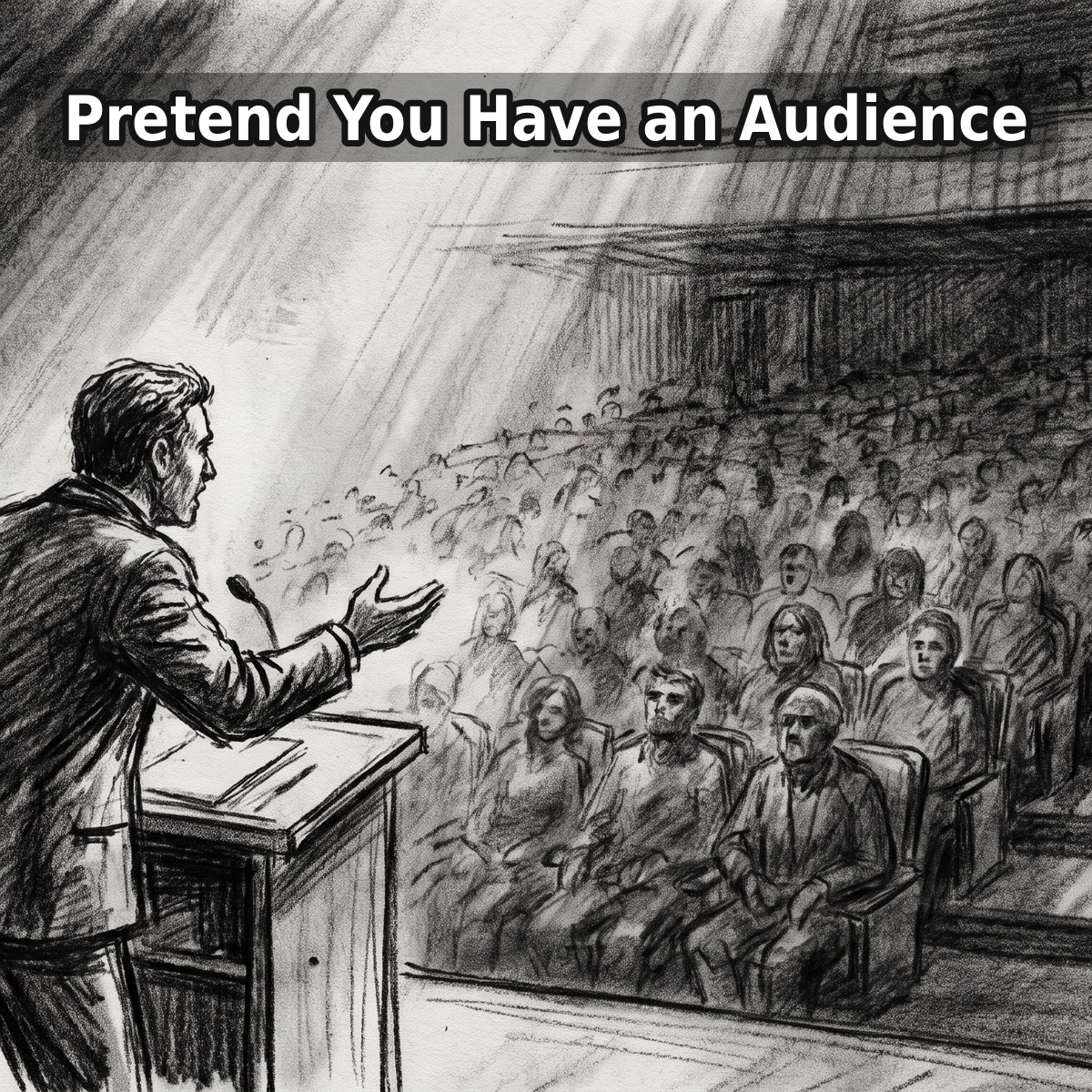
I have a little gimmick that I have used for years when I am trying to learn something difficult. I pretend I have an audience, and I act like I am presenting the idea to them. It sounds slightly ridiculous in the moment, but it has helped me understand hard things better than a lot of more serious study methods.
The reason is simple. When I imagine that I need to explain something to a wide audience, I cannot hide inside vague language or private shorthand. I have to say it clearly. I have to make it make sense.
Clarity is a test
A lot of difficult material can feel understood when it is still sitting in your head as fragments. You recognize the terms. You follow part of the logic. You feel like you are close. But the moment you try to explain it out loud in a way that ordinary people could follow, the gaps become obvious.
That is what makes this useful.
When I pretend I am presenting to a room full of people, I am forced to distill the idea down to its shape. What is the actual point? What matters? What can be removed without losing the meaning? That process does not just help me communicate better. It helps me think better.
Complexity can feel impressive. Clarity is what proves understanding.
"If I can explain it simply to an imaginary audience, I probably understand it."
That is why this has stayed with me for so long. It turns learning into a kind of honesty test. If I keep stumbling, I probably do not know the material as well as I thought. If I need to keep adding extra explanation just to hold the idea together, the idea is still loose in my own mind.
An audience, even an imaginary one, forces specificity
There is something different about thinking silently versus presenting. Silent thinking lets you skip steps. Presenting does not.
The moment I picture an audience in front of me, I start noticing where I am being fuzzy. I notice where I am leaning on words that sound right instead of ideas that are right. I notice when I understand one part of a concept but not the part that connects it to the next part.
That is useful because difficult things often stay difficult when they remain abstract. Once you have to explain them in simple terms, you have to become specific. You have to choose the point. You have to build the bridge from one sentence to the next. You have to make the whole thing stand up on its own.
That pressure is good pressure.
It keeps me from overcomplicating the subject. It keeps me from overcomplicating my own thinking. In that sense, this little study habit is not really a gimmick at all. It is a way of stripping a hard idea down to the parts that actually matter.
The point is not performance
I am not doing this because I expect to give a real talk. I am doing it because the act of preparing to explain something changes the way I learn it.
It gives the study process a job.
Instead of just rereading or reviewing, I am working toward a specific outcome: being able to say the thing clearly enough that another person could grasp it. That changes the method. It gives the whole exercise a direction. I am not just trying to recognize the material when I see it again. I am trying to hold it well enough to carry it from my own mind into someone else’s.
That is a higher bar. It is also a better one.
So if you are stuck on something hard, try this. Picture a room. Picture people waiting for you to make sense of the idea. Then start talking, even if it is only to the wall in front of you.
You may feel a little foolish at first. I still do sometimes. But that is usually where the useful part begins.
The next time you are alone with a difficult concept, do not just study it. Stand up and present it.