Day 291 – God is Not a Slot Machine

This article explores the transactional nature many people adopt in their relationship with God, comparing it to a child's bargaining with parents. It suggests that a more effective approach involves humility, fulfilling responsibilities, and trusting in divine provision, much like a child learns to trust their parents.

I was recently thinking about the old animated film Cinderella. In that story, Cinderella meets her fairy godmother, who grants wishes with a wave of her magic wand. That image seems to stick with us, because many of us approach our relationship with God in a similar way—maybe even worse. We begin to think, If I do this, then I will get that. God becomes transactional, a kind of barter-and-exchange system.

I am afraid that is not how it works, at least not in my experience.

In fact, when my own children come to me with that same mindset, my reaction is usually indifference, or at most tolerance. “Dad, if I clean up the dog poop today, can you take me to the store so I can get those new clothes I want?” My reaction is probably what you would expect: How about you do what you are supposed to do, and then we will see.

So if you truly believe there is a powerful, supreme being with father-like qualities, then perhaps it makes sense to apply some of the lessons from childhood to that relationship. In many ways, it seems to work similarly.

Whining never got me very far with my parents.

Complaining did not accomplish much either.

Trying to bargain with them over what they already provided for me was silly.

Offering to do my basic responsibilities in exchange for some extra favor was, to say the least, arrogant.

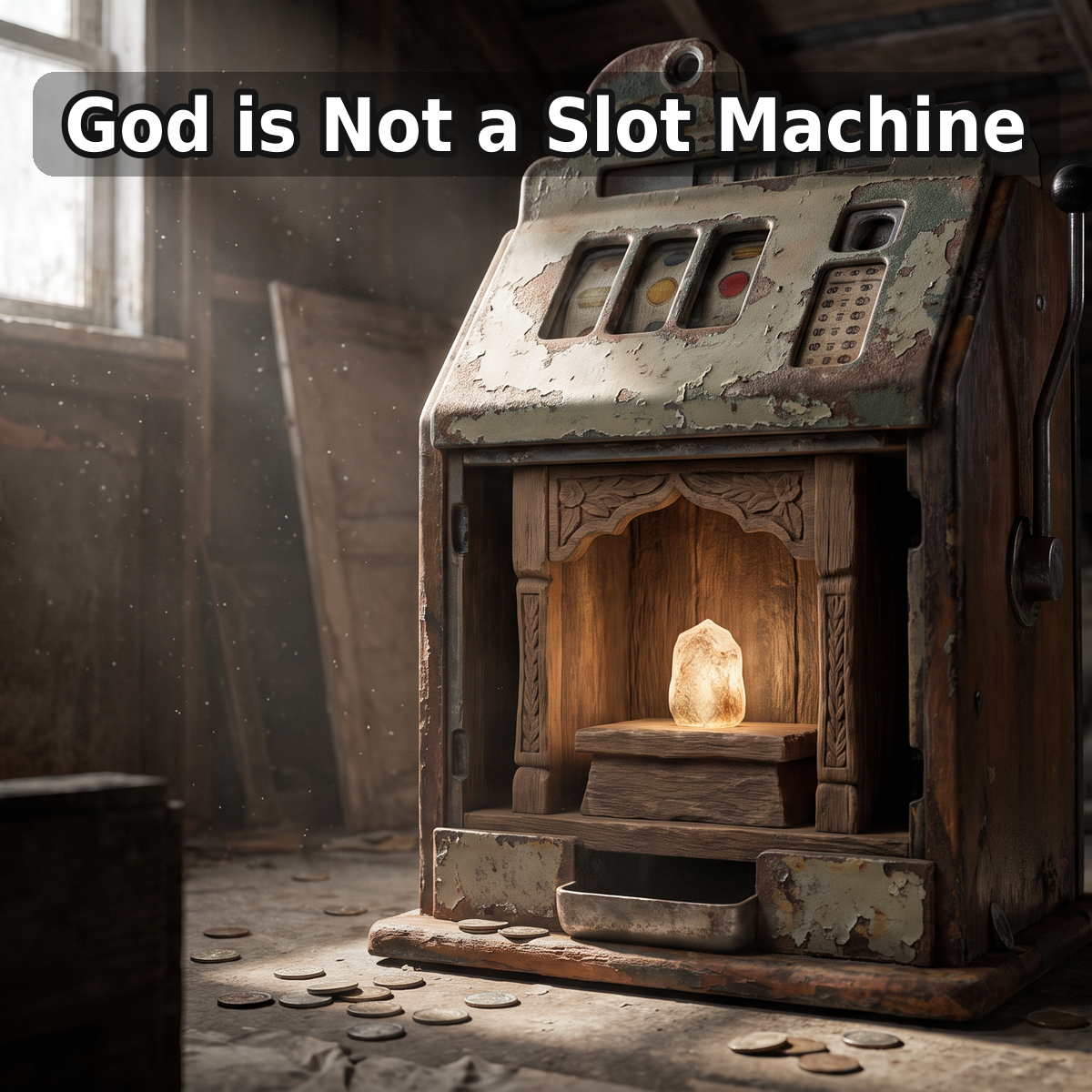
Treating my parents like an ATM—or worse, a slot machine—was certainly not the recipe for getting what I wanted.

What I learned, as most children eventually do, is that if you keep your mouth shut, do what you are supposed to do, do not expect too much, and follow what your parents tell you, they usually come through for you. Mine always did.

Maybe I was lucky to have the parents I did. And assuming you have a good relationship with your parents—which I know is a big assumption—is it really so strange to think that our relationship with the divine Creator might follow a similar pattern?

Come to think of it, perhaps that is one reason God lets us have children in the first place. It certainly teaches humility.
Subscribe
Notify of
guest
0 Comments
Inline Feedbacks
View all comments
Share the Post:

Recent Blogs

Day 311 – Finding Someone is Probability Problem

This article explores the idea that finding a partner, or any new relationship, is fundamentally a probability problem influenced by one’s environment. It suggests that by changing the environments we inhabit, we can increase the number and variety of people we meet, foster repeated exposure for deeper connections, and create new ‘weak ties’ that expand our social universe, ultimately leading to more opportunities for meaningful relationships.

Read More

Day 310 – I Actually Love Opera

The author explores the reasons why people might hesitate to reveal certain aspects of themselves, using their love for opera as an example. They differentiate between privacy and concealment, arguing that while privacy is a healthy boundary, concealment stems from a fear of judgment and can be a burden. The piece concludes by advocating for the freedom found in being less concerned with labels and more comfortable with revealing one’s true complexity.

Read More

Day 309 – The Price Tag of Automation

The author recounts his frustrating experience with home automation after Google abandoned its Nest architecture, leading him to build his own system. He highlights the significant time and effort required for maintenance and the eventual abandonment of his automation efforts due to the high ‘economic life’ cost. However, with the advent of AI, the cost and effort of automation have decreased, making it more feasible and renewing his interest in deploying future automations.

Read More

Day 308 – Speed is The Champion

This article explores the concept that speed often leads to success in various fields, from business to technology and sports. It argues that systems capable of rapid action, feedback, and adjustment tend to outperform those focused on avoiding errors. The author highlights the importance of fast feedback loops, citing John Boyd’s OODA loop and its application in AI systems. The piece also discusses the speed-accuracy tradeoff, noting that while speed can lead to more mistakes, these are often recoverable, and the compounding effect of rapid learning ultimately drives better results.

Read More
0
Would love your thoughts, please comment.x
()
x