There is a peculiar mystery to the relief that washes over us when we commit something to paper. A problem can haunt the mind for hours, even days, resurfacing relentlessly even when immediate action is impossible. Whether driving, dining, drifting to sleep, or engrossed in unrelated work, the thought reappears, as if the mind is a persistent sentinel, ensuring the issue remains unforgotten.
Then, you write it down.
The problem itself remains unchanged. The task is not completed, the difficult conversation not had, the decision not made, and the uncertainty persists. Yet, an internal settling often occurs. The thought no longer clamors for attention. It has been externalized, captured, and that simple act seems to grant permission to set it aside, at least for a while.
Psychologists have long been fascinated by this phenomenon. One of the earliest to explore a related concept was Bluma Zeigarnik.
Born in 1900, Zeigarnik studied psychology in Berlin during the 1920s under the influential Kurt Lewin. The genesis of her research is often traced to an observation made in a restaurant. Zeigarnik and Lewin noted that waiters possessed an extraordinary ability to recall complex orders while customers were still seated. However, once the bills were paid and the transactions concluded, those intricate details seemed to vanish from memory with surprising speed.
This observation sparked a compelling question: Did an unfinished task engage the mind differently?
Zeigarnik began to experiment. In one of her most renowned studies, participants were given a series of relatively simple activities—solving a problem, constructing an object, completing a puzzle, or other small tasks. Crucially, some activities were allowed to be completed, while others were deliberately interrupted.
Later, Zeigarnik asked participants to recall what they had done.
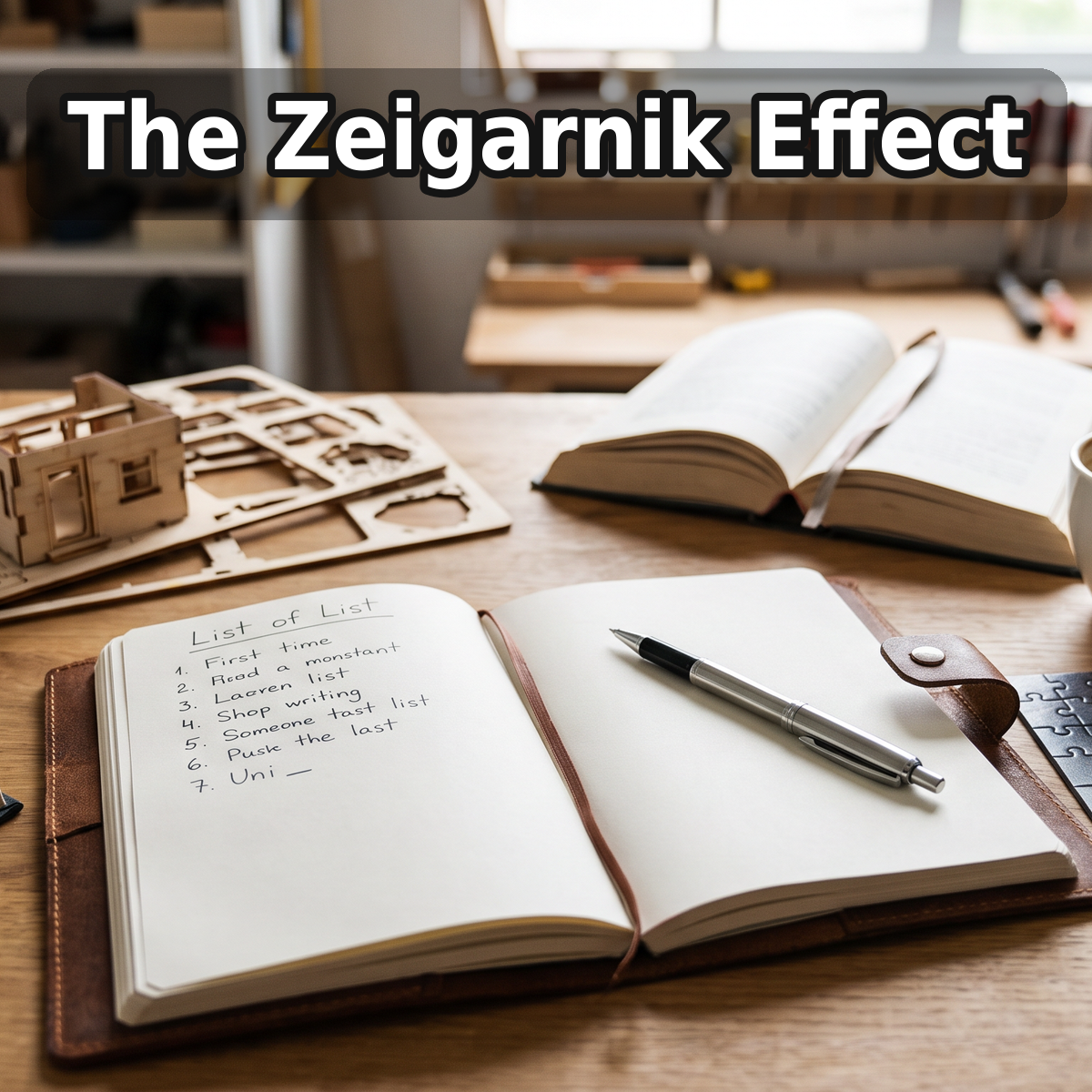
She discovered that people tended to remember the interrupted and unfinished tasks more readily than those they had completed. Her explanation posited that initiating a task creates a psychological tension. Once an objective is set, a part of the mind begins to strive for resolution. This tension is released upon completion. When a task remains unfinished, however, the mind continues to hold onto it.
This tendency became known as the Zeigarnik Effect.
While modern research has added nuance to Zeigarnik’s original findings, and the effect doesn’t manifest identically in all circumstances, the broader idea resonates intuitively. Unfinished matters tend to remain mentally active. They linger. They return. They seem to occupy disproportionate mental space simply because they lack closure.
Viewed through this lens, the nature of stress becomes remarkably clear.
Most of us carry a far greater burden of unfinished business than we realize. There are emails awaiting replies, conversations we know must occur, partially completed projects, commitments made, forgotten tasks, postponed decisions, and problems for which we simply lack solutions. Beyond these tangible items lie more abstract concerns that defy easy placement on a to-do list: worries about finances, family, work, health, relationships, or the future.
Few of these demand our constant attention, yet our minds often treat them as if they do. They periodically resurface, sometimes at the most inconvenient moments, almost as if the brain is conducting a mental audit to ensure they haven’t been forgotten.
This, I believe, is why writing holds such power.
When something exists solely in your mind, your brain bears the dual responsibility of eventually solving it and remembering its existence. This creates an additional burden. A portion of your attention must remain tethered to the problem, lest it slip away.
Once you write it down, that dynamic shifts.
Psychologists sometimes refer to this as cognitive offloading, the process of transferring the work of remembering or organizing information from your mind to the external world. We engage in this constantly, often without conscious thought. A calendar frees us from memorizing every appointment. A grocery list allows us to navigate the store without mentally rehearsing a dozen items. A phone reminder permits us to defer thinking about something until the opportune moment.
Writing down a concern functions in much the same way.
You are not necessarily solving the problem. You are creating a trusted repository where the problem now resides.
This distinction is crucial, for the mind seems to respond differently to an unresolved problem that has been captured versus one that merely floats in our thoughts. The former can often be set aside. The latter tends to resurface repeatedly because the brain lacks assurance that it won’t be forgotten.
I have come to understand this through a long-standing habit: at the end of each day, I make a point of closing my day out.
It is not an elaborate ritual, nor do I approach it as a productivity exercise demanding perfect utilization of every minute. I simply take a moment to honestly assess the day. I note my intentions, my actual accomplishments, what remained unfinished, and what needs to be carried forward.
Over time, I have found this practice profoundly therapeutic.
Acknowledging what didn’t get done is as vital as recognizing what did. Without that acknowledgment, unfinished work tends to follow me into the evening. I may physically cease working, but mentally, fragments of the day persist. A forgotten task resurfaces during dinner. An incomplete item appears in my mind as I try to sleep. My attention drifts back to the workday, even though it has technically concluded.
Closing the day transforms this relationship.
I can look at an unfinished item and simply acknowledge it. I know it’s still there. I know it requires attention. I might even decide when I will revisit it. But I no longer have to mentally rehearse it to ensure its survival until tomorrow.
In a sense, I am not necessarily closing the task; I am closing the day.
This has become an important distinction for me. We often assume that peace arrives when everything is done, yet few of us will ever reach the end of a day with absolutely nothing left unfinished. There will almost always be another email, another project, another conversation, another idea, or another obligation awaiting us.
If our capacity for rest hinges on completing everything, we will rarely find rest.
Instead, we can cultivate a reliable method for acknowledging the current state of affairs. We can recognize accomplishments, accept what remains unfinished, capture what needs to happen next, and then consciously allow the day to conclude.
Most people eventually stumble upon some version of this when overwhelmed. There comes a point when too many things circulate in the mind, prompting us to grab a notebook or open a document and begin listing everything that needs doing. We call it a brain dump or a task list, and almost immediately, a sense of relief washes over us.
The intriguing aspect is that nothing has actually been completed. If you had seventeen problems before making the list, you still have seventeen problems afterward. What has changed is that those problems are no longer seventeen indistinct entities vying for space in your head. They are visible. They have names. They have been captured.
The temporary relief we experience in those moments conveys an important message.
We don’t have to wait until we are overwhelmed to act.
Instead of treating writing things down as an emergency mechanism reserved for moments of extreme mental pressure, we can integrate it into the ordinary rhythm of our day. We can develop a habit of regularly clearing our mental workspace before it becomes cluttered.
For me, this means taking a few minutes at the end of the day to reflect and decide where everything belongs. Some things are complete and can be released. Some are unfinished and must move forward. Some concerns don’t demand an immediate answer but deserve to be captured so I can return to them later.
There is a quiet freedom in knowing that something doesn’t have to be resolved simply because you’ve thought about it.
It can be written down.
It can be placed somewhere you trust.
And you can return to it when the time is right.
Perhaps this is part of what our minds are truly seeking when the same worries and unfinished tasks persistently resurface. They may not always be demanding an immediate solution. Sometimes, they may simply be asking for reassurance that they will not be forgotten.
Writing provides that reassurance.
It allows us to say, in effect, I know this is unfinished. I know where I left it. I will come back to it.
And once the mind believes that, it becomes a little easier to let the day end.