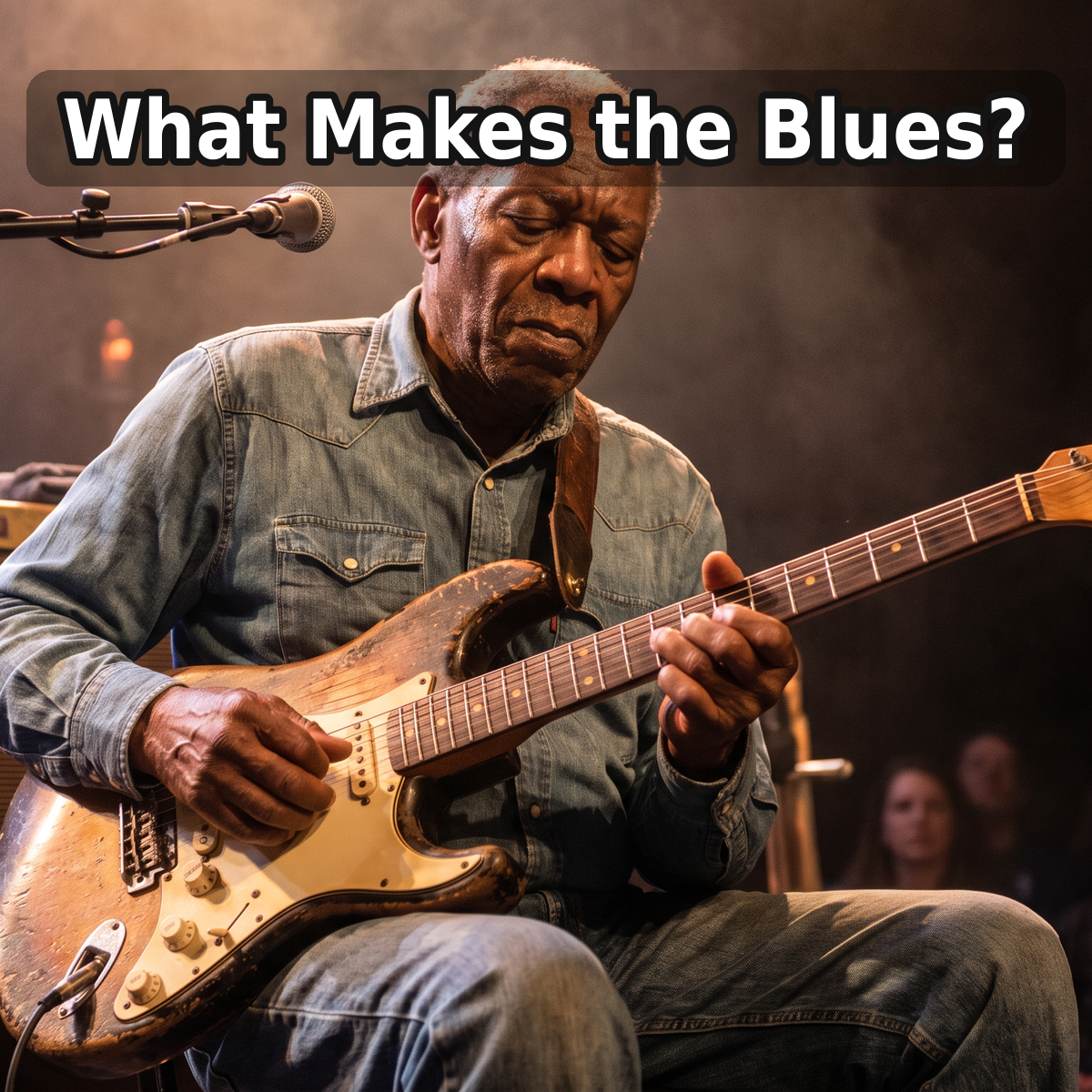
I woke up this morning with the walking blues. A feeling that can only be resolved by walking around. You wake up, feel around for your shoes, and just start walking. You let all the things that have been tumbling around in your head move around with you for a while.
When I finished my walk, I came home and played some blues music. I sat there feeling melancholy but, at the same time, rejuvenated. What struck me was that the conflict inside me had not really been resolved. The tension was still there. Nothing had been fixed. Yet somehow it had been clarified, and because it had been clarified, I felt better.
That made me wonder: what makes the blues, the blues?
I suppose the technical definition is some combination of harmony, phrasing, rhythm, repetition, and emotional tension that makes something sound like the blues.
That definition does not work for me at all.
At a musical level, there are several recognizable elements. There is the common repeating structure known as the 12-bar blues, usually built around three chords. There are also certain notes associated with the blues—the flattened third, fifth, and seventh—but blues musicians rarely treat those notes as fixed points. A singer or guitarist bends into them, out of them, and sometimes somewhere in between.
The notes seem to live between major and minor.
That is part of what makes the blues instantly recognizable. There is uncertainty built right into the melody. So although many blues songs operate within a familiar and highly structured musical pattern, the melody itself can feel wonderfully ambiguous.
So is that the blues?
Structured ambiguity?
Not quite.
A good blues song is more than its structure. It often has a conversational quality, and somewhere inside it there is usually a story being told. A phrase is stated, repeated, and then answered or concluded.
I once heard a historian lecturing on the musical history of Louisiana describe the tradition of call and response. A voice calls and another voice answers. A singer delivers a line and the guitar responds. One instrument speaks and another comments. You can hear this pattern throughout blues music.
Say something.
Say it again.
Then tell us what it means.
The first statement gives us the information. The repetition gives us time to feel it. The response moves the thought somewhere else.
So is that the blues?
A deep emotional connection to a phrase that is repeated and then answered?
Perhaps.
Yet that does not quite capture it either, because rhythm matters.
Blues lives in the pocket somewhere between the repeating musical structure and the rhythm underneath it. Shuffle, swing, slight delay, deliberate deviation—all of it resting in the pauses.
Someone could play every correct note and every correct chord in perfect synchronization and still not sound anything like the blues.
There has to be something else mixed in.
The bend.
The riff.
The hesitation.
The improvisation.
The space between the notes.
The feeling.
But even that does not quite explain it.
Because when the singer and the guitar player make their call, and then repeat the call, they do not always want or need an answer.
The blues is not about solving the problem.
It is about giving the tension somewhere to live.
That may be the most important thing about it. The music itself is always living in opposition. Major against minor. Sadness against humor. Hardship against resilience. Precision against chaos. Structure against improvisation.
The blues is contradiction.
Ambiguity and contradiction are its language.
Perhaps that is why blues became such a powerful way of representing lived experience. Heartbreak, poverty, love, injustice, desire, humor, loneliness, disappointment, and everyday trouble all found a medium for expression through the music.
These things did not have to be resolved before they could be expressed.
A person could simply say:
This happened to me.
Then say it again.
Then tell us what it felt like.
And something personal became communal.
Someone else’s heartbreak could suddenly remind you of your own. Someone else’s struggle could sound familiar. Someone else’s longing could become a melody you understood even if their life looked nothing like yours.
The blues took private trouble and gave it a public language.
Maybe that is as good a definition as any:
The blues is the sound of tension being expressed rather than eliminated.
And maybe that is why the walk this morning helped.
I did not solve anything while I was walking. I did not come home with answers to everything that had been tumbling around in my head. I simply gave those thoughts somewhere to move.
The tension was still there when I returned.
But it was clearer.
And somehow I felt better.
Perhaps the blues does the same thing.
It does not necessarily resolve what troubles us. It gives the trouble rhythm. It gives it language. It gives it somewhere to go.
I still do not know exactly what makes the blues, the blues. I am not sure it can be reduced to twelve bars, three chords, bent notes, rhythm, or call and response.
I only know how it feels.
And the music seems to capture that feeling better than almost anything else.
If you have never really experienced the blues, I carefully picked three songs for you to listen to. I chose them for different reasons, but each carries something that helps explain what I am trying to describe.
I recommend shutting everything else down and finding a quiet place where you can really listen.
Do not just play them in the background.
Listen to the repetition.
Listen to the pauses.
Listen to the guitar answering the singer.
Listen to the notes that seem to bend between major and minor.
Listen to the tension that never completely disappears.
You will recognize the patterns. You will understand the stories. And you may begin to hear how much of the music we listen to today still carries pieces of this same old story, retold again and again.
Together, these three songs show the blues changing across generations while its underlying language remains remarkably recognizable.
Robert Johnson — “Sweet Home Chicago”
https://www.youtube.com/watch?v=O8hqGu-leFc
Muddy Waters — “Got My Mojo Working”
https://www.youtube.com/watch?v=DCaeLFP52oQ
B.B. King — “The Thrill Is Gone”
https://www.youtube.com/watch?v=dvRwZga4hAE