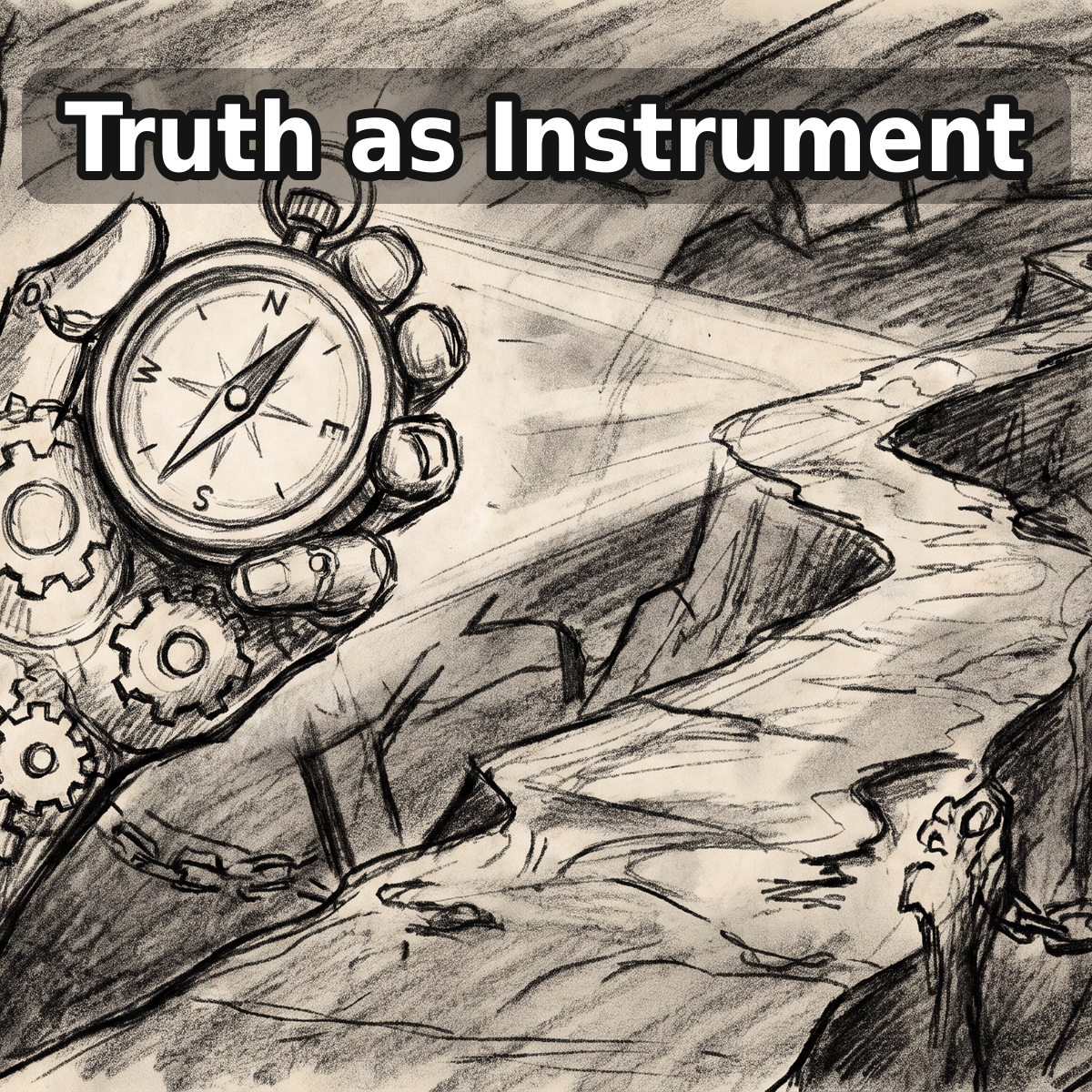
I have no idea how to work with or deal with people who view truth as merely an instrument to benefit them. Truth becomes a weapon in their arsenal, something that they can manipulate, change, and revise to fit whatever narrative best fits their current position. In political dialogue, this is called relativism, but that label is inaccurate and offers the sophist a dangerous escape route. Arguing that truth depends on perspective, culture, framework, or context is a far cry from using truth as a tool for achieving an objective. These two get mixed up all the time when a relativist uses sophistry to win an argument rather than discover what is true. Before you get high on the horse, please realize that both sides of the political spectrum are guilty of this tendency.
On a social level, this matters less to me than it does on a personal level. I naturally work well with people that carry some notion of a fixed truth that binds our community together. You might call this truth morality, but there are certain beliefs that we all tend to hold irregardless of our cultural backgrounds. Simple things like, telling lies is bad. What is difficult to grapple with is encountering people who don’t even consider that. The concept of lying only works for those who believe that there is a truth to grasp onto. If you encounter someone who doesn’t believe in any truth whatsoever, they will lie all the time and claim emphatically that something is true, only because it serves their present need.
When I phrase it this way, it sounds like a psychopathic behavior, but do not dismiss this so quickly. This tendency is universal and happens everywhere. Although I generally believe people are born "good," we do have inclinations that are often self-serving, and one of those is a willingness to bend the truth to benefit ourselves. If you have raised children, you know exactly what I mean. That shocking moment when you realize that your seven-year-old has blatantly lied to you for the first time. You have to lecture them, punish them, teach them, and help them understand that there is a moral and ethical responsibility to hold to some universal truth. That being said, lying is wrong.
Not everyone got this lecture from Mom. Not everyone had a firm, resolute father that held enough credibility to teach their teenager to live as they have, honestly. Many people will use truth as an instrument and not even consider it lying. If they can change the truth, then they are not lying anymore. Problem solved. They can still participate in a society that believes lying is wrong, because they changed the truth. Oh, wait. They did not change the truth; they changed the narrative.
Now I am not about to pretend I haven’t lied to benefit myself. I am guilty of that sin, probably more often than I would want to admit to myself. However, if I were pushed on it, pressed on the topic, and I realized that my little white lie was hurting another soul, then I would fall on the sword of truth. I would admit to the lie without question. I didn’t want to carry the knowledge that a lie I told had harmed someone. I could not live with myself. The older I have gotten, the more I have realized that gossip is a close cousin to this concept, which is why I have reduced my participation in passing gossip where I can. It is too easy to spread a lie about someone through gossip and not realize that you are lying at all.
I have taught the game of chess to young people many times over my lifetime. I remember in the early days of my chess club that I started, there was a young boy who would absolutely lie to defend his ego. He did not want to lose or to be looked down upon in any way. He would cheat, deceive, and deny at any opportunity to show that he should have won or that something was unfair. I caught him multiple times fabricating game results. He would defend what happened as if it were a truth written in granite, when everyone in the room knew he had made it all up. The disconnect with him was hard to fathom.
As the boy grew up in the program and his fear of losing decreased, he became less worried about defending a reality that made him look invincible. He would shrug off a loss and easily say that his opponent beat him good. He started becoming the enforcer of game purity, demanding everyone follow the rules. In stark contrast, this new truth became important to him. Following the rules of chess was not optional; they must be followed, and attempts to bend those rules were criminal acts of injustice in his mind.
This transformation over 10 years has always stuck with me. The young man who would warp truth to his convenience morphed into one who followed strict adherence to the USCF Rules of Chess. To him, the ultimate truth was the purity of the game, and no longer something that could be reframed to fit his desired outcome. He was now hard to deal with for an entirely different set of reasons! Now the other children would complain that it was overbearing in its insistence that they do everything right.
So how do you deal with people who will use the truth as an instrument to win, no matter what the cost? I am not sure; I still struggle with this. I have learned that it is important to identify what is going on as early as possible in the relationship. To look for telltale signs, repeating behavior, and a willingness to bend the truth as a matter of convenience. These types of people are usually very charming and, in the early stages, will be painting a story for you to earn your loyalty and trust. Watch how they treat others; however, if you start to see shifting narratives based on a person’s usefulness, then you know what you are dealing with. A person who views truth as instrument.