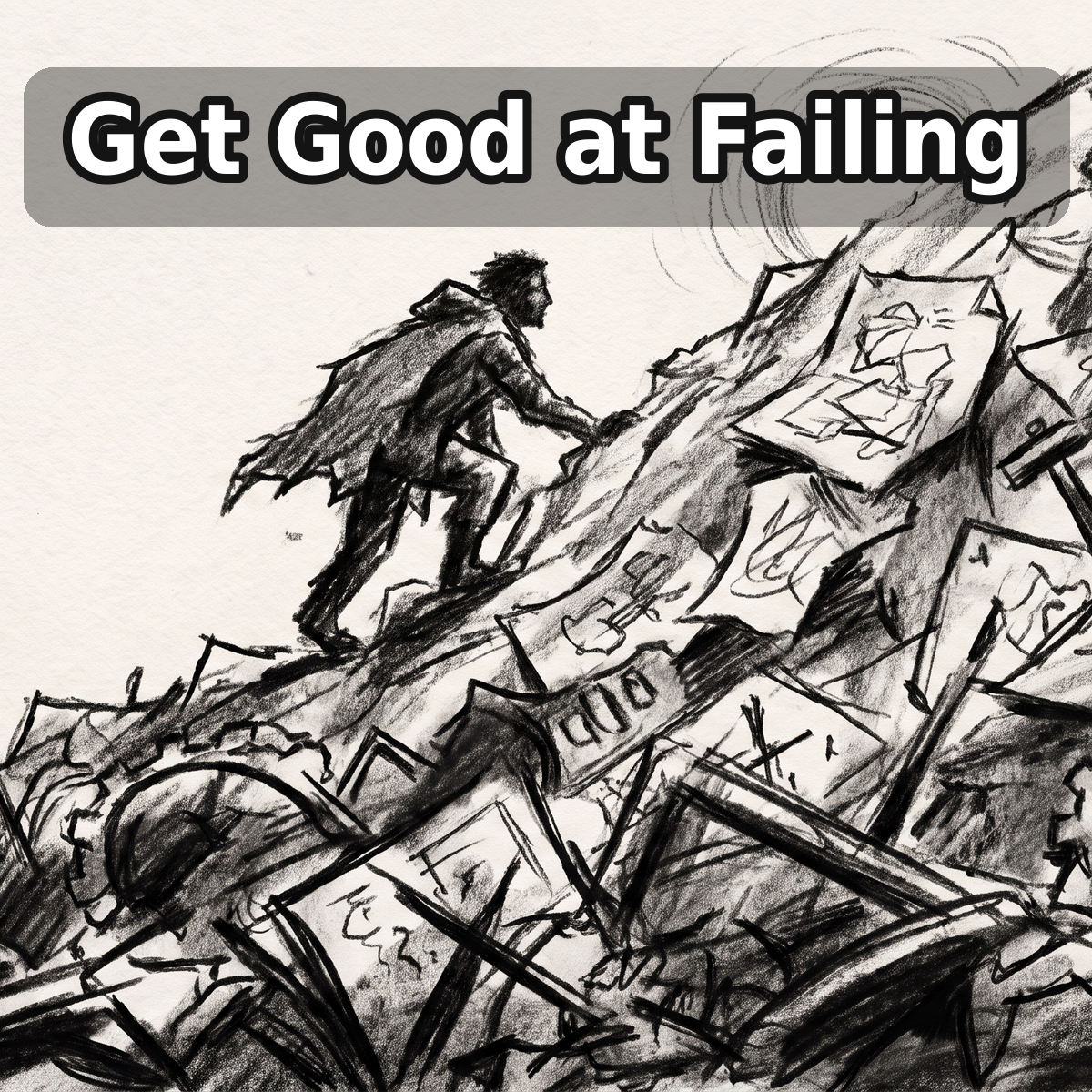
I have been thinking about something that sounds a little strange. What if one of the most valuable skills you could develop is getting good at failing?
Not at accepting defeat. Not at lowering your expectations. I mean getting good at the actual process of failure.
You set an objective. You push hard. You put yourself in a position where the outcome matters. Then you come up short. It hurts. Maybe you are embarrassed. Maybe the result costs you something. That part never becomes particularly enjoyable.
But something interesting can happen next.
You recover quickly. You look at what happened without making excuses. You make an adjustment and go after it again. Not someday. Not when you feel better about yourself. You get back to work as soon as you can.
That recovery is a skill.
I think we tend to judge our performance by whether we succeeded or failed. But there is another measurement worth considering. How long did it take to recover? How much did you learn? Was the next attempt actually better?
A person who fails ten times and improves with each attempt may be making far more progress than someone who has found a comfortable way to avoid failing at all.
The danger, of course, is confusing persistence with stubbornness. Repeating the same approach over and over is not learning. Sometimes the best decision is to change the plan entirely. You can let go of a method without letting go of the goal.
I also think we give failure too much authority. We allow one disappointing result to tell us what we are capable of. We take an event and turn it into an identity. I failed at something, so perhaps I am a failure.
That is a terrible conclusion to draw from a single attempt.
I have started to think the real advantage belongs to people who can shorten the distance between disappointment and renewed effort. They feel the setback, accept the lesson, and move. They do not need every outcome to validate them.
This is part of what a daily commitment teaches. Each day offers another opportunity to act, learn, reflect, and improve. Yesterday’s outcome matters, but it does not get the final word.
Maybe failure only becomes final when we stop using it to grow.
So push hard. Fail when you must. Recover fast. Learn something. And attack again.
Get so good at failing that failure can no longer stop you.