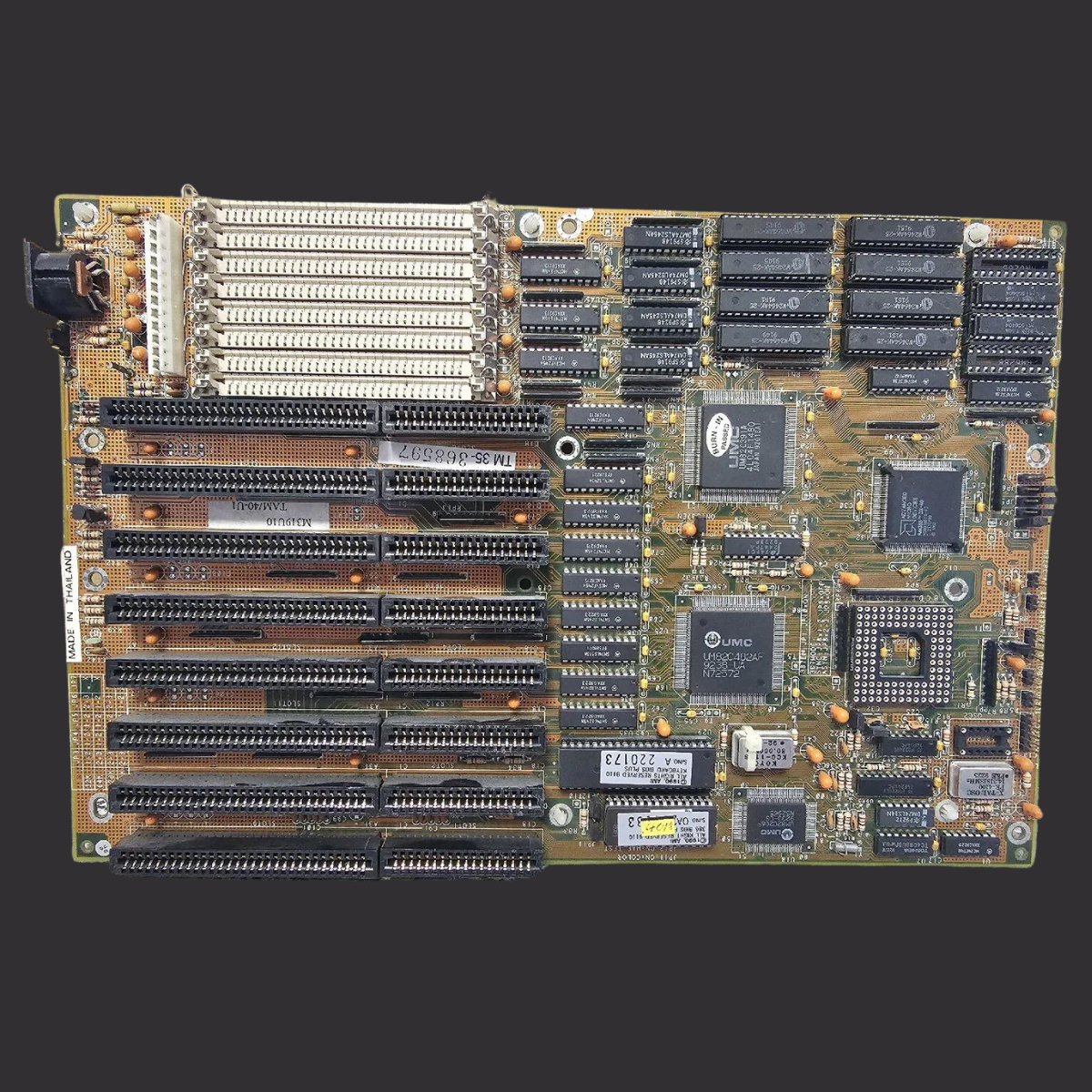
I enjoyed my first major upgrade sometime in 1987. I had a functioning Intel 80286 clone PC that could barely run MS-DOS. I really did not use this PC much; I believe my uncle gave it to me. However, I was finally in for my first upgrade. We got a 386 motherboard with a 486 socket type that supported VESA Local Bus (VLB). I still have the motherboard in my garage, it had an AMI BIOS, and I am unable to tell who the board manufacturer was. However, the upgrade I remember the most was in the early 90s, and we got an AMD386DX processor and motherboard. Although the Intel 486 was out and probably better, for someone on my budget, the DX offered quite a bit. What made this motherboard and chipset amazing is that it supported a 32-bit external address bus. For the first time in my life, we were talking about theoretical maximums of memory capacity in the gigabyte range (GB).
This was theoretical only. My new Am386DX was awesome. I could now run Windows 3.0, and I was very happy to have a sound card, a CD-ROM drive, and even a portable handheld scanner. My new 40MHZ processor was amazing, and this was probably the first year that I actually remember using a PC for any functional purpose other than a game or two. I would soon be adding a modem to this PC and was introduced to the idea of dialing up digital bulletin board systems. This PC, in all of its glory, could run Windows 3.0 in Enhanced mode, barely. I had a total of 1MB of RAM. I think my uncle once again came through by giving me a few chips to install on my motherboard.
So, circa 1991, I had the latest from AMD and 1MB of RAM. Later, I would put in that modem with a dial-up speed of around 14,400 bit/s. I have no idea how my parents could afford that modem. Looking back historically, those things were around $250 USD. Fast-forward to this weekend, 2024. I upgraded the memory in my PC to 64GB of RAM (2x32GB) with a clock speed of 3,200 MHz. That upgrade was cheaper than the modem in 1992. It cost me less than $125. Add on top of that and I recently upgraded my home network to 2.5GB so that I could fully utilize my 2.5GB Fiber Internet Connection.
Just looking at plain numbers, my memory usage has increased 6.4 Million% in 33 years since my first major computing upgrade. I am not counting any virtual machines or cloud resources that I am using. The rate of YOY increase has been roughly 50% per year. My Internet connection has been growing much faster, almost 1.3 Billion% since 1991, approximately 63% per year. My life has been a continuous stream of upgrades. I am staring at my NAS shelf of disk drives and my Dropbox, google, and other cloud storage usage. I am wondering how exponential that has been. I think my hard drive in 1991 was 40MB. So this is a similar exponential growth rate as memory and network bandwidth. So my life is a life of technology upgrades.
This has got me to really ponder, however, if I have upgraded much personally since 1991. With hard drives, memory, and network bandwidth, I have a real, measurable thing to look at. However, with myself, not so much. How do you judge this? That is an interesting question indeed. I have 1 more wife and 3 more children then I had in 1991! I have two degrees that I did not have in 1991. I own 1 more home then I did then. I have a few more social media followers than I did in 1991 because there were none back then at all. By those measures, I am doing pretty well. However, how would you rate your improvement in your life? I certainly do not want to look at the scale. Pretty hard to compete with my 165-pound weight in my late teens. Bank account? Investments? Penny jar? My VO2 Max is going down every year as I get older, so that is not a good thing to judge by. How about the number of friendships!? Well, I have 1 really good friend, and that was the same friend I had then – so I’m not doing so well there either.
How do you track a life of upgrades? How do you know that you are better off? I can tell this for certain. You are not going to find it in MHZ, TB, or BPS. As you improve yourself, you are going to have to find it in less tangible ways. Your personal growth will not be found on a label, a package, or a QR code. Your life of upgrades will actually be measured by the only perspective that will count at the end of all of it, and that is yours. The sum of all life will be narrowed down to the quiet moments that you have by yourself at the end of it all. Are you satisfied with your life? Does the enjoyment outweigh the regrets? I will leave this article with a poem that has been in my Grandfather’s house for several decades now – seems to wrap up what he wanted to be judged by, and maybe it is as good as any:
The Fisherman’s Prayer
I pray that I may live to fish
Until my dying day.
And when it comes to my last cast,
I then most humbly pray:
When in the Lord’s great landing net
And peacefully asleep
That in His mercy I be judged
Big enough to keep.