I’ve cataloged, over the course of my career, some of the stupidest, most irritating things I’ve been asked to do by an employer. And high on that list—top ten, easily—is this: “Write your own job description.”
I almost sent back a one-line email in response: This job description is subject to change.
Seriously, who has ever had a job where what you’re supposed to be doing doesn’t change every five minutes?
I decided to look into this, and apparently, this is a real trend in today’s professional landscape. Not only are job descriptions subject to change, but in many environments, your actual role will shift entirely every 3 to 6 months. This is the new normal. It’s beyond the typical occupational life cycle trends we’ve seen in post-industrial economies. We’re heading into a future where so much is being automated that the tasks people need to work on, assist with, or validate will constantly shift.
Why Job Descriptions Really Change
Sure, there have always been reasons to update job descriptions. HR departments will give you a dozen of them—none of which I can remember. I’m sure it involves performance evaluations, salary bands, and compensation benchmarks.
But let’s be honest: the real reason job descriptions change is financial. Businesses are constantly adjusting compensation to reflect cost-of-living increases, wage pressures, and shrinking margins. Since labor is often the largest cost center, job descriptions become a tool to justify (or re-justify) pay rates based on skill sets.
Enter: The Pancake Initiative
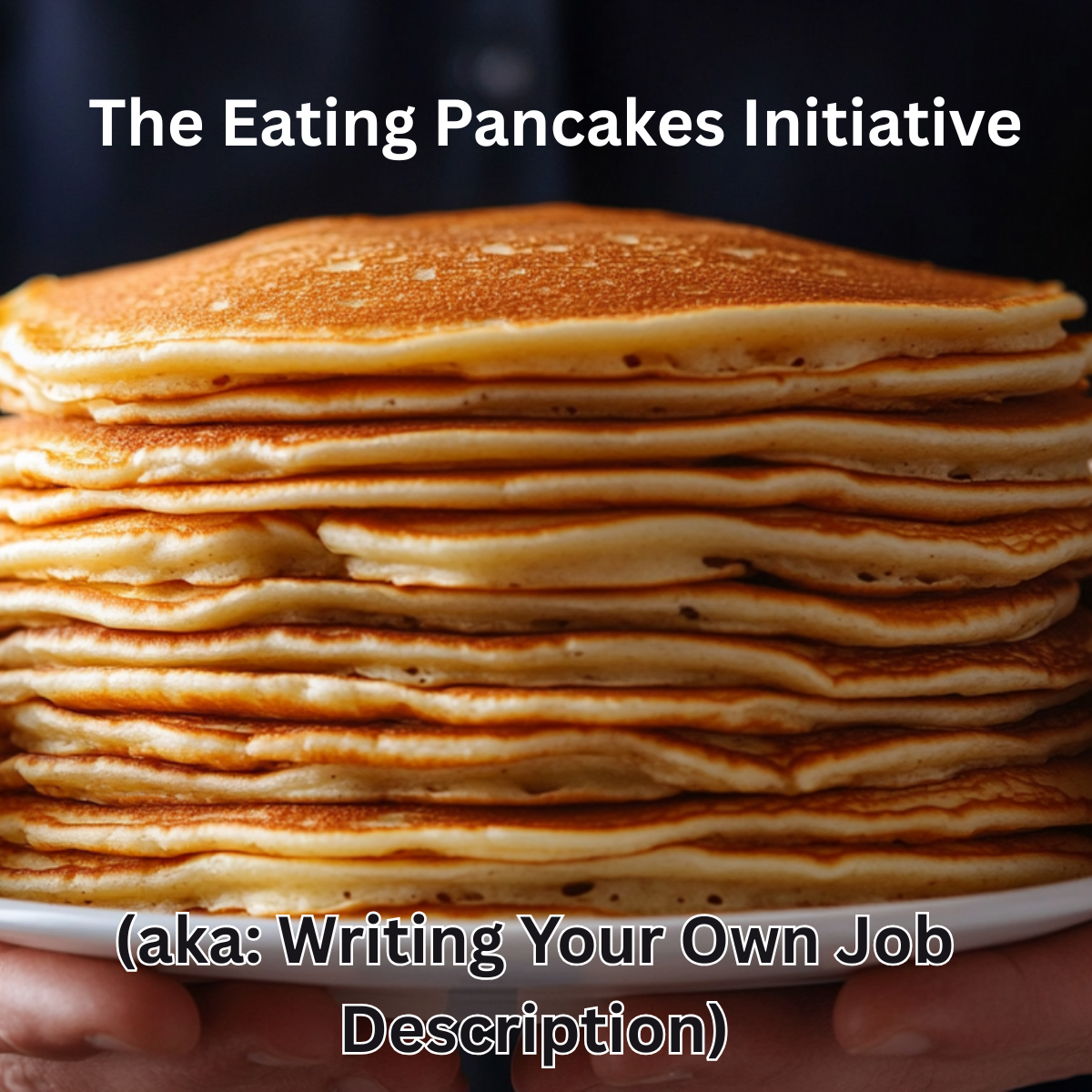
In my case, my boss had been asked by HR to provide updated job descriptions for highly compensated employees. This was almost certainly due to what I like to call The Eating Pancakes Initiative.
If you’re unfamiliar with the term, let me explain.
One of the age-old cost-saving strategies used by consulting firms is to attack the layers of middle management. Over time, every company trends toward complexity: you hire a manager, that manager hires other managers, and so on.
To control this growth, companies often create strict policies. For instance, a sales manager may be required to supervise no more than 20 and no fewer than 8 salespeople. That’s a policy meant to control middle management costs. The more complex the business, the lower the manager-to-employee ratio will likely be.
But there’s always pressure to consolidate. That’s where the “pancakes” come in.
“Eating pancakes” is my affectionate term for flattening the organization—finding overlap and redundancy so that you can collapse layers and reduce headcount. When a high-priced consultant comes in, they always start with “cost efficiencies.” The first meeting often starts with:
“Well, we have some good news—we found opportunities for significant savings with just a few simple organizational changes.”
And I always respond, “Great! I love eating pancakes!”
They look at me cross-eyed… until they show their first slide. And sure enough, it looks like a stack of pancakes: top-level management, the workforce below, and a mushy middle that’s about to get eaten alive.
So, About That Job Description
So when my boss asked me to write my job description, I knew exactly what was happening. I wasn’t in the pancake meeting, but I was clearly the one stuck in the middle of the stack.
I was now being asked to justify my existence.
What my boss was really saying was: I’ve lost control of my org chart, we’re not growing fast enough, and a consulting firm has been brought in to optimize things—starting with high-paid middle managers like you.
And while that’s not the point of this blog, I will give one piece of advice:
If you’re asked to write your job description, know this:
You’re being asked to write a document that helps prove there’s redundancy.
Don’t simply write what you do. Instead, write why you are unique, and why you are pivotal to your team’s or division’s success. Write it so clearly and so compellingly that the consultant has to invent a brand-new category just for you.
But I digress…
Writing a Job Description for Yourself
Let’s return to the original thought. What if the request to write a job description came from you?
That was my thought today: What is my actual job?
What is the role of Guy in the Guy Reams circus?
What purpose do I serve? What are my responsibilities? What are the working conditions, expectations, and—here’s the kicker—how much should I be paid for this role?
Let me tell you something: being me, working for me, is brutal.
I am a very annoying boss. Demanding. Needy. Borderline psychotic. I micromanage myself. I use guilt, fear, and intimidation all the time. I expect far more of myself than I’m capable of delivering, and when I fall short, I pile on even more.
I change my mind constantly. I’m unclear, scattered, and unreasonable.
And the benefits? No breaks. No PTO. No recognition. I wear every hat—CEO, CFO, CTO, CMO, CRO. All the C’s.
If I were interviewing for the job of me, I’d say,
“Hell no. You’ll have to pay me 10x your offer and throw in more than just a few unvested options.”
The Exercise
After that little tantrum, I actually started writing down what I do. The list was long. Every time I thought I was done, I’d remember something else.
One observation: I’m pretty good at Accounts Payable—but Accounts Receivable? Not so much.
(That’s a joke, in case you missed it. Payable is what you owe. Receivable is what you earn.)
Joking aside, this exercise was strangely therapeutic. It helped me understand why I feel so stressed sometimes. I’m overworked. Underpaid. And unfortunately, I don’t have the guts to show this “job description” to my wife. So let’s just keep that between us friends.
How Much Are You Worth?
This brings us to the question of compensation. When you work for someone else, you’re trading time for money. So: how much is your time actually worth?
How much does your employer think it’s worth? And more importantly—how much do you?
I recently talked with one of my kids who got a part-time job. She was thrilled to receive a little overtime—an extra $250 in her paycheck. After taxes, of course.
Then I told her that a professional with the right experience can make that much (or more) in one hour. She wanted that, too. But the follow-up conversation was sobering:
Nobody pays $250 an hour to clear tables at a restaurant.
Enter the need for qualifications, experience, or building something people are willing to pay real money for.
Another example: A salesperson once proudly showed me a massive commission check. After high-fives, I asked how long they’d worked that deal. The answer: months. Nonstop.
When we did the math, they’d made less than minimum wage per hour.
Deflating? Yes. But also a valuable reality check.
Time for a Self-Audit?
Here’s my point:
Every so often, it’s worth writing your own job description.
Not just at work—but in your life.
Do some management consulting on yourself. Take a hard look at what you’re doing. Are you spread too thin? Have you added so much complexity to your life that you’ve become your own worst boss?
Maybe it’s time to eat some pancakes and flatten your own organization.
Not everything you’ve been doing still has value. Maybe you’re just stuck in old habits. Maybe you’re living beyond your time budget. Maybe you’re trading your most valuable hours for the wrong kind of return.
So take a minute. Write your own job description.
Be honest. Be bold. Then figure out what you’re worth—because you might be worth far more than you’re getting.



I think there’s a big piece of your worth that is missing from this analysis. For example, I do expert consulting and charge a lot per hour. I also am on non-profit boards and charge $0/hour. Does that mean the non-profit is underpaying me? No, I’m contributing to making a better world. And I take a lot of pride and satisfaction from that. So when looking at your job description, keep in mind that some of what you’re getting can’t be measured monetarily.
Well, I agree! You and I are similar in this regard. However, when I calculate how much someone needs to us, shouldn’t we INCLUDE our charitable work?