Since Adam and Eve left the Garden of Eden, humankind has been trying to figure out how to make more margin on goods and services by using cheap labor. If you look closely, this issue sits at the root of many of our political and international conflicts.
So it should come as no surprise that when the large railroads were building the Transcontinental Railroad in the 1800s, they were looking everywhere for low-cost laborers. One of the most significant sources of lower-cost labor at that time was China. Seems little has changed in the last century.
The difference, however, was that in this instance, laborers from mainland China were being brought into the U.S. to work on the railroads. I’m not a historian, but if I were, I think I’d find it fascinating to study the stories of this class of immigrants and the impact they had on the societies they integrated with—or were segregated from.
Among the many cultural contributions these workers brought, one in particular stands out: snake oil.
These workers introduced traditional Chinese remedies, including snake oil made from the Chinese water snake—a species rich in omega-3 fatty acids and used to treat joint pain, inflammation, and arthritis. Today, we use “snake oil” as a negative term to describe a fraudulent product, but that’s a misrepresentation. Modern scientific analysis has shown that real Chinese snake oil likely does help with inflammation due to its omega-3 content. So how did it come to represent the opposite?
The origin of the negative stereotype traces back to a fraud perpetrated by Clark Stanley, known as the “Rattlesnake King.” In 1916, it was proven that his famously advertised Snake Oil Liniment was a total sham. Contrary to his marketing, it contained no actual snake oil and had nothing to do with secret remedies from the Hopi tribe. The ingredients? Mineral oil, chili peppers, and turpentine. He was fined under the Pure Food and Drug Act of 1906—just $20.
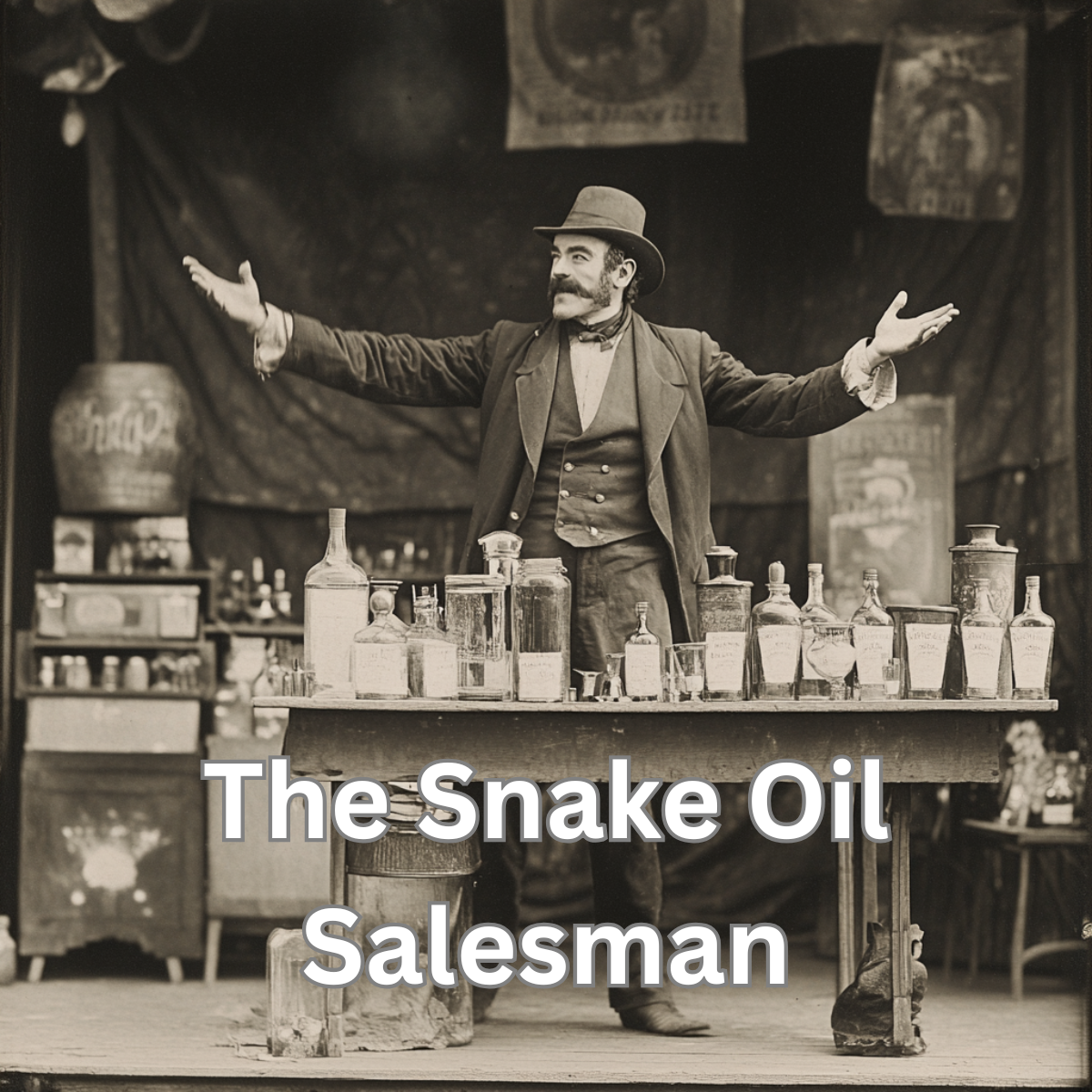
Stanley wasn’t the first to do this. He was simply capitalizing on what had already become a fixture in late 1800s American culture. The original Chinese snake oil had become known in the U.S.—probably because it actually worked. But enterprising American salesmen, lacking access to the genuine article, saw a business opportunity. They concocted phony versions and hit the road, selling “miracle cures” at medicine shows, complete with flashy presentations, staged testimonials, and smooth-talking “doctors.” Their goal was simple: sell as much as possible before anyone figured out the truth.
And so, the term “snake oil salesman” entered our language as a metaphor for scam artists, smooth-talking hucksters, and anyone selling something that sounds amazing but doesn’t actually work. Today, it’s commonly used in industries like tech, personal fitness, and self-help to describe those peddling hype over substance.
So why bring this up? Because someone recently accused me of being a snake oil salesman.
Let’s set the record straight.
What they meant, I think, is that I sounded like a salesperson. To that I say: guilty as charged. But sounding like a salesperson and being Clark Stanley are two entirely different things. In my case, I’m selling the real thing—the Chinese version of snake oil—which actually works. Not the red pepper-in-turpentine knockoff.
So I beg you: if you’re going to insult hard-working salespeople, please get your metaphors right. Not all American salespeople are hucksters trying to pass off fake products “supposedly made in China” while overstating their claims.
Well… uh… at least one or two of us aren’t.




Amen! Great read Guy. Had to chuckle when I read that. What about “Used Car Salesmen”?