There are people buried in the ground, scattered across this country, whose names I carry with me. Some I knew. Some I only heard about in stories told by relatives who did know them. Their voices have gone quiet, their hands have stilled, but their influence has not ended. It moves through me like a current, shaping the way I think, the way I speak, the way I choose to live. A few of them will outlast me. I have made sure of that. I have told my children about them, and I will say to my grandchildren. They will know the stories, the values, the moments that mattered. They will see why these people shaped our family, why their lives still echo in ours.
Today is Christmas, and the world pauses to remember a man who walked the earth nearly two thousand years ago. Jesus of Nazareth. Eighty generations have passed since he lived, and yet most people on this planet know his story. They know his teachings, his personality, and the acts attributed to him. The religious movement he began is still alive, still growing, though it has splintered into countless branches. That kind of influence is staggering. It makes you wonder what about him made his memory endure when so many others have been forgotten.
That thought led me down a different path. I started thinking about the oldest people we know about, the ones whose names have survived the longest. Two figures came to mind. Hammurabi of Babylon and Moses of the Hebrews. Both lived more than three thousand years ago. Both are remembered for laws written in stone. But the way they are remembered could not be more different.
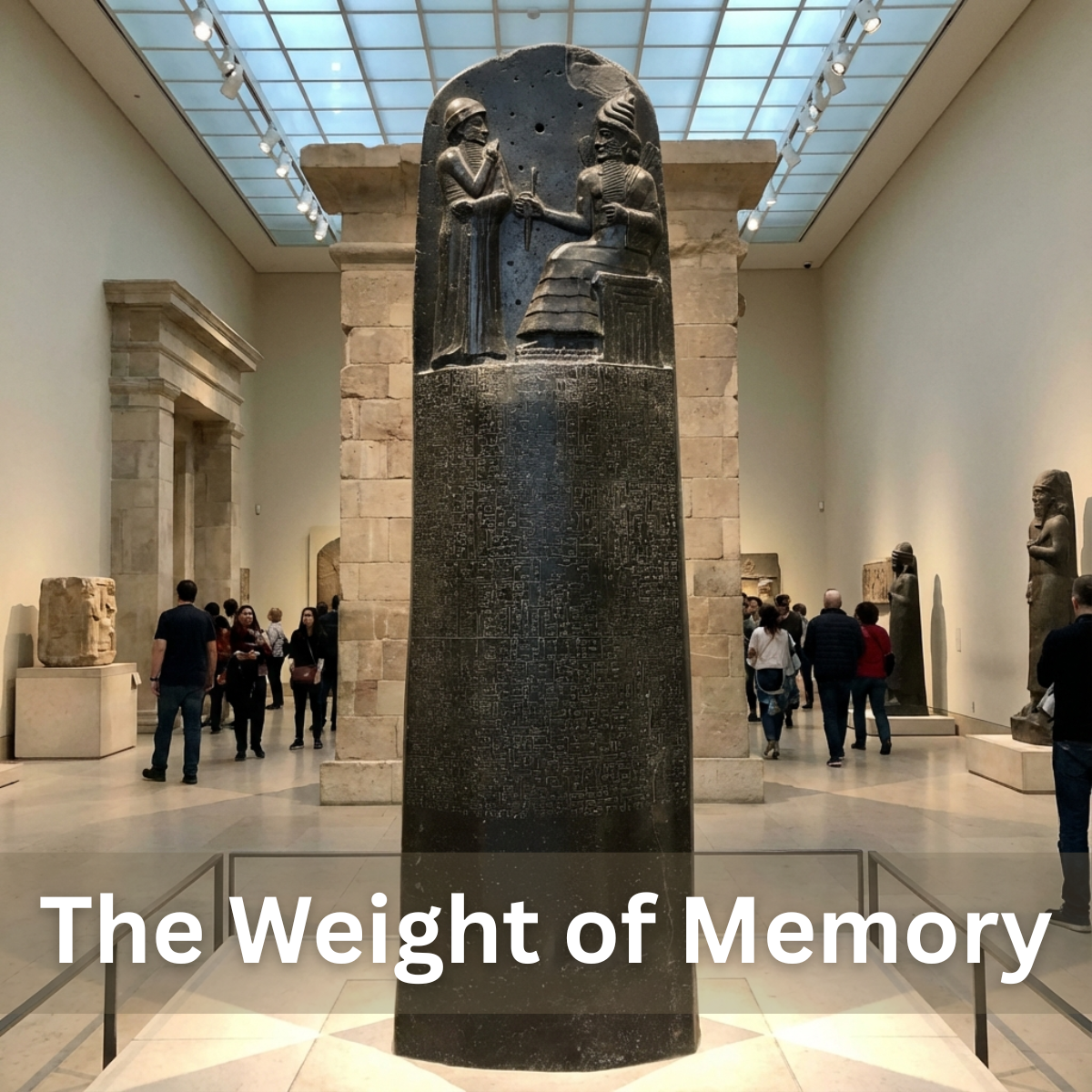
Hammurabi’s laws are still here. You can see them in the Louvre, carved into a massive stone stele. The physical artifact has survived. We have administrative records, royal inscriptions, and archaeological evidence that confirms his existence. We know he ruled Babylon. We know he created a system of civil and criminal law that was punitive, transactional, and precise. He believed his laws were divinely inspired, sanctioned by the gods. He was the first in recorded history to establish a legal code that governed both crime and commerce. Hammurabi created laws that illustrated statecraft. He built a structure, and that structure has endured.
But we know almost nothing about Hammurabi as a person. We do not know what he sounded like, what he cared about, what kept him awake at night. We have the stone, but we do not have the man.
Moses is the opposite. Christians, Jews, and Muslims all believe he lived. His name is known throughout the world. We know his personality, his weaknesses, and his qualities. We know he was raised in Pharaoh’s house, that he fled into the desert, that he stood before a burning bush and argued with God. We know he led his people out of slavery, that he climbed a mountain and came down with laws written by the finger of God. We know he was slow of speech, that he doubted himself, that he struck a rock in anger, and was denied entry into the promised land. We know him deeply.
But archaeologists are less sure of his existence. The stone tablets he carried are gone. The ark that held them has been lost. We have no physical proof that he lived. What we have instead are narratives, oral traditions, and religious continuity that have lasted three millennia. His laws have been repeated, rewritten, and reinterpreted, but they have never been forgotten. They are not preserved behind glass. They are practiced. They are living. They shape the identity of billions of people.
Hammurabi anchored law in stone. Moses anchored the law in memory. The stone preserved the structure. The memory preserved the meaning. Scientists are certain Hammurabi existed, but we know very little about him as a person. With Moses, we are uncertain about his physical existence, but he is deeply remembered. Hammurabi’s laws are remembered behind protective glass. Moses’ laws are still practiced by a majority of the human population. Hammurabi shows us how law creates order. Moses shows us how law creates meaning. One needed a king. The other made people who could survive without one.
This brings me back to my own ancestors. What was it about them that caused them to be remembered? Why do some names endure while others fade? I think about the ones I know, the ones whose stories I carry. They were not kings. They did not write laws. They did not lead nations. But they left something behind. They left values. They left lessons. They left a way of being in the world that mattered enough to be passed down.
And then I think about the ones I do not know. The ones whose names are lost. The ones who lived and died, leaving no trace. Were they less important? Did they matter less? Or did they simply not leave behind something that could be carried forward? Maybe they had no one to tell their story. Their story may not be one that others wanted to remember. They lived quietly, without drama, without conflict, without the kind of moments that make people take notice.
But I wonder if that is the whole truth. The difference between being remembered and being forgotten is not about what you did, but about what you meant. Hammurabi built a structure. Moses built a people. Jesus built a movement. My ancestors built a family. The ones who endure are the ones who gave others something to carry. Not just rules. Not just achievements. But meaning. Identity. A sense of belonging to something larger than themselves.
That is the lesson of Christmas. The world remembers Jesus not for what he built, but for what he gave. He gave people a way to see themselves. He gave them a story they could belong to. He gave them a vision of what it means to be human, to be loved, to be redeemed. He did not write his teachings in stone. He spoke to them. He lived with them. He trusted others to carry them forward. And they did. For eighty generations, they have taken them forward.
I think about the people I will leave behind. My children. My grandchildren. The ones who will come after them. What will they remember about me? Will they know my name? Will they know my story? Will they carry something of me forward, or will I fade like so many others have faded?
I do not know the answer. But I know this. If I want to be remembered, I cannot rely on stone. I cannot rely on artifacts. I have to give them something worth carrying. I have to live in a way that means something. I have to be the kind of person whose influence does not end when my body goes into the ground. I have to be the kind of person who shapes the way others think, the way they speak, the way they choose to live.
That is the weight of memory. It is not about what you leave behind. It is about what you give others to carry forward. Hammurabi left a stone.
Moses left meaning. Jesus left a movement. My ancestors left values. And I have to decide what to leave behind. I have to decide what I want to be remembered for. I have to decide what story I want to tell.
Because in the end, we are all storytellers. We are all writing a narrative with our lives. And the only question that matters is whether that narrative is worth remembering. Whether it is worth carrying forward. Whether it is worth passing down to the next generation and the one after that.
Today is Christmas. The world remembers a man who lived two thousand years ago. Not because of what he built. Not because of what he wrote. But because of what he gave. He gave people a way to see themselves. He gave them a story they could belong to. He gave them meaning.
And that is the only thing that lasts.