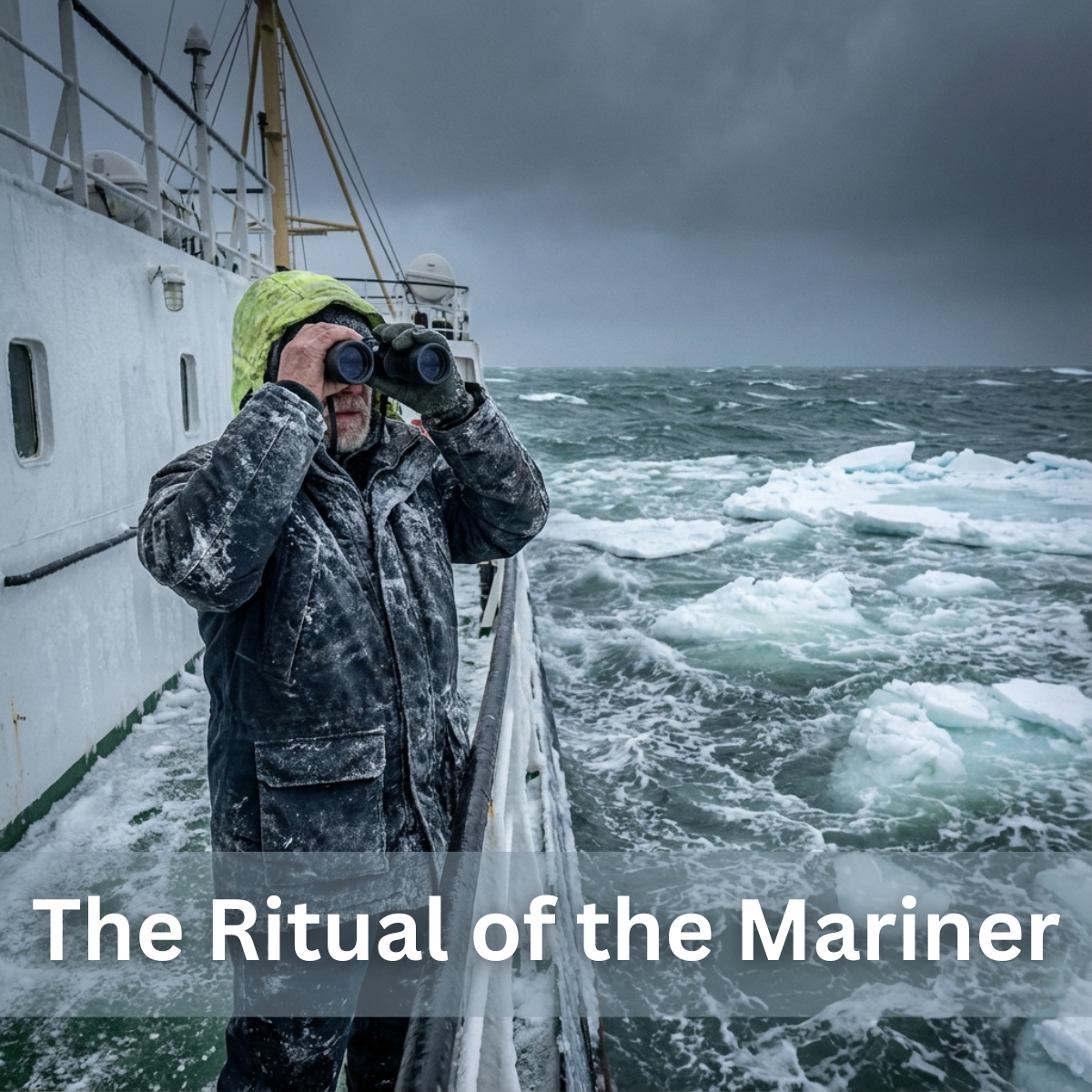
The ancient mariner stood at the helm with salt crusted on his face and wind pulling at his clothes. He had no engine to restart when the breeze died. He had no radar to warn him of the reef. He had no satellite to tell him where he was or where the storm would strike. What he had was ritual. The checking of lines at dawn. The reading of the sky at dusk. The careful notation in the log. The prayer before sleep. These were not superstitions. They were the structure that held him together when the ocean tried to pull him apart.
The sea offered two kinds of suffering. The first was monotony. Days of flat water and slack wind. The horizon is unchanging. The crew is restless. The supplies are dwindling. The mind turns inward and finds only doubt. The second was chaos. The squall arrived without warning. The mast that cracked. The wave that swept a man overboard. The fire in the galley. The mutiny in the hold. Between these two extremes, the mariner had little control. He could not summon the wind. He could not calm the storm. He could only prepare, respond, and endure.
What kept him sane was not hope. Hope is a fragile thing in the open water. What kept him sane was ritual. The same knots are tied the same way every time. The same watch schedule. The exact distribution of rations. The same inspection of the hull. These acts were small, but they were his. They were proof that he still had agency in a world that offered very little. When everything else was uncertain, the ritual was specific. When everything else was out of his hands, the ritual was in his hands.
I think about this often now. I am not on a ship, but I am on a voyage. I am building a startup, and the conditions are remarkably similar. There are long stretches of monotony where nothing seems to move. The product is not gaining traction. The investors are not responding. The team is tired. The market is indifferent. Then, without warning, everything changes. A competitor launches. A key employee quits. A customer complains publicly. A bug takes down the system. A partnership falls through. These events arrive like squalls, and I have very little control over them.
What I do have control over is my ritual. The morning begins the same way. I wake before the sun. I sit in silence for a few minutes and let my mind settle. I write one page in a notebook. Not a to-do list. Not a strategy document. Just one page of honest thought. Then I move. A walk. A run. Something that reminds my body it is alive. After that, I review the priorities. Not all of them. Just the three that matter most today. I choose one, and I begin. Before the emails arrive. Before the meetings start. Before the noise can drown out the signal.
This is not heroic. It is not impressive. It is simply the structure that keeps me from drifting. When the monotony presses in, the ritual gives me something to do. When the chaos strikes, the ritual gives me something to return to. It is the anchor that holds when the wind shifts.
The ancient mariner knew this. He knew that resilience was not about feeling strong. It was about practicing that did not depend on feeling. He knew that faith was not about certainty. It was about showing up to work even when the outcome was unclear. He knew that personal strength was not about never breaking. It was about having a way to put yourself back together after you broke.
The ritual was that way. It was the knot he could tie in the dark. It was the prayer he could say when his voice was hoarse. It was the log entry he could write when his hands were numb. It was the small act that reminded him he was still the captain, even when the sea was in charge.
In a startup, the sea is always in charge. You can plan, but the market will ignore your plan. You can build, but the customer will want something different. You can hire, but the person will leave. You can raise money, but the terms will change. You can launch, but the timing will be wrong. You are not in control. You never were. The sooner you accept this, the sooner you can focus on what you do control.
You control the morning. You control the first hour. You control the decision to begin again when yesterday ended badly. You control the quality of your attention. You control the honesty of your communication. You control the care you bring to the work. You control the ritual.
The ritual does not guarantee success. The mariner who tied perfect knots could still be lost at sea. But the ritual gave him the best chance. It kept his ship seaworthy. It kept his crew aligned. It kept his mind clear. It kept him ready for the moment when the wind finally came.
I have learned to trust this. When the product is not moving, I return to the ritual. When the investor says no, I return to the ritual. When the team is frustrated, I return to the ritual. When I am tired and doubt creeps in, I return to the ritual. It does not solve the problem, but it keeps me in the game. It keeps me from drifting into despair or rushing into panic. It keeps me steady.
The ancient mariner did not have the luxury of waiting for inspiration. He had to act whether he felt ready or not. He had to check the rigging to see whether the wind was blowing. He had to decide whether the stars were visible. He had to lead whether the crew trusted him or not. The ritual was the bridge between intention and action. It was the thing that moved him forward when motivation failed.
This is the lesson I carry now. I do not wait to feel ready. I do not wait for the conditions to be perfect. I do not wait for the market to validate my idea. I begin. I do the next small thing. I keep the ritual. I trust that the accumulation of these small acts will carry me across the distance, just as it carried the mariner across the ocean.
There are days when the ritual feels pointless. The wind is dead. The horizon is empty. The work seems futile. On those days, I remember the mariner. He did not stop checking the lines just because the wind was not blowing. He did not stop reading the sky just because the stars were hidden. He did not stop writing in the log just because the voyage was long. He kept the ritual because the ritual was the only thing that kept him from becoming lost.
I am not lost yet. I am tired. I am uncertain. I am facing conditions I cannot control. But I am not lost. I have a ritual. I have the morning. I have the first hour. I have decided to begin again. I have the knot I can tie in the dark. I have a small promise I can keep. I have work that does not depend on the wind.
The ancient mariner knew that the sea would test him. He knew there would be days of monotony and days of chaos. He knew he would face both with very little control. But he also knew that the ritual would hold. It would have when his strength failed. It would hold when his faith wavered. It would hold when the storm came. And when the wind finally returned, he would be ready. Not because he was lucky. Not because he was talented. But because he kept the ritual.
I am keeping the ritual. I am checking the lines. I am reading the sky. I am writing in the log. I am doing the next small thing. I am beginning again. I am trusting that the wind will come. And when it does, I will be ready.