Yesterday, I reviewed a pitch deck for a company that had raised over $100 million. No customers. No patents. No revenue. Just a concept and a story. I have spent months trying to raise $1 million, and every investor wanted proof. They wanted evidence that the idea could convert into profit. So I sat there staring at the screen, trying to figure out what I was missing. How did this team raise one hundred times what I could not, with less to show for it?
The answer, I think, is mystery.
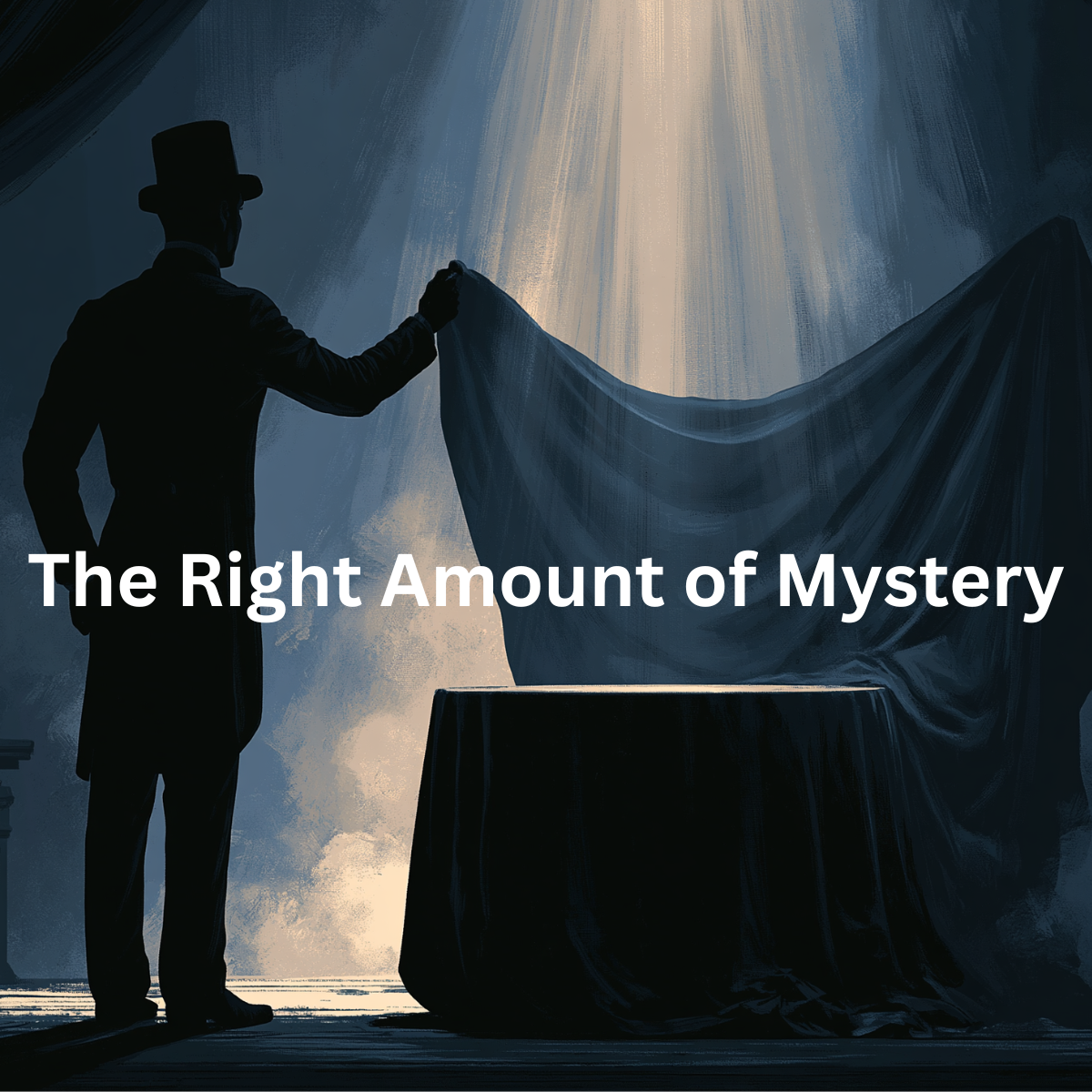
Mystery increases perceived value because people fill in what they do not know with imagination. When something is partially hidden, it creates intrigue. The unknown gives people room to project possibility, status, depth, or magic onto it. That is why luxury brands do not over explain. Great films do not reveal the monster too early. A compelling product demo does not show every wire behind the wall. A confident person does not explain every detail of their competence.
But mystery only works when there is enough visible evidence of value to make the mystery credible. Too little information creates intrigue. No information creates confusion. Contradictory information creates distrust. Over explanation destroys wonder.
The better principle might be this. Reveal enough to create belief. Hide enough to preserve imagination.
In business, this matters. You want people to understand the outcome, the transformation, the credibility, and the reason to care. But you do not always need to expose every mechanism, every feature, every technical detail, or every internal process. The value is often higher when people feel something specific. They think, “That is impressive. I understand why it matters. I do not fully know how they do it, but I believe they can.”
That space between belief and full understanding is where mystery becomes magic.
“Reveal enough to create belief. Hide enough to preserve imagination.”
I went back to my own pitch after that. I looked at how much I was explaining. I was showing every wire, every process, every technical detail. I was trying to prove competence by exposing everything. But I was also removing the room for imagination. I was removing the space where someone could project possibility onto what I was building.
So I started cutting. I kept the outcome. I kept the transformation. I kept the reason to care. But I stopped explaining every step of how it worked. I stopped trying to prove that I had thought of everything. I let the mystery do some of the work.
The next time you are trying to explain what you are building, pause. Ask yourself whether you are revealing enough to create belief or whether you are explaining so much that you are destroying wonder. Then cut what does not need to be there. Let the mystery work for you.