My intellectual journey has led me to a profound bias toward iterative thinking. This approach, at its core, follows a simple yet powerful cycle: Try, observe, learn, adjust, and then try again.
This stands in stark contrast to the linear thinking that characterized my younger years: Analyze, decide, execute, and finish. The philosophical chasm between these two methodologies can be distilled into two distinct principles:
Linear is Perfection-first: One thinks until confidence in action is absolute.
Iterative is Action-first: One acts when sufficient knowledge exists to learn more.
It’s crucial to acknowledge that neither approach is inherently superior, though I confess a preference for the latter. Iterative thinking shines brightest when the cost of learning is low and feedback is readily available and actionable. Conversely, it falters when errors carry extreme costs, are irreversible, or when the problem domain is already thoroughly understood.
Consider product development, writing, strategic planning, software engineering, training, or scientific experimentation—these are fertile grounds for iteration. One can readily test an idea, gauge its impact, and refine it.
However, one would be ill-advised to "iterate" through bridge construction, a surgical operation, nuclear safety protocols, or a significant legal brief. Such endeavors demand meticulous planning, rigorous modeling, exhaustive verification, and adherence to established procedures before execution.
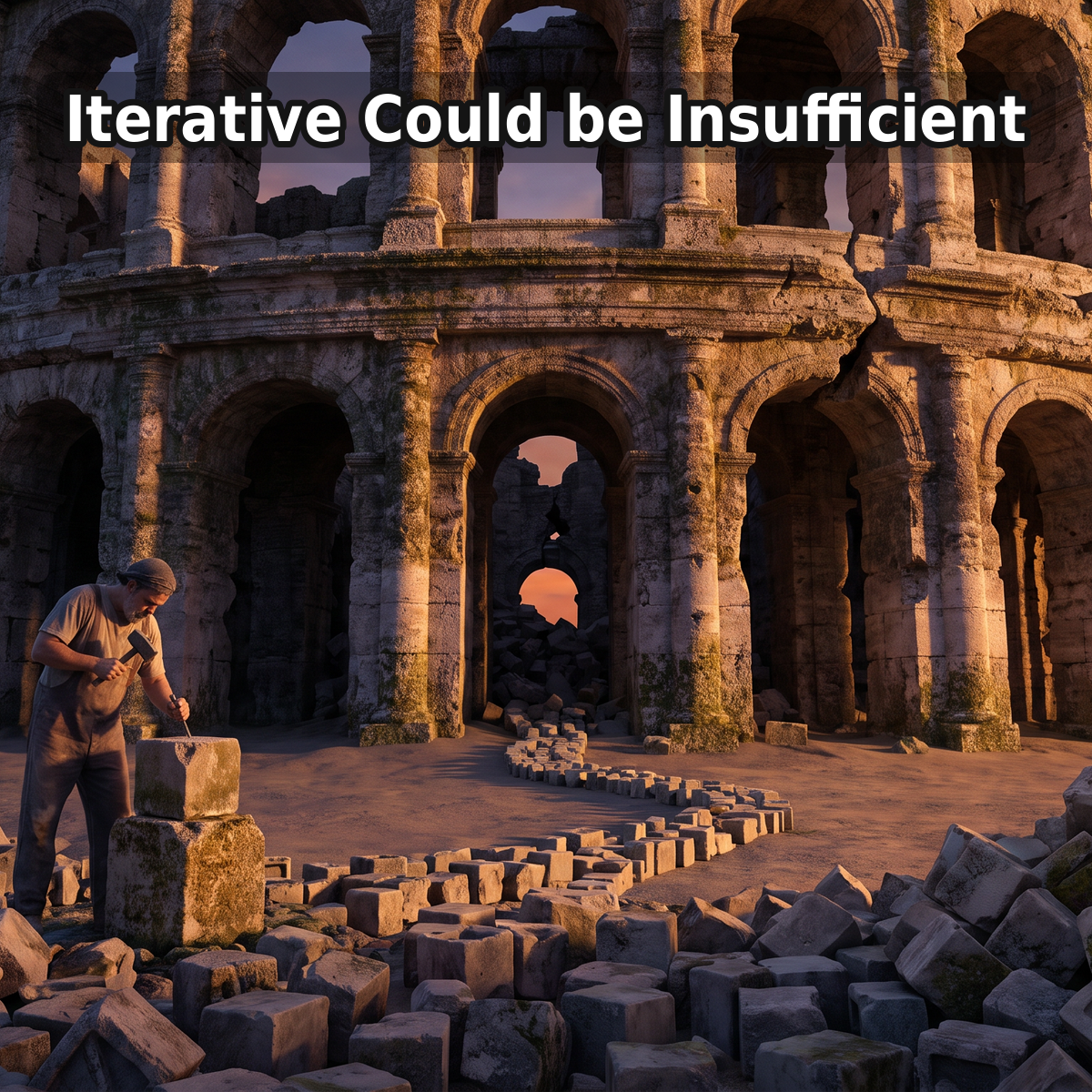
The rapid advancements in artificial intelligence have, rather forcefully, taught me a critical lesson: iteration can, at times, serve as a convenient excuse for insufficient upfront thought. While speed and learning are invaluable, an endless cycle of trial-and-error can squander precious time when careful reasoning could preempt obvious missteps.
Though not yet fully implemented, I am formulating a hybrid approach, a more robust decision-making pathway that synthesizes these two modes of thought:
Think → Plan → Act → Measure → Learn → Adjust.
This might appear self-evident, yet in practice, we often lack the discipline to measure, thereby failing to extract the full lessons from our actions. Unplanned, chaotic actions, devoid of a clear execution strategy and without metrics to track progress, frequently lead to unproductive repetition.
The true inquiry, then, isn’t which thinking style reigns supreme. Rather, it’s about determining the optimal balance: how much thought should precede the initial action, and with what alacrity should one adapt thereafter?