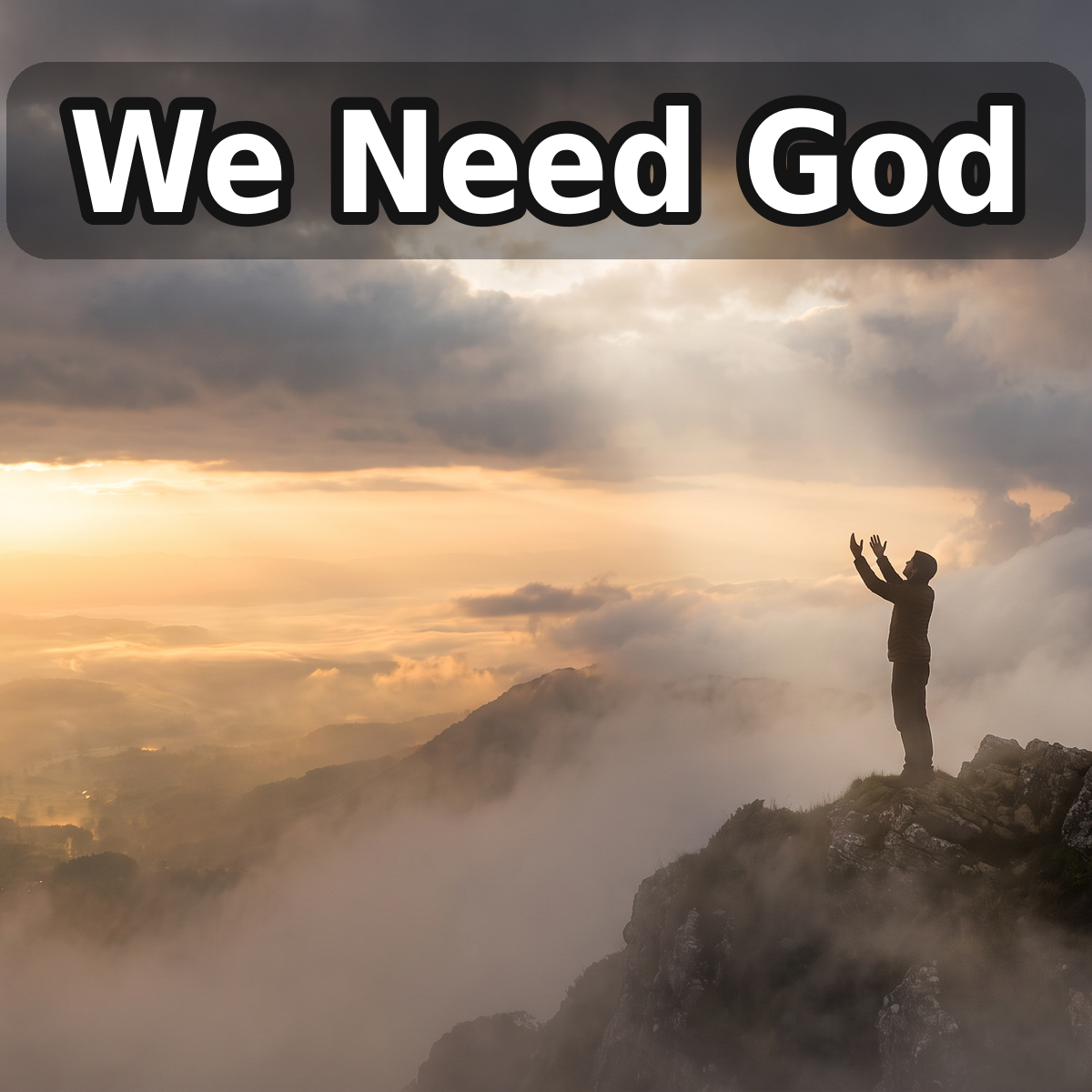
Believe in God or do not believe. Honestly, for the purposes of this post, that is not important. I personally believe in God, I have no qualms stating that unequivocally, but I am not writing this to convince you of anything theological. I am writing this to convince you of something far more practical. You need God. Humanity needs God. Let me explain why.
Humans have a strange problem. We are walking around with these enormously complex brains that can imagine the future, evaluate ourselves from the outside, build moral systems, sacrifice for people we have never met, and chase goals that take decades to accomplish. No other species does this. A hungry animal looks for food. A threatened animal runs. That is the whole program.
Not us. We can be hungry and choose to fast. We can be terrified and walk into the danger anyway. We can turn down money because taking it would violate a principle. We can forgive when revenge would feel so much better. We are capable of overriding what we want in the moment because we believe something else matters more.
Which brings up the real question. What sits at the top?
Every one of us has a hierarchy of values, whether we consciously built one or not. Something eventually becomes the measuring stick that everything else gets held up against. Might be money. Might be success. Might be family, political ideology, pleasure, reputation, power, or just ourselves.
Here is the problem. None of those work very well as an ultimate value.
Money is useful, but it makes a terrible god. Put money at the top and eventually almost anything can be justified in its pursuit. Success is valuable, but dangerous as a god. Put achievement on the throne and watch relationships, health, and integrity quietly become expendable. Politics might be the most frightening god of all. Once a political cause becomes sacred, disagreement becomes heresy and your neighbor becomes your enemy. Even family, and I consider almost nothing more important than family, becomes destructive if loyalty demands that I defend behavior I know is wrong.
Humans seem to need something above all of these things. Something that says money matters, but not that much. Achievement matters, but not that much. Your tribe matters, but not that much. Even your own life is not necessarily the highest thing you are capable of valuing.
This is where God enters the picture.
Whether you believe God literally exists or not, the concept performs an extraordinarily important function in the human mind. The ideal sits outside of our body, and that ideal is God. Something higher than us against which we can measure ourselves. Truth above my preferred version of events. Goodness above my immediate desires. Justice above my self-interest. Love above my resentment.
God provides a fixed point outside ourselves. That matters, because human beings are spectacularly good at moving the goalposts. If I am the final authority on what is right, then give me enough time and I will slowly redefine "right" until it happens to resemble whatever I currently want. We do this constantly. We rationalize anger. We justify selfishness. We excuse in ourselves what we would condemn in anyone else.
A concept of God creates resistance to that whole process. It asks a deeply uncomfortable question. What if the standard does not move just because I do?
Now, this also changes how you think about prayer.
If God exists primarily to manipulate circumstances on my behalf, prayer quickly becomes ridiculous. God, put a billion dollars in my account. God, make me win. God, make everyone agree with me. That is not prayer, that is a cosmic vending machine, and I do not blame anyone for being skeptical of it.
But consider a different kind of prayer. Help me control my anger. Help me see where I am wrong. Help me have the courage to do what I already know I should do. Help me forgive this person. Help me stay honest when dishonesty would benefit me. Help me endure something I cannot change. Help me keep the most important things the most important.
Those prayers make an extraordinary amount of sense. Prayer, viewed this way, is an act of alignment. The struggle between your will and something higher than your will. You stop reacting to the immediate world, you consider your life from a higher perspective, you examine what you want and question why you want it. You stop merely asking, what do I want? You start asking the far better question. What should I want?
Perhaps that is one of the most valuable functions God serves in a human life. God prevents temporary things from becoming ultimate things. God reminds the wealthy man that money is not the highest good. God reminds the powerful man that power is temporary. God reminds the angry man that justice and revenge are not the same thing. God reminds all of us that there just might be something more important than ourselves.
You can argue endlessly about whether God exists. Humans have been at that argument for thousands of years and I suspect we have thousands more in us. But there is another question that may be just as important. What happens to a human being when nothing exists above them?
When there is no higher standard, something else takes the throne. It always does. Money. Power. Politics. Pleasure. Tribe. Ego. We always put something up there. So perhaps the question is not whether human beings will worship. Perhaps the question is simply what we will worship.
That is why I believe we need God. Not because God should give us everything we want. Quite the opposite. We need God precisely because we need something that teaches us that everything we want should not necessarily be ours. We need something above ourselves that calls us upward, reminds us who we are trying to become, and keeps forcing us to reconsider what deserves to matter most.
So believe in God or don’t. But choose very carefully what you put in God’s place.