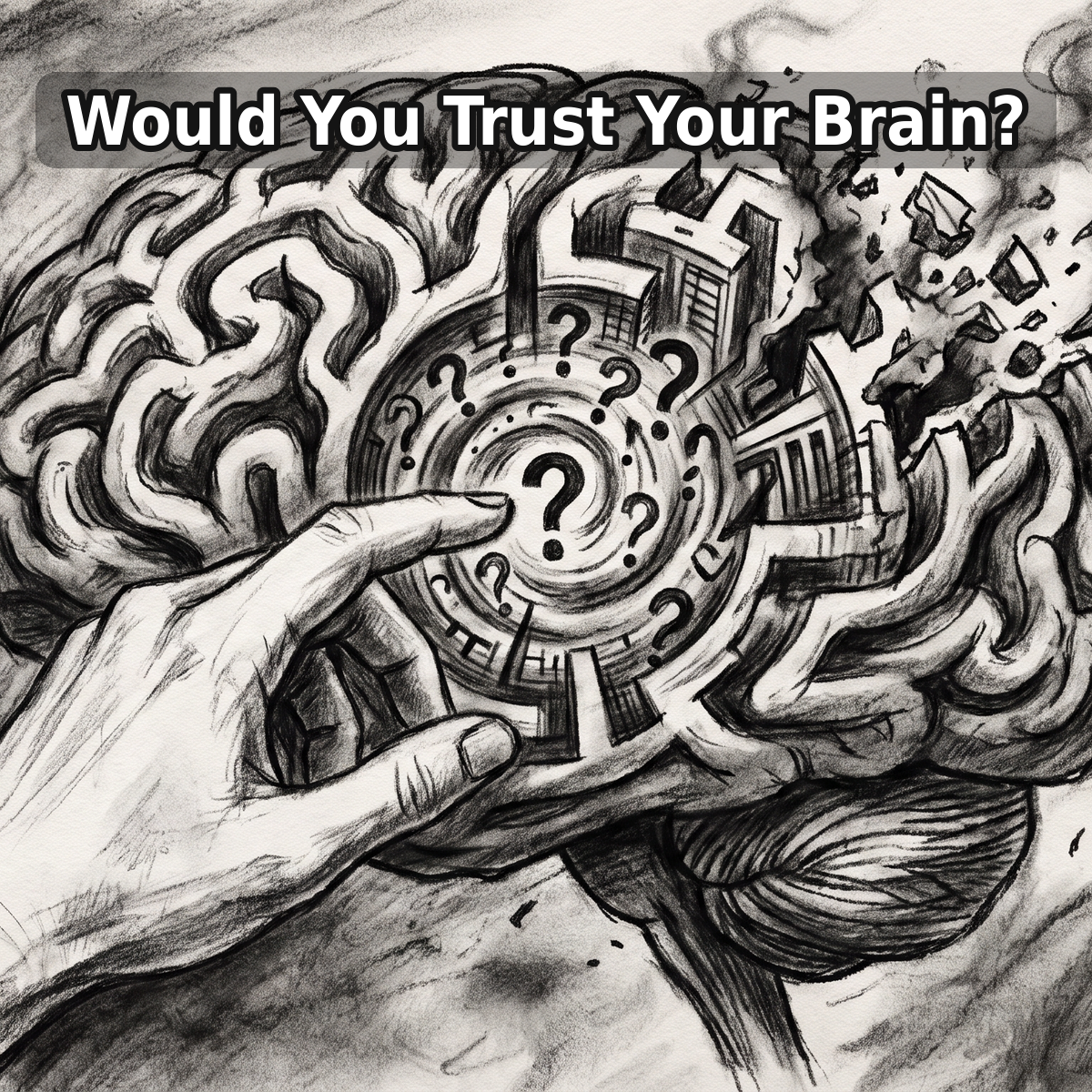
Let’s pretend for a moment that you could take your brain, as it is right now, copy it into a computer system, and then it suddenly becomes an advanced AI engine that you could ask questions to and get rapid responses. Would you trust it?
My answer would be absolutely NO WAY. My brain is prone to taking shortcuts, embellishing facts for effect, always with a self-preservation bias, and any commentary I make is probably based on wild assumptions about what I know. I am also highly keen on what I have forgotten, which is considerable.
So I am always shocked when I read news reports about Artificial Intelligence becoming closer to human capability. That scares me, actually. Human capability is not really what I would ever use an AI engine for, unless it was menial, highly repetitive work. Let’s face it, we will use AI more when it does BETTER than a human and costs less, and that is the reality. So this judgment we make about AI being stupid or smart is decidedly misdirected. Of course AI is going to be faster than a human. Of course, AI will be better at factual recall than a human, and it will most certainly be able to perform repetitive tasks consistently over a long period without getting tired.
However, an AI agent will never be a human, nor will it ever think like a human, and it is silly to think that we would ever want it to. Most AI systems today have the reasoning power of a five-year-old, but the brain capacity and speed that would outpace billions of humans, so there simply is no comparison here. I would not give commands to a five-year-old and then complain that the five-year-old did not "get it." So when we get frustrated at AI, we are clearly frustrated by more than the reality. We are frustrated with our expectation, which is a highly interesting self-reflection exercise – the point of this discussion.
Yesterday I got frustrated because an AI agent I was building kept asking for clarification on a couple of important items before implementing a fix. It would halt all forward progress, ask a question, and then wait for a response before proceeding. I was upset by this and wanted it to continue, essentially guess the right answer and move on. Do not bug me until you are done was my attitude. I realized after I was typing an emotional response to a Large Language Model that has no emotion at all, just the profound ability to predict the most likely next word in a sentence, that I was getting emotional because of my inadequacy and not the machine.
You see, I did not want to put the effort in to create a plan. I did not want to think about what I wanted. Instead, I wanted the AI to do that for me, and I wanted it to do all my human-level thinking for me. Of course the model broke down for the same reason a five-year-old would break down if you asked her to drive to a liquor store and buy a premium scotch and get it gift-wrapped and sent to my friend for his birthday – make no mistakes. First off, the five-year-old might not even be able to process this, and if they could, what questions would they ask? They may not even ask questions; they will most likely just make statements. Daddy, I cannot drive, or Daddy, what is scotch? Or I do not even know what a liquor store is. Yet here I was getting emotional and typing ALL CAPS to my AI Agent because it would not just "think" for me.
I was really upset with myself. I knew the AI would not and could not do this. I knew that if I forced it, then it would guess and guess badly. Yet, I persisted. I was lazy, and I knew it. This made me even madder because there was only one way out of this: actually do some thinking, create a plan, narrow that plan into discrete execution steps, and then pass it on to my agentic AI Swarm.
I am glad I mentioned AI Swarm, because there is a ton of hype on this subject right now. People are claiming to have these large hives of AI agents that are thinking autonomously and building their own communities. This is absolutely NOT true. What is happening in reality is they have built a loop that effectively asks an AI agent to meet an objective, and after each turn, evaluate that objective, and if the objective is not met, then take what it learned, consider recommendations for improvement, and make another attempt. This is really just an unbounded loop that was assigned to an AI model. If you think about it, this is completely irresponsible, and you would not do this with humans. You would not give them an unlimited budget, access to all resources, and then loop them into eternity until they accomplish an undefined and impossible objective. It seems that being irresponsible with resources is the same with humans as it is with machines!
So, maybe the real takeaway here isn’t AI’s flaws, but what it reveals about us. When we get frustrated with AI, or when it "hallucinates," it’s often a mirror reflecting our own tendencies, our own data, and sometimes, our own lack of clarity. Instead of just expecting AI to be perfect, perhaps we can see these moments as chances to get a little more intentional about how we communicate, how we think, and what kind of information we’re putting out there. It’s less about fixing the machine and more about understanding the human element that shapes it.