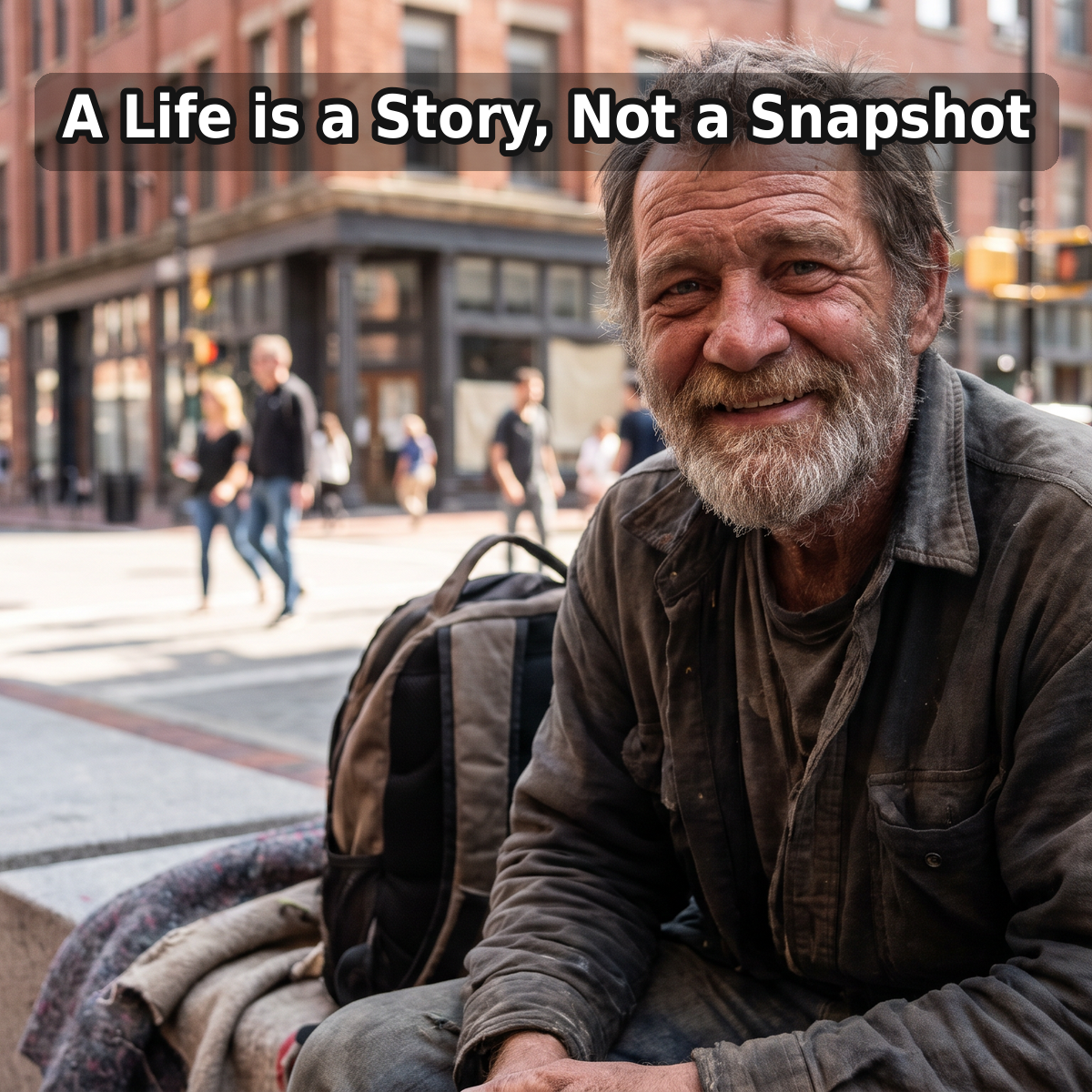
There is great danger in judging the value of a life from its present condition. A human life is a long trajectory, but we tend to encounter people as snapshots. We see who they are now and unconsciously let that moment rewrite everything that came before it. When I was in high school, my aunt and I drove around downtown, taking pictures of random people. I was trying to get on the yearbook staff as a photographer. The only people around that afternoon were the homeless. I came across one of the photos I took of one of these men, with a bright smile and a jovial expression.
I remember the moment; the man looked passive and distant as he stared out at the street, invisible to everyone who passed by. Then, suddenly, out of nowhere, a young kid and his aunt came rushing in and asked to take his picture. He asked what for, and I explained to him that I needed to submit a bunch of pictures to an advisor to go along with my application to be a staff photographer. He said something to the effect, "Well, in that case, we’d better make this look good." So he smiled, and I took his picture. I did get on the yearbook staff, and ended up taking most of the photos that show up in our high school yearbook. Unfortunately, I got into some trouble late in the year, and they removed my name from any attribution. So the few months of my emerging career as a photographer came to a quick end. What did I do wrong, you might ask? I sold yearbook advertising to an organization that wasn’t exactly a great look for the school. A story for another day.
Anyway, at that moment in time, I viewed that man as a homeless person. His entire lifetime of experiences had been reduced to my momentary view of him. I have no idea what he did after that, or what he did before that, but in my mind he was just another homeless person. All too often we let the present condition become the identity for others and often ourselves. We are all this homeless person at least one point in our lives. We all have a bad day, a bad moment, a time when we are at our lowest point. If someone took our picture at that moment, we would be forever captured and judged by that snapshot.
However, our value is not a snapshot, and we intrinsically know this. The stories of Jesus healing the stranger, talking to the woman at the well, or feeling his virtue leave him by the touch of a stranger all resonate with us because we all desperately cling to the idea that all of our contributions over time must mean more than their present value. It gives us hope that the life we have lived has accumulated value and that the worth of our soul is indeed great.
The modern way of thinking that human worth must continuously justify itself through current productivity. That standard becomes particularly cruel because nearly everyone eventually loses under it. Strength fades. Cognitive ability can decline. Careers end. Circumstances change. Eventually, most of us will need more from other people than we are presently capable of giving them. Someone’s worth should not depend entirely upon whether their lifetime ledger happens to show a positive balance. But recognizing the difference between a lifetime and a snapshot is an important place to begin.