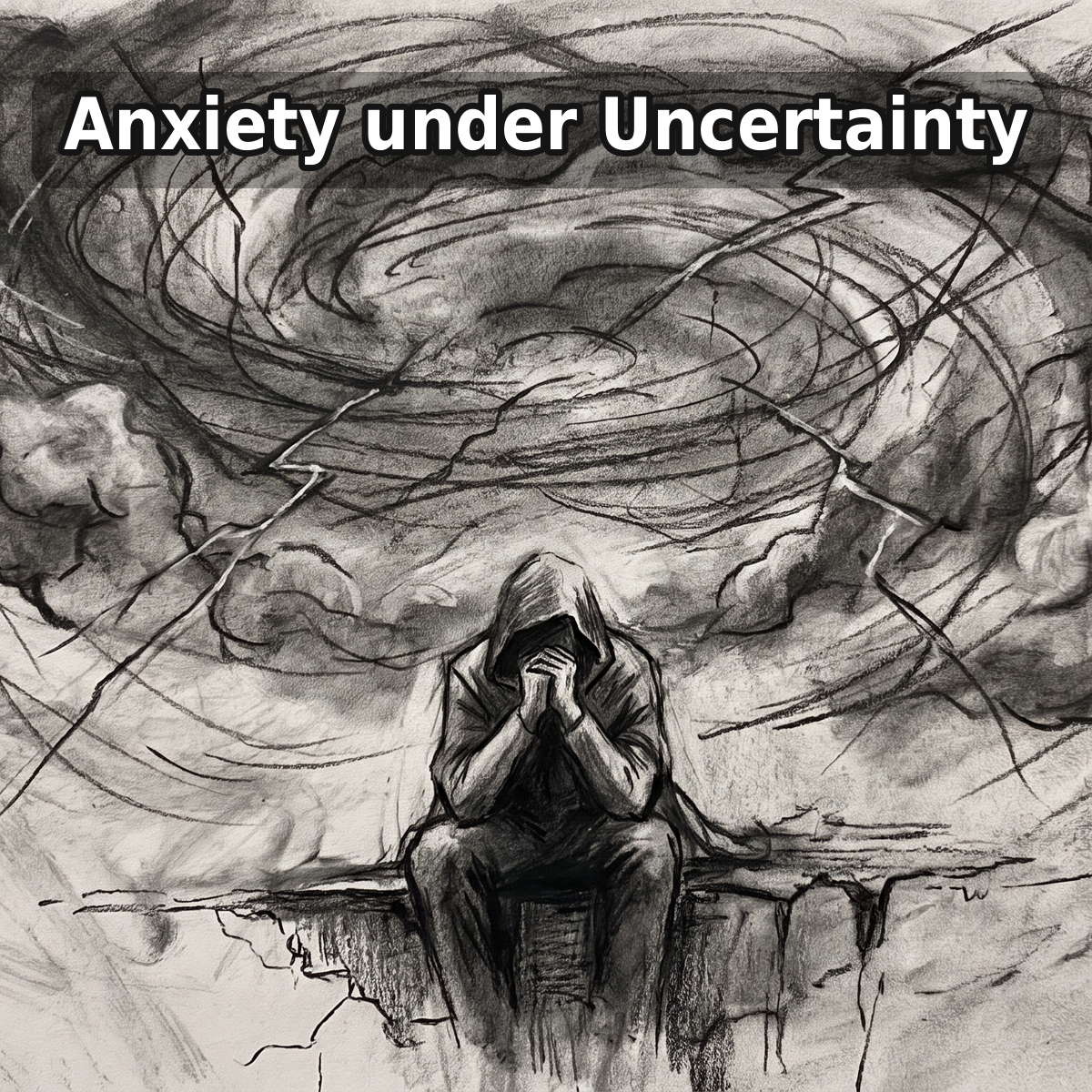
This next week, I am going to try to focus on coming to grips with anxiety that is caused when you are faced with uncertainty. Anxiety can come from many sources, but this source is, in particular, quite troublesome. When the outcome is uncertain, your brain becomes highly active, and when that pairs with the anxiety of not knowing the result, it can become an emotional burden. I think my first breakthrough on this topic came when I recognized that a thought about a possible future isn’t evidence that it will happen.
When an important outcome is uncertain, the brain can interpret that unpredictability as danger. It begins generating scenarios, often favoring negative ones because it is attempting to protect you. This creates a cycle in your thought process which can spiral toward increased anxiety. Due to an uncertain outcome, your brain starts to anticipate potential threats; you then worry about imagined scenarios, which leads to actual physical anxiety, as if your body is preparing itself for the pending attack, and then, to resolve this, your mind starts searching for anxiety. When you cannot find certainty to pull you safely to shore, the brain starts all over again.
The problem is that thinking harder does not necessarily produce more certainty. Sometimes it simply produces more anxiety. To avoid this cycle, actively remind yourself that just because you thought of a possible scenario about a possible future does not mean that this future state will occur. Most likely, you don’t need to do anything, because this future scenario probably won’t happen. Fretting, wringing your hands, and stewing over all the possible scenarios of your destruction put your mind and body into survivalist mode, so the first defense is to check these doomsday scenarios you craft in your mind earlier in the process. Before they have time to overwhelm you with feelings and symptoms of anxiety.
So, as you go about your day, maybe try to remember that it’s okay to just let things be uncertain sometimes. It’s not about ignoring what’s ahead, but more about recognizing that you don’t have to have all the answers right now. Just like you wouldn’t beat yourself up for feeling a bit under the weather, don’t beat yourself up for feeling a little unsure about what’s next. It’s a natural part of being human, and sometimes the best thing you can do is ride the wave, knowing you can handle whatever comes your way.