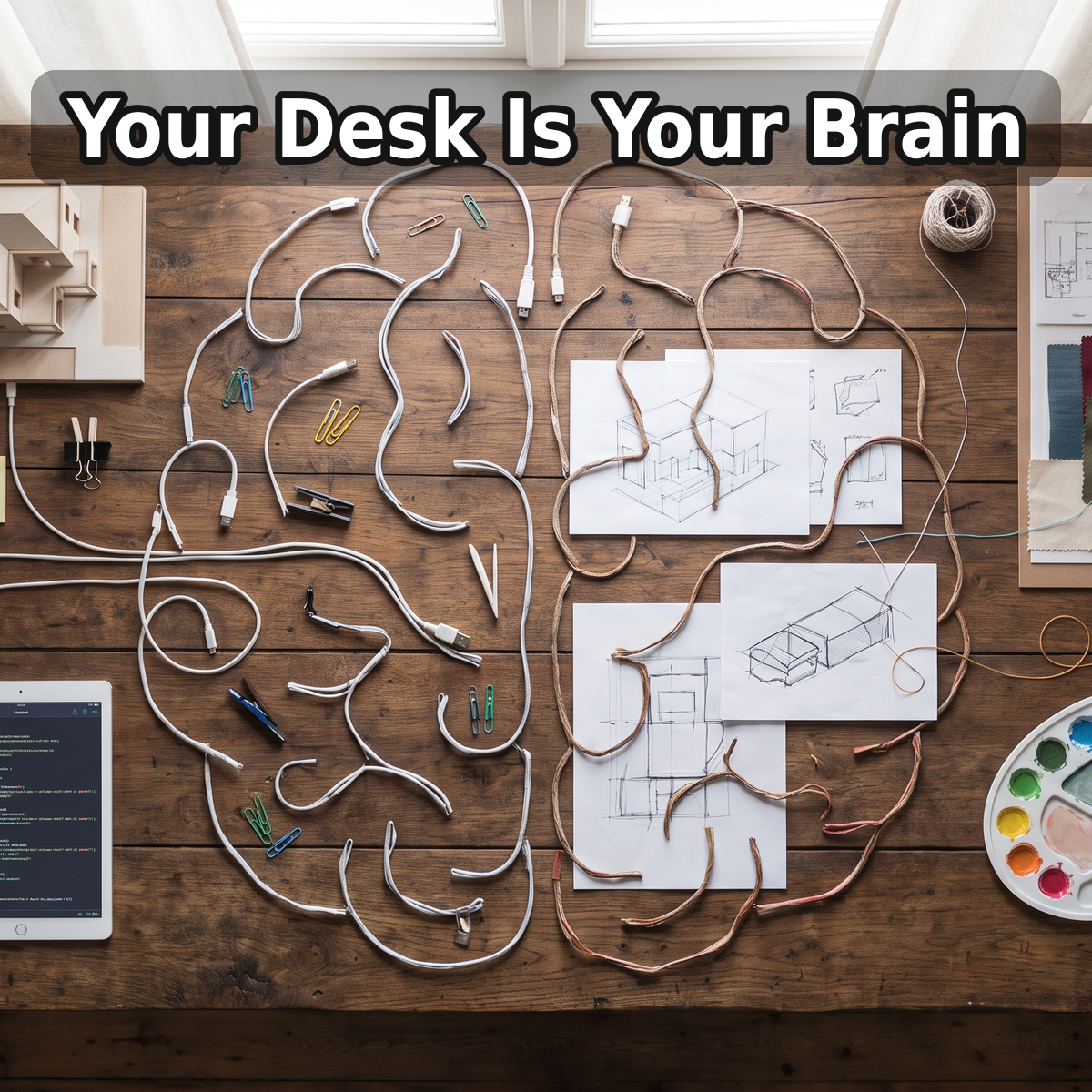
Look at your desk right now. The one you work at, if you have one. You are not just looking at your desk; you’re looking at your brain. Is it messy, chaotic, and disorganized? Perhaps it is structured and clean with everything in the proper place? Are there doodles everywhere, discarded candy wrappers perhaps? Are there notes of things that were really important to remember from months ago? What you are looking at is not just a messy desk, you are looking at a snapshot of what your brain looks like as well.
Now, I am not suggesting that a clean desk means you are intelligent or that a messy desk means you are not. I have known some brilliant people who operate in complete chaos. However, I do believe that our physical environment is often a reflection of the things we are allowing to occupy our minds.
Consider that stack of papers sitting off to the side. Why is it there? Perhaps it represents decisions you have been avoiding. That sticky note with a phone number on it? Maybe that is a conversation you have been putting off. That unfinished project sitting in the corner? Perhaps it represents something you started with great enthusiasm but never found the discipline to finish.
We tend to think of our thoughts as something completely separate from our physical surroundings, but I am beginning to believe that the two are far more connected than we realize. We leave things on our desks because we do not want to forget them. Eventually, however, we become so accustomed to seeing them that we forget them anyway.
I have noticed something about myself. When I take the time to organize my workspace, I often find myself organizing my thoughts at the same time. I am forced to make decisions. Do I really need this? Is this still important? Why have I been holding on to this? Those questions are not really about the objects on my desk. They are about the priorities in my life.
Perhaps the exercise we should all consider is not simply cleaning our desks, but deliberately deciding what deserves to remain there.
So here is my challenge for today. Take fifteen minutes and examine your desk. Pick up each item and ask yourself why it is there. Make a decision about it. Keep it, act on it, or get rid of it.
You might discover that you are doing something far more important than cleaning a desk.
You might just be clearing your mind.