When I was seven years old, my neighborhood was divided into two types of households: those where moms watched ‘As the World Turns’ and those where they tuned into ‘General Hospital.’ We rarely mixed with families outside this soap opera circle. Returning home from second grade, I was always eager for the latest on Luke and Laura from ‘General Hospital’ — yes, we were firmly in that camp. Regardless of the show, each episode unfurled the latest in romantic entanglements, family drama, career challenges, criminal activities, the occasional pressing social issue, and, sometimes, a supernatural occurrence bordering on the unexplainable. Over time, I realized the multitude of problems faced by these characters didn’t matter much in the grand scheme. You could skip six months, tune back in, and find the storylines relatively unchanged. Problems arose and dissipated; the world kept turning, and life continued much as before. This early lesson in perspective taught me the relative scale of issues we face.
Watch my video on As the World Turns, here
A day, as we commonly understand it, is rooted in the natural phenomenon of the Earth’s rotation. In reality, a day represents the time it takes for the Earth to complete one full rotation on its axis. This period was observed and recorded by ancient civilizations through the Sun’s apparent movement across the sky. However, the division of the day into 24 hours is less about celestial mechanics and more about human convention and history. This system dates back to ancient Egypt. The Egyptians used a sundial during the day, which divided the period of daylight into 10 parts. They also added a twilight hour at the beginning and end of the day, making 12 hours in total. For the night, they used a system of 12-star groups or decans, each appearing on the horizon for an hour. This 12-hour division was likely chosen for its divisibility — 12 has many divisors (2, 3, 4, 6), making it a practical choice for subdividing periods of time. The 24-hour day, as we know it, emerged from combining the 12 hours of the day with the 12 hours of the night.
While a day is determined by the Earth’s rotation on its axis, a year is defined by its orbit around the Sun. It takes approximately 365.24 days for the Earth to complete this orbit. This period has been recognized since ancient times, with early astronomers observing the changing positions of stars and the seasons to measure the length of a year. This slight discrepancy led to the gradual misalignment of the calendar year with the solar year. To correct this, the Julian calendar, introduced by Julius Caesar in 45 BCE, included an extra day every four years (the leap year) to account for the additional 0.24 days. The more accurate Gregorian calendar, which most of the world uses today, refined this system further by omitting leap years in certain centennial years unless they are divisible by 400. Thus, the 365-day year is a human adaptation to an astronomical reality, rounded for practicality and periodically adjusted to stay in sync with the Earth’s journey around the Sun.
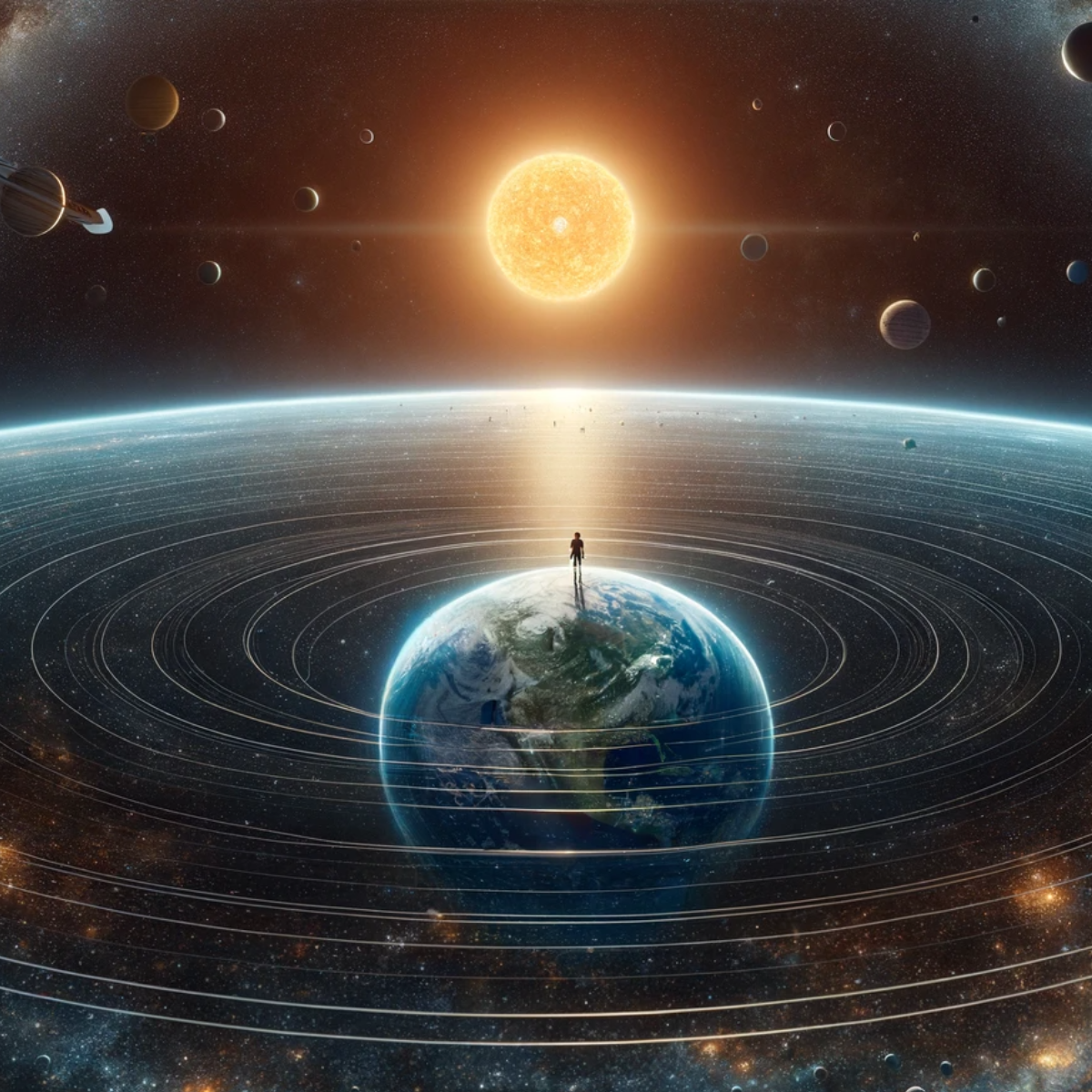
I bring all this up to emphasize that time is entirely about our perception of reality. Each moment, each minute, each hour, the Earth is spinning at over 1000 MPH and traveling around our Sun at over 66,000 MPH. Our solar system is traveling about 514,000 MPH around the center of our galaxy. So, this morning, when I was running, I thought I was moving too slowly. I felt sluggish, unable to keep up my intended pace. However, isn’t there a perspective to be considered here? Despite my perceived slowness, I am actually traveling extremely fast right now, just in a way that’s imperceptible to me. Have you ever considered how fast you move with the Earth, even when you feel still?
This thought leads to a broader reflection: what other aspects of our lives are influenced by how we perceive them? Can shifting our perspective change our experience of time, challenges, and ourselves? As the world turns, perhaps our understanding of it, too, invites us to look at the familiar in new ways.