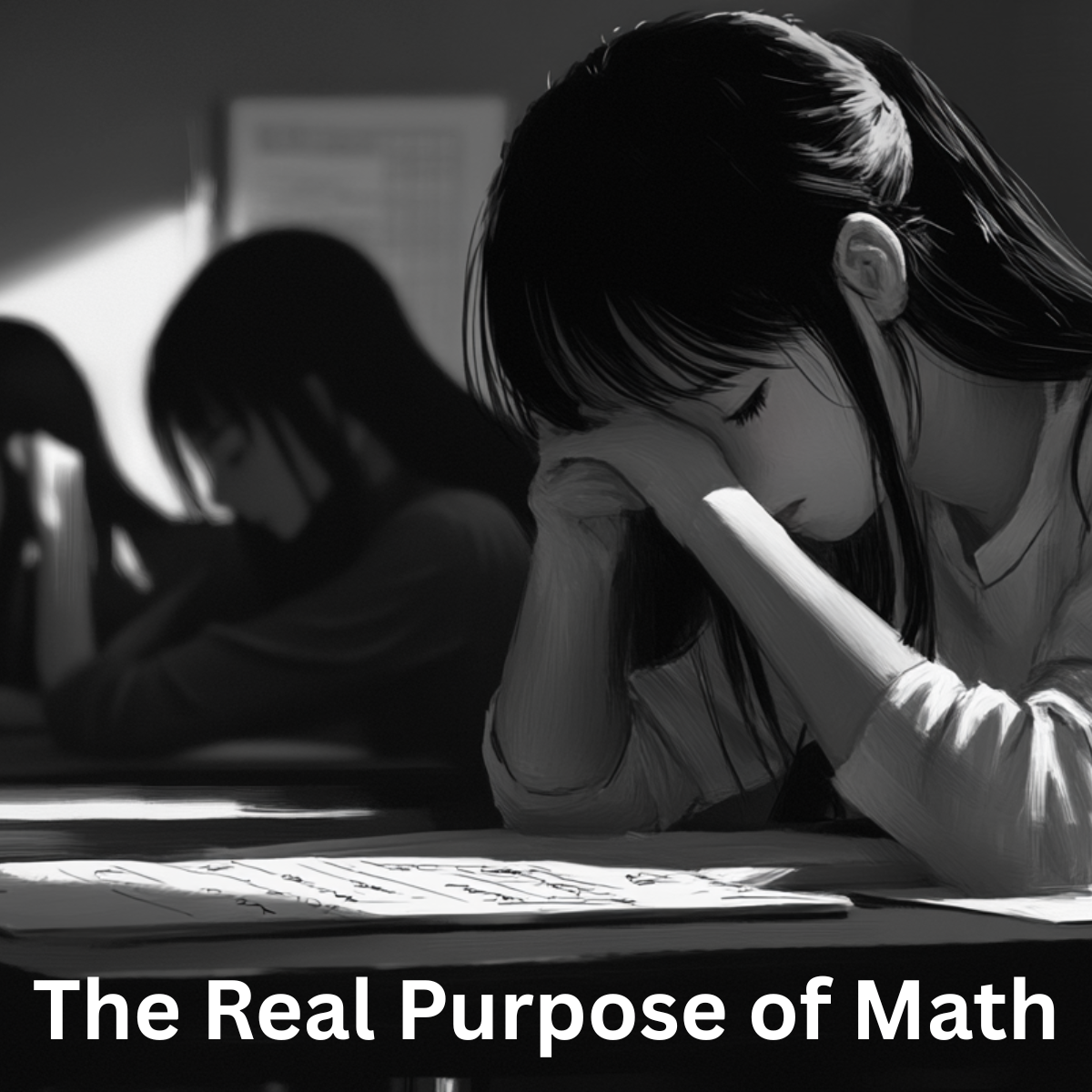
I have taught high school algebra to six people in my life. When I say taught, I mean did their homework, helped them prepare for tests, and held their hand as they sobbed uncontrollably because they were convinced they would never pass the final. I have spent many late nights—unexpectedly, of course—assisting with last-minute assignments that the “teacher just assigned out of the blue today.” I dare say I’ve become somewhat of an expert on what learning math actually does to the human spirit and what one ultimately gains from it. Inevitably, usually approaching midnight after tackling several increasingly severe problems, the question arises: “What am I ever going to use this for anyway?”
As I write this, I recognize that the United States is falling hopelessly behind in math and science. These disciplines are not treated with the same enthusiasm as softer-skilled courses. Social sciences and humanities have taken center stage for quite some time now, and we have simply forgotten what it takes to push through and grapple with exceptionally challenging concepts. We have lost the art of constant repetition until patterns emerge—patterns that become recognizable later when solving more complex problems. Each of these complex problems is, after all, a culmination of smaller, previously mastered steps. We complain that average wages for younger people are declining and that college costs are skyrocketing, and these are valid concerns. However, we also have a difficulty problem. The reality is that future jobs in our society will be complex and will require high-order logic and reasoning skills.
I also realize, reflecting on my children’s experiences, that many students shrug off math as “too hard,” opting instead to cheat or whine their way to a passing grade. There are certainly those who excel and even embrace math problems nightly, but they represent a small percentage. Even at the high-end tech academy my two oldest children attended, a large portion of students seemed to slip into an early-stage coma whenever the word “Calculus” was mentioned.
We marvel at how AI simplifies language and writing, but the fields of computer science and engineering have been impacted equally, if not more significantly. If you thought using an LLM to write your English essay was easy, consider how simple it has become to take a photo of your math worksheet and get instant answers. Basic Python scripts are now easily automated. The days when I struggled through data structures and algorithms in C seem distant. This technological shift creates a new environment in which the question, “Why do I need to understand this at all?” is becoming increasingly common among the rising generation.
So what is the real value of learning math? Why is it important to graph a cube root function, determine the domain and range, or identify transformations resulting from changes in operands? It comes down precisely to learning the right way to think: breaking down problems into manageable parts and solving what you know first. This form of logical thinking is essential, perhaps the only genuinely critical high-order skill all young people must master. There’s also significant value in overcoming mental resistance and actively using your brain to solve difficult problems, though this is secondary. The practice of repetition leverages human pattern recognition, refining skills and ultimately enabling those who master this habit to excel significantly over their peers.
So tonight, I’ll be diving headfirst into another long algebra session, preparing for the looming final exam. My daughter will inevitably glare at me, convinced that this is some form of parental torture. But perhaps someday, amid her future successes, she’ll pause to reflect and reluctantly admit that solving for “x” wasn’t just math—it was preparation for solving the greater puzzles of life. For now, though, I’m bracing myself for yet another midnight algebra showdown. Wish me luck—I’ll need it.