There’s a lot of talk and theory about taking one path or another. The road less traveled. The straight and narrow. The shortest path first. We are taught to follow the map, read the signs, and keep ourselves aligned to true north.
But what do you do when there is no path?
Last year, I went on a backpacking expedition into a wilderness area. For the most part, there was a trail to follow. However, there were moments when it completely disappeared—washed out by a river or swallowed by overgrowth from the previous spring. We found ourselves perplexed, scrambling around, trying to rediscover the way. For about an hour, we tried a few different directions—each one ending in a dead end.
Eventually, I decided to take a break. I sat by the river to enjoy the view, eat lunch, filter some water, and dry my socks on a rock. While watching water skimmers drift along the current, I had a sudden realization: What if there is no path at all?
That thought led me to a deeper consideration. Maybe all this emphasis on “staying on the path” is flawed advice in the first place. Who says the existing path is the right one? Who says the people who marked the trail even knew what they were doing? We put a lot of blind faith in whoever carved out the original way—shouldn’t we stop and question that sometimes?
I realized we could have had just as good a time staying where we were. We could have explored, set up camp, and simply enjoyed ourselves. We could have meandered down the river and discovered whatever came our way.
I was mulling over this idea when I looked up and noticed a cairn of rocks I had missed earlier, hidden behind a fallen tree branch. Sure enough, just beyond it was a clearly defined trail. We had found our way.
Or had we?
Later that day, after following the trail for a while, we sat in a glade of trees to eat lunch. Then the hail came—larger than I was used to. We were wet, tired, and realized that if we stayed on this trail, we’d be in for several more miles of cold, soggy hiking through wetlands. That’s when I decided to veer off course and take a new route.
Not long after, we found a spot where we spent the day—a hidden gem and the highlight of our entire experience.
Maybe we don’t need to be heading somewhere all the time. Maybe the experience is the destination. Maybe the journey really does come before the destination.
Instead of constantly trying to clarify the path, perhaps we should consider what we’re doing while we’re on it. I’m on a path now, and I keep thinking that one day I’ll reach the end, and everything will finally fall into place.
But what if there is no end?
I think that’s the truth of it. There’s no gold at the end of the rainbow. Only death—and whatever comes after. So maybe I should worry less about the destination, and more about how I live right now.
In the words of Mr. Garcia:
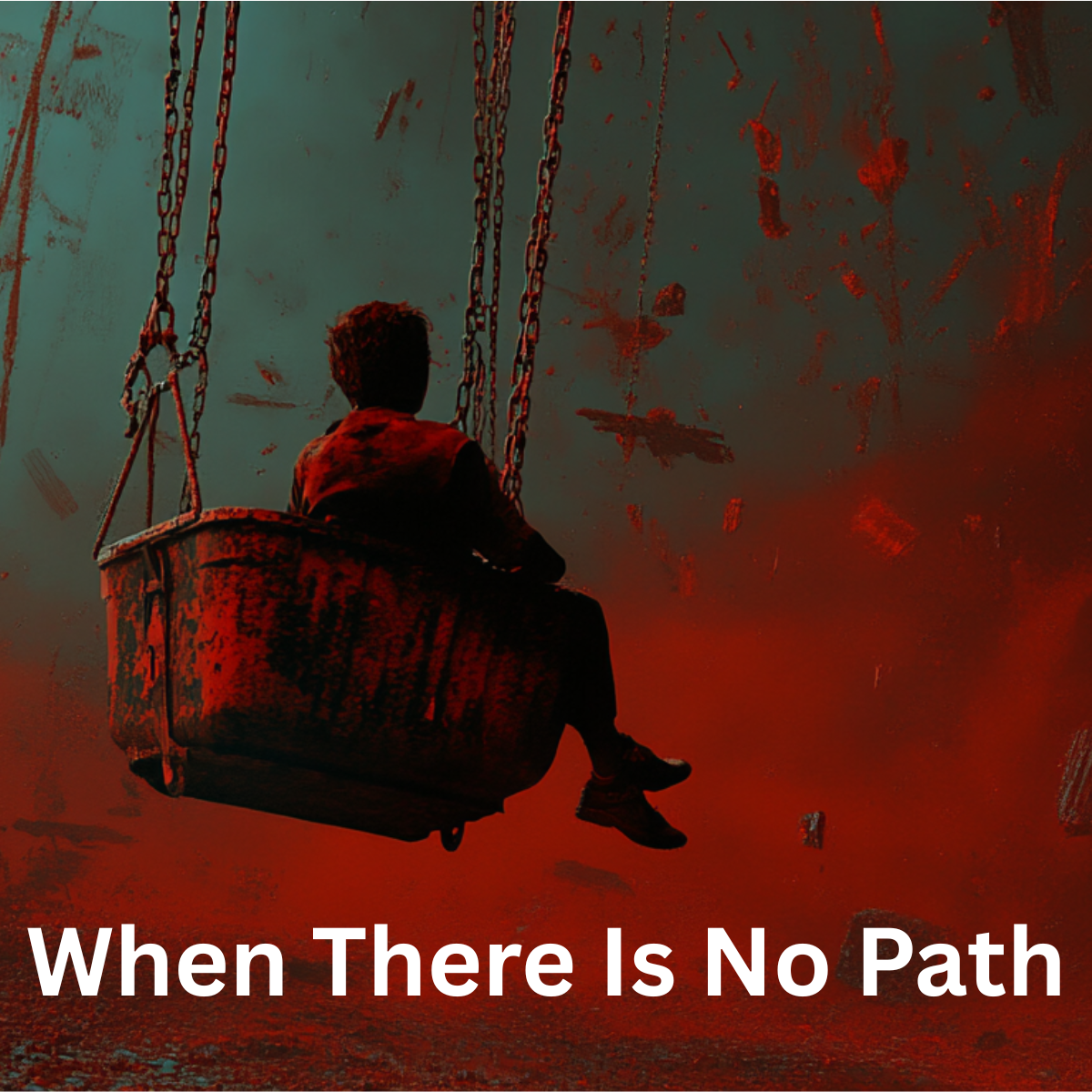
“I may be going to hell in a bucket, but at least I’m enjoying the ride.”
That sentiment—sarcastic though it may be—is fitting. I don’t really know where I’m going, but what I do know is this: the only thing I truly have is what’s in front of me right now.
The past is gone. The future doesn’t exist yet.
All that matters is what’s happening right now.
So I might as well take a few moments to enjoy what I have—rather than constantly wringing my hands, wondering where the next signpost is supposed to be.