On the first night of my backpacking trip last week, I discovered that I had forgotten a book to read. A tragic mistake, indeed. Here I am, laying on the ground, unable to sleep, with nothing to do but stare at the sky. My aunt happened to have a spare book called Poetics by Aristotle. This is most likely the first and foremost piece of literature on the dramatic arts, and this kept me busy for at least one night.
During this read, I was reminded of this ancient theory about our capability as humans to conceive of and understand what is not here. Call that imagination if you will, but we have this rather unique ability to visualize things in our mind that do not exist.
What is interesting about this talent that we all have is that this capacity to imagine things uses the same mechanism and neural pathways we use when we remember something. Which means that memory and imagination are closely related. In fact, we have the ability to remember an imagination, which is quite incredible if you think about that for a moment. So in essence, our memory capacity and our unique ability to imagine are closely related categories in our brains. I think, for the most part, the brain does not distinguish between the two.
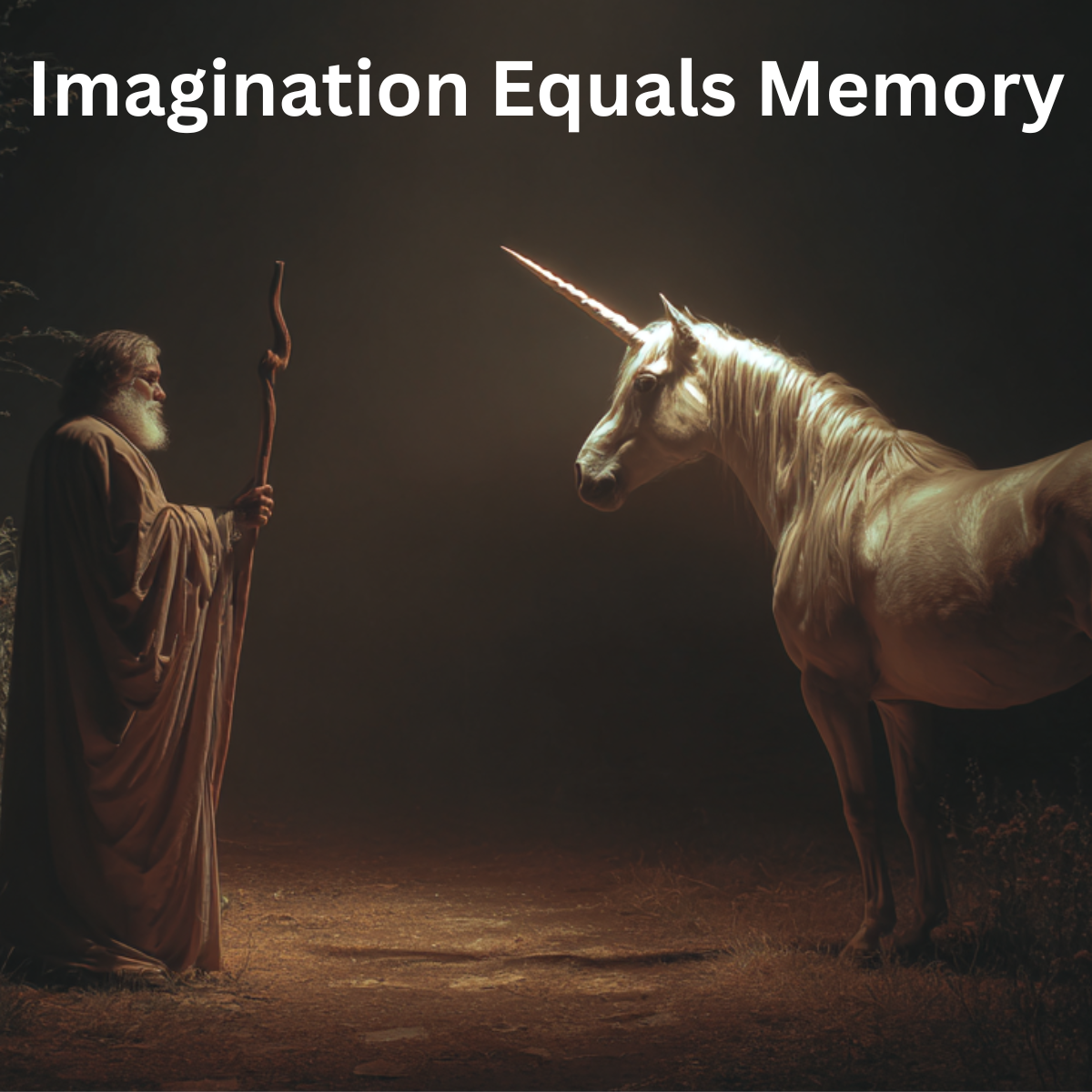
When you imagine something, you are most likely taking elements of what you remember and combining them together to create the new imagination. When you imagine a new beast, such as a unicorn, you think of a horse and then a horn and then combine them together. You can do this recombining-fragments concept with many elements, including memories, stories, emotions, images, and potentially scents. It is important to understand this ability of ours because it can become quite useful as a tool to aid in many aspects of our lives, including our business ambitions.
The first consideration is using this understanding to help yourself conceive of something that does not exist yet. For example, a new and innovative product or service idea. You can deliberately trigger this capability by forcing yourself to ask questions such as, “What if this were easier, faster, better, or more magical?” You can also break what you know down into individual parts and then reassemble them back together in your mind; what combinations will you come up with? By reviewing contradictions, frustrations, and problems of your potential clients, you can start to see how things could be different than they are now. You have the ability to do this, to imagine this, and reassemble what you already know into a potential solution.
The second consideration is that you can actually make your imagination a memory. If there is something you want to achieve, like some massive successful event in the future, you can imagine it. You can picture it in your mind with surprising detail. Then you can memorize it and bring it back to your mind every once in a while. After doing this for long enough, your brain will not tell the difference between the imagination and the memory. As a consequence, you will start behaving like it has already happened. This is why all that new-age hippy stuff about vision boards probably works. Napoleon Hill said, “Write it down.” Well, I say, imagine your success until your future destiny becomes a memory.
Understanding how our brain functions, especially when it comes to our powerful imagination, can be an accessory to fulfilling our ambitions. By realizing how we are able to visualize things, reassemble them, and recall them over and over again, we can start to see how the brain can be used to achieve some extraordinary things.
A sociologist named Robert Merton created this idea that was popular when I was young. It was called the “Self-Fulfilling Prophecy.” He taught this from a more negative social effect. For example, if we believe the banks will fail, then they will, because we will perform actions that will cause it. I am more in the William James camp: “Believe that life is worth living, and your belief will help create that fact.”