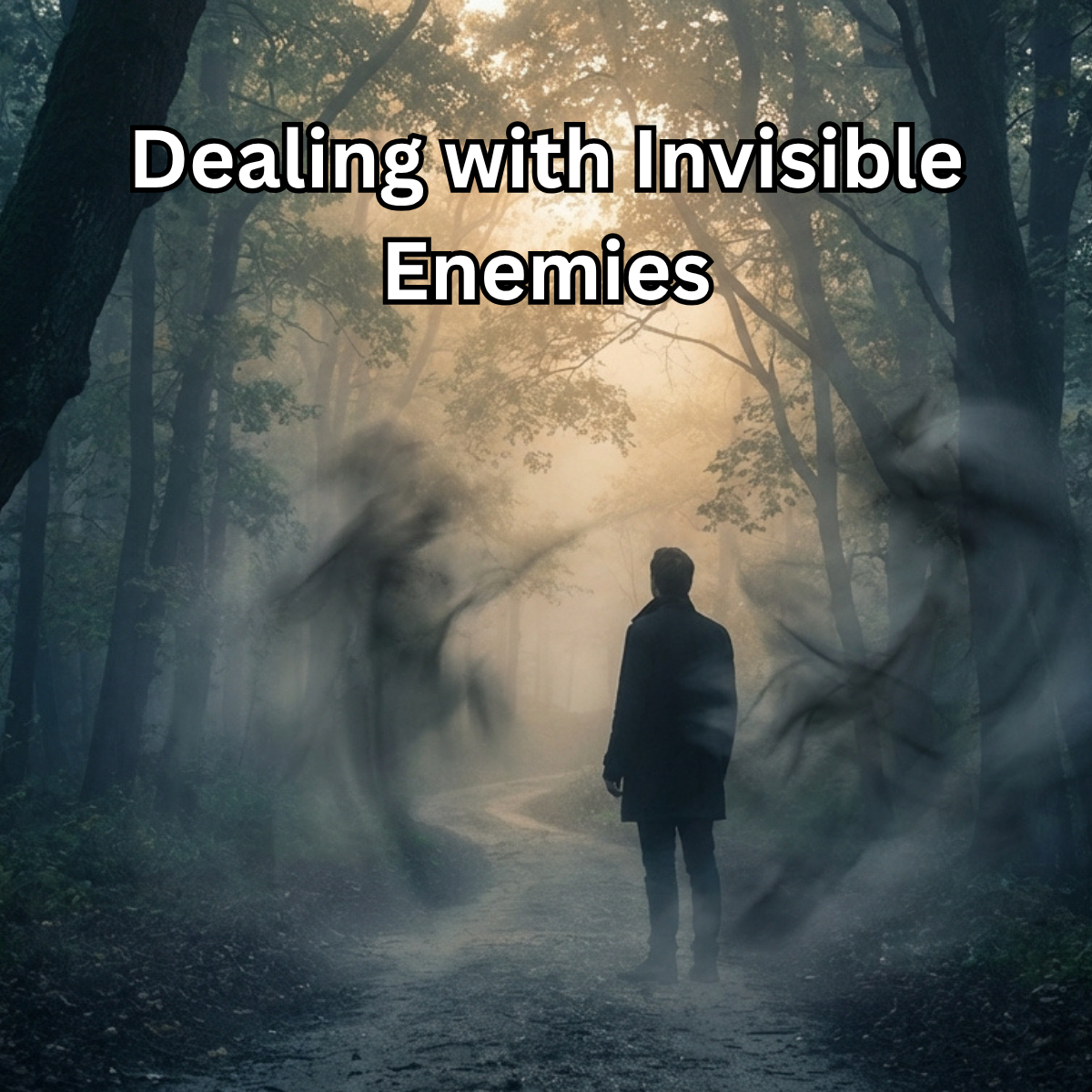
When I was a child, I was absolutely certain that there were invisible forces at play and they were trying to “get me,” whatever that meant. I probably still feel this way. But what changed wasn’t the feeling itself. What changed was the realization that if there was an invisible entity out to get me, there was very little I could actually do about it. So if any effort was completely ineffective, then why even worry about it?
That childhood logic turned out to be surprisingly useful.
Later in life, this same principle extended to similar notions. You can’t directly attack a feeling like “people don’t like me” the same way you’d fix a broken machine. There’s no lever to pull. You don’t fight the intangible by wrestling with it. You influence it indirectly through behavior, evidence, and interpretation.
The invisible forces of childhood became the invisible narratives of adulthood. The fear that someone is judging you. The suspicion that you’re falling behind. The gnawing sense that something is fundamentally wrong, even when everything looks fine on paper. These aren’t problems you can solve by confronting them head-on. They’re ghosts. And ghosts don’t respond to direct combat.
We all have direct influence over our behavior and our interpretation of the intangible. You can’t “fight the feeling” directly, but you can challenge the story behind it. You can ask: what evidence am I using? What am I choosing to focus on? What would change if I acted as though the opposite were true?
You also have direct control of your focus. When something is unprovable or uncontrollable, like “an invisible agent” or “everyone is against me,” the correct move is not to engage. It’s to redirect energy toward outcomes. You can’t directly fight what you can’t observe or prove.
So instead of fighting it, you either test it, reframe it, or ignore it, and keep moving toward what produces real results.
Testing it means treating the fear like a hypothesis. If you believe people don’t like you, act friendly anyway and see what happens. If you think you’re being sabotaged, document what’s actually occurring versus what you’re imagining. Most invisible enemies dissolve under observation.
Reframing it means changing the interpretation without changing the facts. Maybe people aren’t distant because they dislike you. Maybe they’re preoccupied. Maybe that critical comment wasn’t an attack. Maybe it was clumsy care. The facts stay the same. The story shifts. And with it, so does your response.
Ignoring it is the hardest and sometimes the wisest. Not every fear deserves your attention. Not every doubt deserves a rebuttal. Some things are simply noise, and the most powerful thing you can do is refuse to let them set the agenda for your day.
The invisible forces are still there. I haven’t outgrown them. But I’ve stopped letting them dictate my actions. I’ve stopped trying to win arguments with phantoms. Because the truth is, the person who helps you see through the fog, the one who reminds you what’s real and what’s worth your energy, may already be on their way into your life.
So stay open. Keep walking. Keep showing up. Your story still has introductions left. And some of them will teach you that the invisible enemy was never as powerful as the visible choice you make every day.