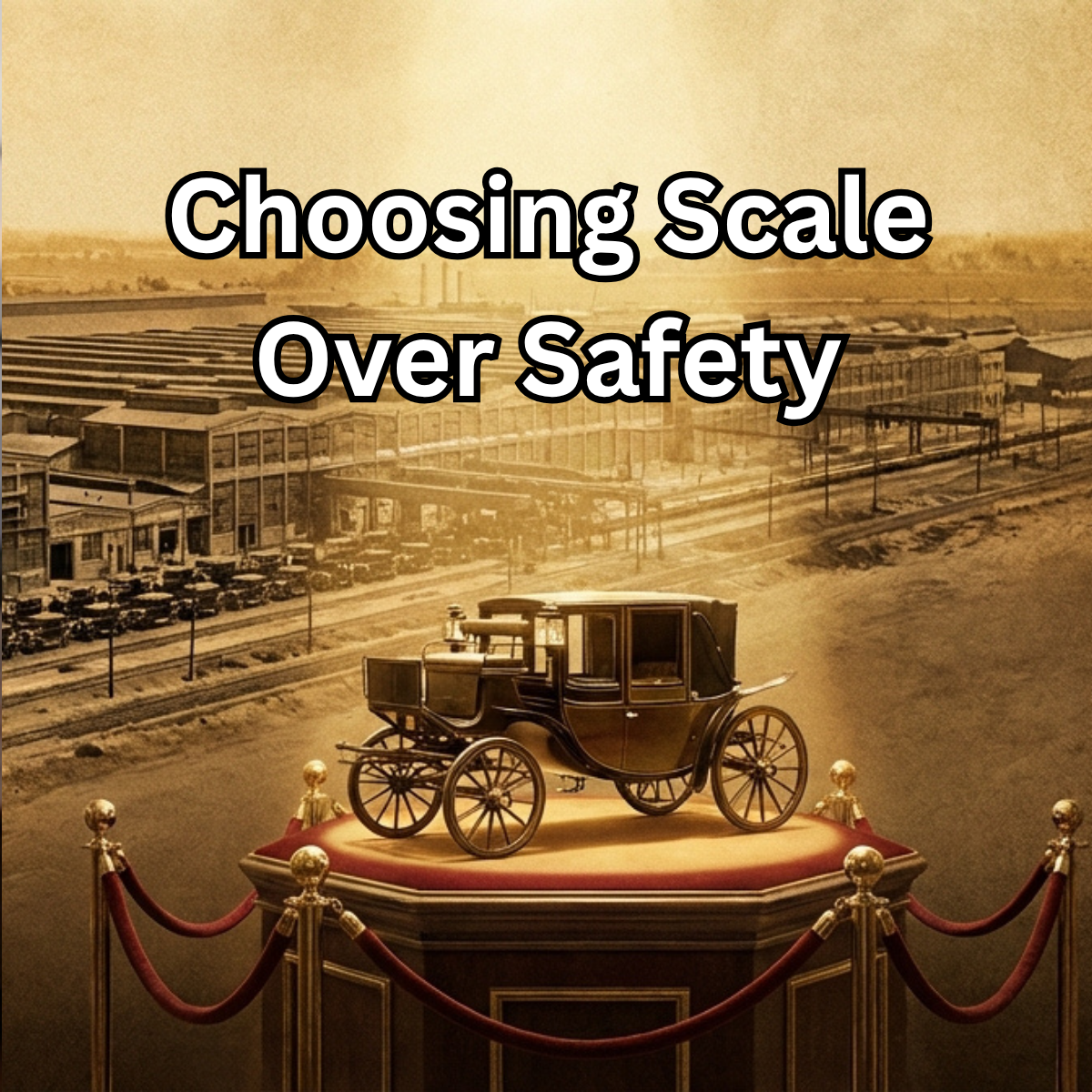
This is my fourth and final day of pondering the lessons I might learn from the early days of Henry Ford and his little automotive startup. I keep coming back to one pattern that runs through everything he did. Ford consistently chose long term dominance over short term comfort. That choice, more than anything else, separated him from the competitors who played it safe and disappeared.
Most early car companies focused on high margins, low volume, and premium positioning. They built expensive cars for wealthy buyers and protected their profit per unit. Ford flipped this completely. He went after lower margins, higher volume, and massive scale. It was a bet that required patience and nerve, and it put him at odds with nearly everyone around him.
When Ford implemented the assembly line, he had to rebuild factories, redesign workflows, and commit significant capital. If it failed, costs would spike and production could stall. But if it worked, costs would collapse and output would explode. He took the risk. The assembly line became the foundation of everything that followed.
The same logic drove the five dollar workday. In the short term, labor costs doubled. Investors were furious. But in the long term, turnover dropped, productivity increased, and Ford created a workforce that could afford to buy the cars they built. He sacrificed immediate profit for systemic advantage.
Ford also continually reduced the price of the Model T, from around eight hundred fifty dollars down to under three hundred over time. Every price cut meant less profit per car in the short term. But it also meant massive market expansion and eventual market dominance. He was building infrastructure that would compound, not chasing the next quarter’s numbers.
This was risky. It required patience. It depended on execution. It could have backfired if scale didn’t materialize. Many competitors stayed safe and lost.
“Short term safety often caps long term growth.”
I see this pattern everywhere now. Most people optimize for immediate income, predictability, and low downside. Ford optimized for systems that compound, infrastructure that scales, and long term positioning. He was willing to take short term discomfort for long term leverage.
This shows up in daily decisions. Investing in skills instead of chasing quick wins. Building systems instead of reacting to problems. Choosing the path that feels harder now but opens more doors later. The question is whether you are choosing safety that limits your future, or whether you are willing to trade short term comfort for long term scale.
Across all four themes I have explored this week, Ford’s risk taking was not chaotic. It was coherent. He believed in a specific future. He simplified to pursue it. He tolerated being misunderstood. He invested in scale over comfort. That combination is rare. And that is why it worked.
Today, I am going to look at one area where I have been choosing safety over scale. Just one. And I am going to ask myself what it would cost to flip that choice.