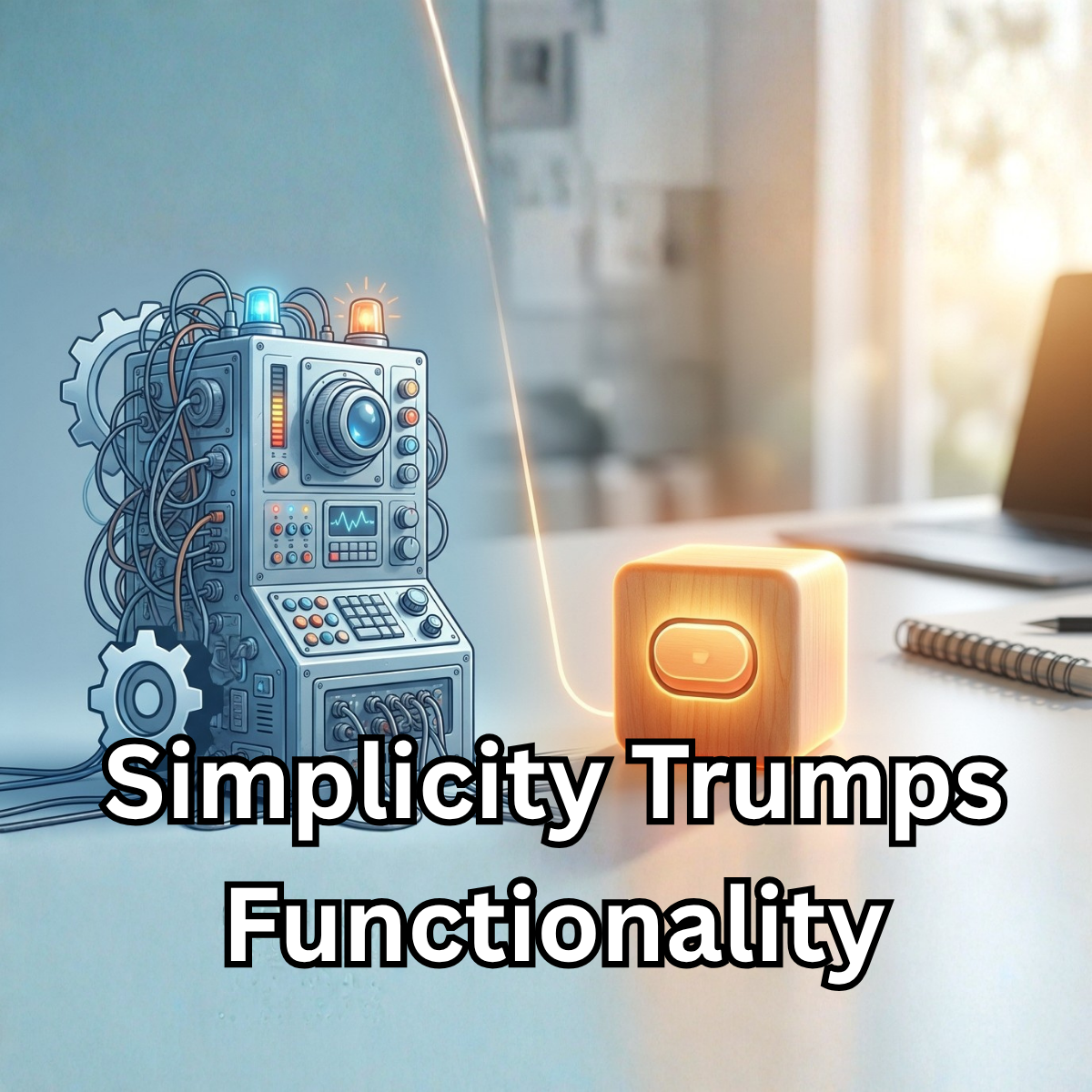
I watched a customer’s face as I demoed the new feature. We had spent weeks building it, solving edge cases, refining the logic. I was proud. They nodded politely and said, “That’s cool, but I think I’ll just keep using the other tool. It’s easier.” That moment taught me something I should have known sooner. Simplicity trumps functionality every time.
Builders fall in love with functionality. We obsess over what the product can do, how many problems it solves, how clever the architecture is underneath. We believe that depth equals value. But users do not think that way. Users trust simplicity fast enough to adopt it. They are not asking whether the product can do everything. They are asking whether they can understand it quickly enough to start using it without risk, confusion, or extra effort. That is a different standard entirely.
Adoption happens before appreciation. If the product feels heavy, complicated, or mentally expensive, most users never stay long enough to discover the functionality you worked so hard to build. They leave before they see the value. Not because the value is not there, but because the path to it was not clear enough to walk.
Functionality creates potential value. Simplicity unlocks realized value. That does not mean functionality is unimportant. It means functionality only matters after the user crosses the threshold of clarity, confidence, and ease. Simplicity is not the opposite of ambition. It is the delivery mechanism for ambition.
What I have learned is that customers reward the product they can grasp fastest. Simplicity lowers perceived risk. It reduces training and change resistance. It makes the first win happen sooner. Once users get a win, they become willing to explore more functionality. But they have to get that first win. Without it, the rest does not matter.
The real hierarchy is adoption first, depth second. Or maybe it is simpler than that. Simple enough to start, powerful enough to stay. That is the formula.
“Simplicity is not the opposite of ambition. It is the delivery mechanism for ambition.”
I still believe functionality is the ambition. But I have added one more thought to that belief. Functionality is the ambition internally. Simplicity is the requirement externally. The work we do to build depth matters, but only if users can reach it. And they can only reach it if the path is clear.
So the next time you build something, ask yourself one question. Can someone understand this fast enough to start using it without help? If the answer is no, you have more work to do. Not on the functionality. On the simplicity. That is where adoption lives.