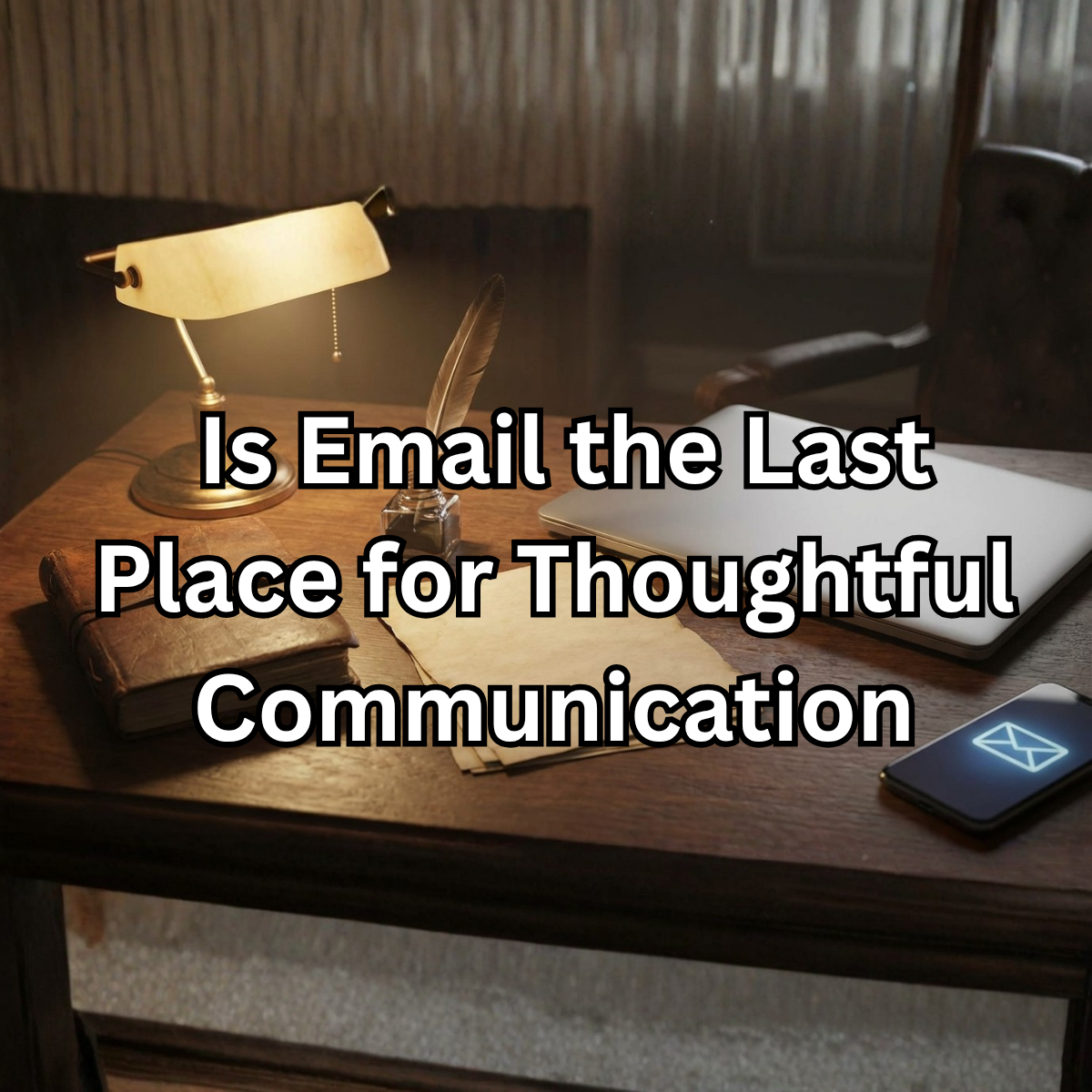
My grandfather used to respond to correspondence with handwritten letters. Not occasionally. Not when he had extra time. Not when the moment felt sentimental. He did it as a matter of principle.
That detail has stayed with me. It says something about the way he saw words, and maybe the way he saw people. A response was not just a reply. It was an act of care. It deserved effort. It deserved thought. It deserved a measure of formality because communication itself was treated as something meaningful.
We are a long way from that now.
Today, we live inside a flood of communication. Text messages, direct messages, Slack messages, comments, voice notes, quick replies, reactions, one line answers, half finished thoughts. We can reach anyone in seconds, and because we can, we often do. Constantly. Instantly. Casually. And too often, carelessly.
I am not against speed. There is real value in it. Quick communication can be useful, practical, and even necessary. But somewhere along the way, it feels like we lost something. We lost some of the sanctity of the written word. We lost some of the sense that when you write something down and send it into the world, it ought to carry some weight.
Maybe that is why this old line keeps coming back to me. Omar Khayyam wrote,
“The Moving Finger writes; and, having writ, Moves on: nor all thy Piety nor Wit Shall lure it back to cancel half a Line, Nor all thy Tears wash out a Word of it.”
That still lands. There is something sobering in those words. Once written, words do not simply disappear because we regret them. They move out from us. They land somewhere. They shape how we are understood. They reveal something of our character, our thoughtfulness, or our lack of it. The tools may have changed, but that truth has not.
What has changed is the amount of friction between thought and expression. A handwritten letter demanded something from the writer. You had to sit down. You had to gather your thoughts. You had to choose your words. You had to slow yourself enough to mean what you were saying. Even the physical process encouraged a kind of seriousness. The medium itself resisted carelessness.
Now, most communication platforms do the opposite. They remove friction. They invite reaction before reflection. They reward speed over depth and immediacy over precision. We send messages before our thoughts are fully formed. We communicate moods as if they were conclusions. We reply from impulse and call it efficiency.
That shift has consequences. When every mode of communication is casual, then eventually communication itself becomes casual. Not relaxed. Casual in the deeper sense. Disposable. Thoughtless. Thin. We begin to treat words as temporary bursts rather than lasting expressions. We stop seeing writing as something that represents us and start using it merely to discharge a thought or satisfy a moment. That is not a small loss.
A society needs at least one place where words are expected to be chosen carefully. One place where a person can say, through the way they write, “I took time with this.” One place where communication is not merely fast, but considered.
So the question becomes, is that place email?
Maybe. Email is not perfect. A great deal of email is rushed, cold, fragmented, or purely transactional. Plenty of people have imported the habits of texting into email and taken the soul out of it. So I do not want to romanticize it too much. But email still has some qualities that make it different.
Email can still hold a complete thought. It can still include a greeting, an explanation, a point of view, and a proper closing. It can still carry tone, structure, and intention. It allows room for context. It does not require the abruptness of a text or the performative speed of a group chat. It can still be formal without being stiff and personal without being careless. In other words, email is one of the last mainstream forms of communication where people can still choose to be thoughtful.
That may be its real value. Not that it forces thoughtfulness, but that it still permits it.
And maybe that is the real issue beneath all of this. No medium can preserve dignity on its own. Handwritten letters were meaningful not just because of pen and paper, but because of the principles behind them. Email will not become a sanctuary for thoughtful communication simply because it exists. It only becomes that when people decide to use it that way. The medium matters, but the standard matters more.
“No medium can preserve dignity on its own. The standard matters more.”
What my grandfather preserved was not merely a tradition. He preserved a discipline. He believed that correspondence deserved effort. That a response should reflect the seriousness of being addressed. That words ought to be sent with some measure of care because once sent, they cannot be gathered back.
That feels old fashioned now. Maybe it is. But not everything old fashioned is obsolete. Some things are old because they worked. Some things endure because they matter. The idea that words deserve care is one of those things.
The next time I sit down to write an email, I am going to pause before I send it. I am going to read it once more. I am going to ask if it says what I mean. I am going to treat it like it matters, because it does. Not every email needs to be a masterpiece. But your words can be intentional.